
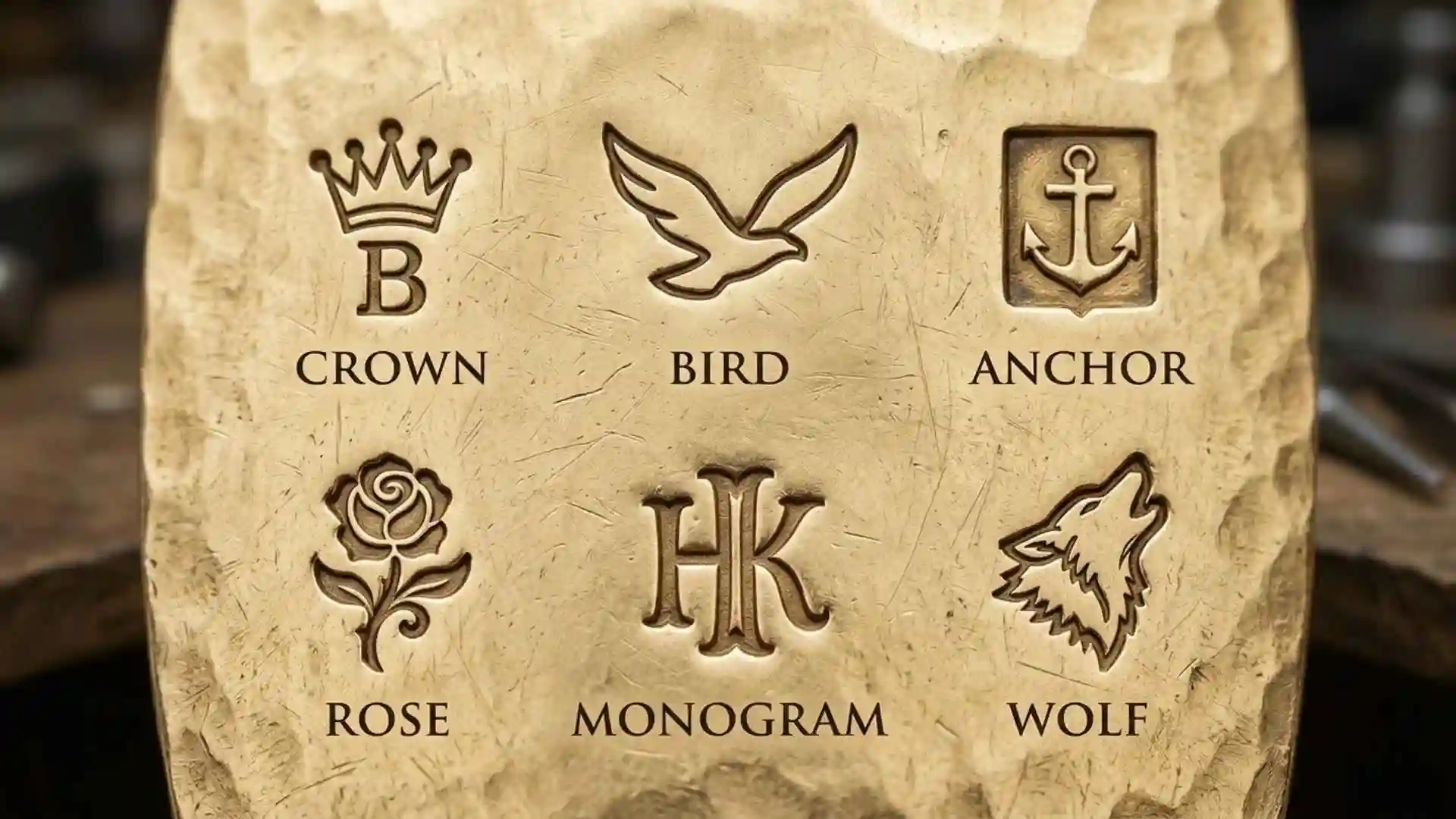
Maker’s mark identification symbols stamped on jewelry can reveal fascinating details about a piece’s origin, manufacturer, craftsmanship, and history. These tiny marks often appear inside rings, on bracelet clasps, behind pendants, or along the back of brooches. Although they may look like simple letters, initials, numbers, or small symbols, they can help you identify who made a piece of jewelry and sometimes determine when and where it was produced.
Understanding jewelry maker’s marks becomes easier when you know how they differ from other common stamps. A maker’s mark identifies the manufacturer, goldsmith, or responsible workshop, while a purity mark indicates the metal content, such as 925 for sterling silver or 750 for 18-karat gold. Other marks may identify a country, assay office, date, or jewelry brand. Examining these symbols together provides valuable clues, but not every stamp can be identified without additional research.
In this complete guide to maker’s mark identification symbols stamped on jewelry, you’ll learn how to read common markings, recognize manufacturer initials, understand gold and silver hallmarks, and research unfamiliar symbols. You’ll also discover where to find these stamps, how to distinguish authentic marks from misleading ones, and what they can reveal about vintage and antique jewelry. Whether you’re examining a family heirloom, evaluating a secondhand find, or exploring a piece you already own, this guide will help you uncover its story with greater confidence.
Quick Answer
Maker’s marks are names, initials, logos, or symbols stamped on jewelry to identify a manufacturer, designer, retailer, sponsor, or company responsible for the item. They often appear beside metal purity marks such as 925, 750, or 14K. A maker’s mark alone does not prove the jewelry’s age, metal content, or authenticity.
Quick Facts About Maker’s Mark Identification Symbols Stamped on Jewelry
| Aspect | Information |
| Origin | Developed from ancient craft, trade, and quality-control traditions |
| Historical Significance | Connected jewelry to workshops, guilds, merchants, and responsible sponsors |
| Main Meaning | Identifies the person or business associated with the item |
| Spiritual Meaning | Can symbolize authorship, legacy, identity, and human creativity |
| Cultural Importance | Preserves information about regional craftsmanship and trade |
| Modern Usage | Used for branding, legal responsibility, authentication, and research |
What Are Maker’s Mark Identification Symbols Stamped on Jewelry?
A maker’s mark is a small stamped, engraved, cast, or laser-applied identifier found on jewelry. It may consist of initials, a full name, a company logo, an animal, a geometric shape, or a symbol registered by a manufacturer or responsible business.
However, the phrase “maker’s mark” is sometimes used too broadly.
In the United Kingdom, the official term is usually sponsor’s mark. It identifies the person or company registered with an assay office and responsible for submitting the item for hallmarking. That sponsor may be the actual craftsperson, but it may also be an importer, retailer, commissioner, or business that did not physically manufacture the jewelry.
A complete British hallmark normally contains three compulsory elements:
- The sponsor’s mark
- The metal and fineness mark
- The assay office mark
A date letter and traditional metal symbol may also appear, but they are optional on modern British pieces.
In the United States, marks operate differently. Jewelry may display a quality mark such as 14K, sterling, or platinum together with the name or registered trademark of the company responsible for that claim. The Federal Trade Commission advises buyers to look for a company name, symbol, or initials near the metal quality mark.
Historically, these symbols became important because buyers could not judge precious-metal purity by appearance alone. Marks created a visible chain of responsibility between the object, the seller, the workshop, and the testing authority.
How to Read the Marks on Jewelry
The safest approach is to read every stamp as part of a group rather than interpreting one symbol in isolation.
Maker’s or Sponsor’s Mark
This usually appears as initials, a name, or a logo. British sponsor’s marks commonly contain two to five initials inside a distinctive shield or surrounding shape. Each registered combination is designed to be identifiable within the relevant assay office records.
Examples might look like:
- T&Co.
- CMC
- A star beside initials
- A crown-shaped company logo
- A monogram inside an oval or shield
The outline surrounding the letters can be as important as the letters themselves.
Metal Purity or Fineness Mark
Purity stamps describe the proportion of precious metal in the alloy.
| Common Stamp | Likely Meaning |
| 375 | 37.5% gold, commonly called 9 karat |
| 417 | Approximately 41.7% gold, commonly called 10 karat |
| 585 | 58.5% gold, commonly called 14 karat |
| 750 | 75% gold, commonly called 18 karat |
| 916 | 91.6% gold, commonly called 22 karat |
| 925 | 92.5% silver, the sterling standard |
| 950 | Often platinum or high-grade silver, depending on context |
| 999 | Nearly pure precious metal |
| 10K, 14K, 18K | Karat gold quality marks |
The Birmingham Assay Office identifies 375 as 9-carat gold and 925 as sterling silver, illustrating how millesimal numbers express metal purity in parts per thousand.
A purity mark is not the maker’s mark. It tells you what the metal is claimed to be, not who made the object.
Assay Office Mark
An assay office symbol shows where an item was independently tested and hallmarked.
Modern UK examples include:
- Leopard’s head for London
- Anchor for Birmingham
- Rose for Sheffield
- Castle for Edinburgh
These symbols identify the assay office, not the jewelry maker.
Date Letter
A date letter may indicate the year in which a piece was hallmarked. The letter must be studied together with its font, capitalization, surrounding shape, and assay office.
A single letter such as “A” cannot be dated safely without this wider context because alphabets have been reused over different cycles.
Britain’s date-letter system has deep historical roots. London introduced a letter associated with the assay year in 1477. Modern UK date letters are optional and change annually.
Patent, Design, or Model Marks
Other stamps may refer to:
- Patent numbers
- Registered designs
- Model numbers
- Inventory codes
- Stone weights
- Ring sizes
- Import codes
- Country of origin
These can look official but may have nothing to do with the maker or metal purity.
Types and Variations of Jewelry Maker’s Marks
Initial Marks
Visual description: One or more letters, sometimes joined as a monogram.
Meaning: Usually identifies a designer, company, workshop, sponsor, or retailer.
Where it appears: Inside rings, on bracelet clasps, behind pendants, and near brooch fittings.
Initials are difficult to identify because many unrelated makers shared the same letters. The surrounding cartouche, country, period, and nearby marks must also match.
Full-Name Signatures
Visual description: A surname, brand name, or designer’s full name.
Meaning: Often indicates a recognized jewelry house or individual designer.
Cultural connection: Signature marks became especially important as jewelry shifted from anonymous workshop production toward designer branding.
A clear name may be easier to research, but spelling variations, reused trademarks, and counterfeit stamps still require caution.
Pictorial Logos
Visual description: Animals, birds, flowers, crowns, stars, tools, or abstract shapes.
Meaning: Represents a company’s visual identity.
Symbolism: Logos can suggest prestige, heritage, nature, strength, royalty, or regional pride.
Such imagery has ancient roots. Craftspeople have long used recognizable symbols because pictures could communicate identity across language barriers.
Shield and Cartouche Marks
Visual description: Letters enclosed within an oval, rectangle, lozenge, shield, or other outline.
Meaning: The complete design, including both letters and border, forms the identifier.
This is especially important in British hallmark research. Two sponsors may have similar initials but different surrounding shapes.
Retailer Marks
Visual description: Store name, initials, or retail-house logo.
Meaning: Shows the company that sold or commissioned the piece.
A retailer mark does not necessarily identify the workshop. Major stores often sold jewelry produced by outside manufacturers.
Import and Export Marks
Visual description: Country names, abbreviated codes, control symbols, or national hallmarks.
Meaning: May show where the jewelry entered a market, where it was tested, or where it was legally sold.
These marks can help trace international trade, but they do not always identify the true place of manufacture.
Maker’s Marks Across Different Cultures
Ancient Egypt
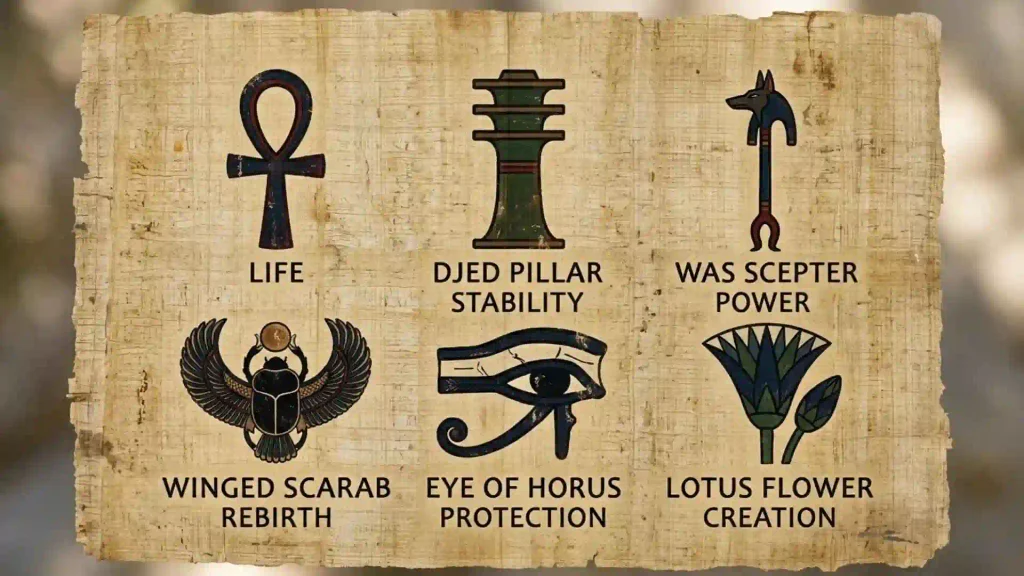
Ancient Egyptian jewelry carried powerful religious and social meaning. Scarabs, ankhs, falcons, lotus flowers, and royal names could indicate protection, rebirth, divine authority, or ownership.
These were not maker’s marks in the modern legal sense. Still, they show an early desire to connect objects with identity, belief, status, and origin.
Ancient Greece
Greek craftspeople sometimes signed pottery, sculpture, coins, and metalwork. Jewelry was less consistently marked, but workshop style and technical details can help scholars attribute pieces.
Greek motifs such as the meander, owl, laurel wreath, and mythological figures usually describe cultural meaning rather than manufacturer identity.
Roman Culture
Roman jewelry could include ownership inscriptions, military references, imperial portraits, or protective symbols. Rings were also used as seals, turning personal symbols into legal and social signatures.
As a result, Roman jewelry often blurred the line between decoration, authority, identity, and communication.
Eastern Traditions
Chinese, Japanese, Indian, and Middle Eastern jewelry traditions developed their own systems of workshop signatures, purity marks, calligraphy, auspicious symbols, and official controls.
A character or religious motif should not automatically be treated as a maker’s mark. It may instead represent a blessing, family name, place, devotional phrase, or decorative theme.
Indigenous Traditions
Many Indigenous jewelry traditions emphasize clan identity, community knowledge, family teaching, and individual artistry. Some modern Native American and First Nations artists use initials, pictorial signatures, or personal symbols.
Attribution should be handled respectfully. A motif alone does not prove tribal origin or a particular artist.
Modern Interpretations
Today, jewelry may be marked through hand stamping, casting, engraving, micro-laser technology, or digital production codes. Contemporary marks can serve branding, legal compliance, inventory control, and protection against copying.
Similar Jewelry Symbols and Their Meanings
| Mark Type | What It Identifies | What It Does Not Prove |
| Maker’s mark | Maker, designer, brand, or responsible business | Metal purity or exact date |
| Sponsor’s mark | Registered party responsible for hallmark submission | Physical manufacturer |
| Purity mark | Claimed precious-metal content | Maker or age |
| Assay office mark | Official testing location | Designer or retailer |
| Date letter | Hallmarking year in a specific system | Manufacturing year in every case |
| Retailer mark | Seller or commissioning company | Workshop that produced the piece |
| Serial number | Individual item or production record | Precious-metal quality |
| Decorative symbol | Design, belief, or aesthetic meaning | Maker identity |
A common mistake is assuming that “925” is the manufacturer. It is normally a silver fineness mark.
Another mistake is believing every crown, eagle, star, or lion is a company logo. Such symbols may be national hallmarks, traditional fineness marks, import controls, decorative motifs, or unrelated workshop emblems.
The Symbolic Meaning of a Maker’s Mark
Spiritual Level
Technically, maker’s marks are identification tools, not spiritual symbols. However, people may experience them as symbols of creative energy, continuity, and human presence.
A stamped signature can make a century-old ring feel personal. It reminds us that an unknown person shaped, polished, assembled, and finished the piece by hand.
In this sense, the mark may symbolize legacy, intention, and the desire to leave something meaningful behind.
Psychological Level
Humans naturally search for patterns and stories. A hidden stamp creates mystery because it suggests that the object has an identity waiting to be discovered.
From a Jungian viewpoint, the maker can resemble the archetype of the creator, the figure who transforms raw material into order, beauty, and meaning. The stamp becomes a compact sign of authorship.
Yet emotional attachment can also produce confirmation bias. A person who hopes a ring is rare may interpret unclear scratches as famous initials. Careful research protects the story from wishful thinking.
Cultural Level
Maker’s marks connect private possessions to larger systems of trade, law, technology, fashion, and labor.
A small symbol can reveal:
- The growth of urban craft guilds
- The movement of goods across borders
- Changes in metal standards
- The rise of designer brands
- The history of women and family-run workshops
- The relationship between artisans and retailers
Maker’s Marks in Mythology and Folklore
Myths often describe divine craftspeople whose creations carry unmistakable power.
Hephaestus in Greek mythology forged weapons and objects for the gods. Vulcan filled a similar role in Roman tradition. In Norse stories, skilled dwarfs created magical treasures such as Thor’s hammer, Mjölnir.
These stories do not describe modern hallmarks, but they helped shape the cultural idea that an object reflects the identity and power of its maker.
Folklore also warns that objects may carry traces of those who created or owned them. This belief helps explain why people feel emotionally drawn to handmade, signed, antique, or inherited jewelry.
Maker’s Marks in Art, Literature, Fashion, and Pop Culture
In art history, signatures can transform an object from an anonymous product into an attributed work. Jewelry functions in a similar way.
In literature, a hidden inscription or family seal often becomes a clue to ancestry, lost identity, or inheritance. Mystery stories frequently use rings, lockets, and engraved objects as evidence.
Movies and television use jewelry marks to reveal secret organizations, royal bloodlines, criminal networks, or forgotten relationships. These plots exaggerate reality, but they reflect a genuine truth: tiny details can preserve important information.
In modern fashion, visible designer logos have become status symbols. The mark is no longer hidden only for identification. It may be displayed as part of the design itself.
Spiritual and Dream Meaning of Jewelry Maker’s Marks
Dream interpretations are personal and are not a reliable method of identifying actual jewelry.
Still, dreaming of a hidden stamp may symbolize:
- A search for identity
- A desire to understand family history
- Recognition of overlooked talent
- Questions about authenticity
- The need to take responsibility for one’s work
- Fear of being copied or forgotten
Finding a clear signature in a dream may suggest confidence or self-recognition. An unreadable mark may reflect uncertainty about origin, belonging, or trust.
These are reflective interpretations, not fixed spiritual rules.
Positive and Negative Meanings
| Positive Meaning | Negative or Cautionary Meaning |
| Craftsmanship | Counterfeit branding |
| Responsibility | Misleading attribution |
| Heritage | Obsession with status |
| Authenticity | False confidence |
| Creative identity | Exploitation of another maker’s name |
| Historical evidence | Misreading damaged marks |
| Human connection | Ignoring scientific testing |
The same stamp can inspire trust or suspicion depending on context. A legitimate mark supports research, while a copied mark may be used to make a modern item appear valuable or old.
How to Identify an Unknown Maker’s Mark
Begin by examining the jewelry under bright, indirect light.
Use a jeweler’s loupe or macro camera to photograph every mark. Capture the stamp from several angles because worn letters can change appearance as light moves across them.
Next, record:
- Every visible letter and symbol
- The shape surrounding the mark
- Purity numbers
- Assay symbols
- Date letters
- Country names
- Construction style
- Gemstone setting
- Clasp or hinge type
- Known ownership history
Then search by country and object type. A British silver mark should be compared with British assay records, while an American costume-jewelry logo requires a different reference system.
Resources such as official assay offices, museum collections, trademark records, auction archives, specialist books, and established hallmark databases are more dependable than image-only social media posts. The 925-1000 encyclopedia is a widely used research resource for antique silver hallmarks and maker’s marks, but important conclusions should still be checked against official or scholarly records.
Finally, remember that a mark is only one form of evidence. Metal testing, gemstone examination, construction methods, provenance, and expert inspection may all be necessary.
Why Humans Are Attracted to Maker’s Marks
A maker’s mark turns jewelry into a puzzle.
People are drawn to it because the symbol offers the possibility of discovery. It may connect a person to a vanished workshop, an artistic movement, a foreign city, or an ancestor who once wore the piece.
Psychologically, marks also satisfy our need for authenticity. We want to know that an object is what it claims to be.
Most importantly, a mark preserves human presence. It tells us that beauty did not appear by accident. Someone imagined the design, selected the material, solved technical problems, and placed a sign of responsibility upon the finished work.
Modern Uses of Maker’s Marks
Today, maker’s marks appear in:
- Fine jewelry
- Artisan collections
- Luxury fashion
- Wedding and engagement rings
- Limited-edition pieces
- Studio jewelry
- Watches
- Costume jewelry
- Personalized gifts
- Online resale listings
Independent jewelers may use hand-stamped initials, while larger manufacturers use trademarks, laser marks, serial numbers, and digital tracking systems.
Marks can support branding and authentication, but they should never replace proper documentation. Receipts, grading reports, assay records, provenance, and professional appraisals provide stronger evidence when value is significant.
Interesting Facts About Jewelry Maker’s Marks
- A sponsor’s mark may identify the company that submitted the item, not the craftsperson who made it.
- The outline around initials can be essential to correct identification.
- A date letter usually refers to hallmarking, which may not be the exact day or year of manufacture.
- Tiny stamps can become distorted during resizing, polishing, repair, or long wear.
- Some antique pieces contain several marks because they passed through different workshops, countries, or testing systems.
- A purity number such as 925 is not automatically proof that the metal is genuine.
- Famous names and logos have been copied, so a recognized stamp still requires examination.
- Unmarked jewelry is not necessarily fake. Marks may have worn away, been removed during repair, or never been legally required in the place and period of production.
- Official assay-office archives can sometimes connect a sponsor’s mark with a registered person or business.
- The Birmingham Assay Office maintains sponsor-mark records dating back to 1773 for items marked through Sheffield records and related collections.
Frequently Asked Questions
How do I find out who made my jewelry?
Photograph the complete mark, including initials, symbols, and surrounding shapes. Record nearby purity and assay marks, then compare them with official hallmark registers, trademark databases, specialist books, museum records, or reputable jewelry-mark archives.
Is 925 a maker’s mark?
No. The number 925 usually indicates an alloy containing 92.5% silver, commonly known as sterling silver. The actual maker’s mark should appear as separate initials, a name, logo, or symbol.
Does a maker’s mark prove jewelry is authentic?
No. It is useful evidence, but marks can be copied, altered, or misread. Authentication may require metal analysis, construction inspection, provenance research, and evaluation by a qualified jeweler or appraiser.
What does a symbol beside 14K mean?
It may be the manufacturer’s trademark, retailer’s logo, sponsor’s mark, or another responsibility mark. In the United States, the FTC advises consumers to look for a company name or registered trademark near the karat quality mark.
Can a maker’s mark tell me how old my jewelry is?
Sometimes, but rarely by itself. You need to know when the mark was registered and used. Date letters, assay symbols, construction methods, style, and ownership history may provide stronger dating evidence.
Where are maker’s marks usually located?
Common locations include the inside of a ring shank, the back of a pendant, the clasp of a necklace or bracelet, the pin stem or reverse of a brooch, and the case or movement area of a watch.
Conclusion
Maker’s mark identification symbols stamped on jewelry are small records of responsibility, artistry, trade, and history.
They can help reveal who submitted, manufactured, designed, or sold a piece, but they must be interpreted with purity marks, assay symbols, construction, and provenance.
The most valuable discovery is not always a famous name or high price.
Sometimes, it is the simple realization that a tiny stamp has preserved the presence of a craftsperson across generations.
 Michael Rivera
 John Mercer