
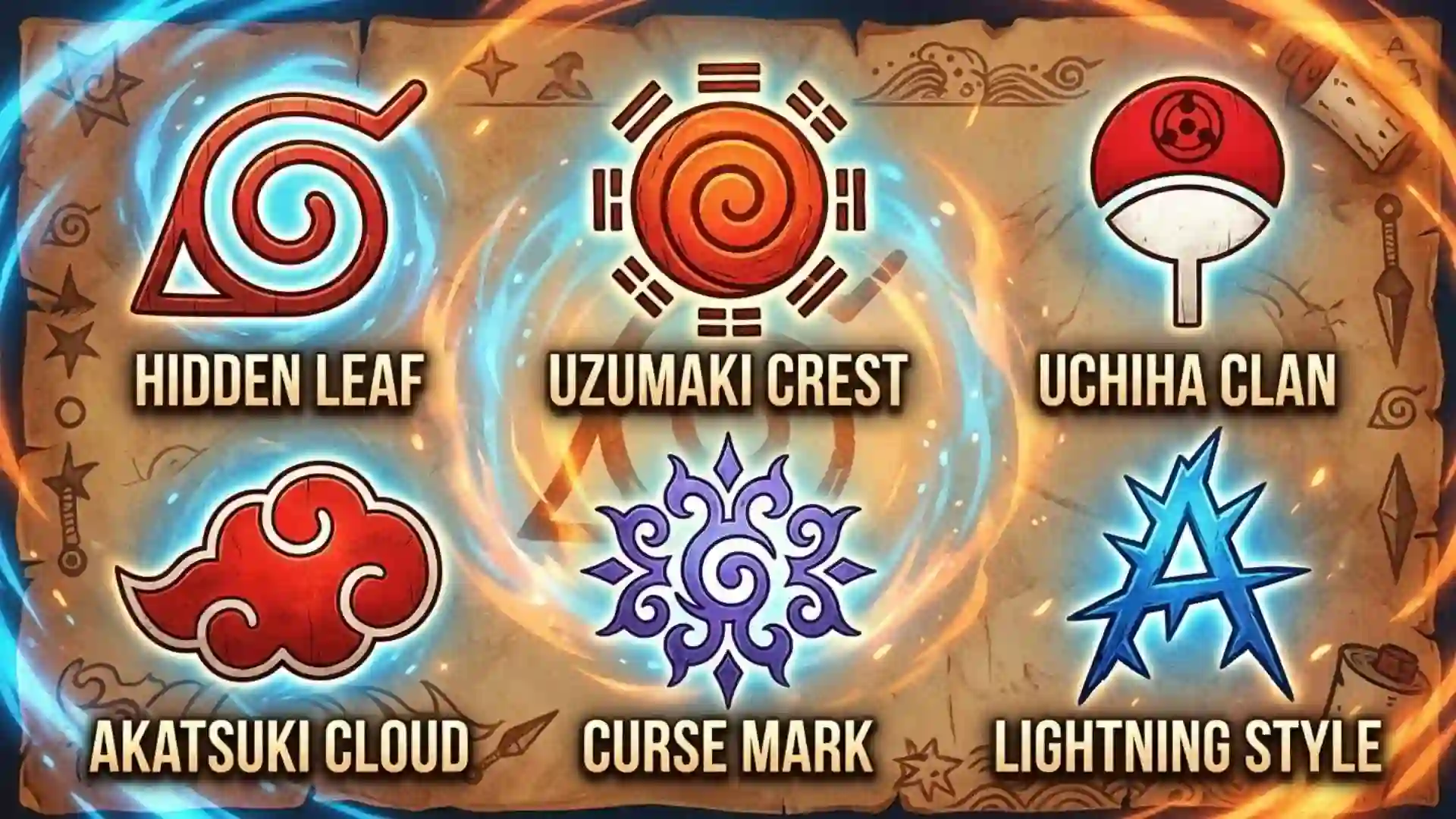
Naruto symbols hold deep meanings that connect to the characters, clans, villages, and powerful ninja techniques in the Naruto universe. From the Hidden Leaf Village’s iconic spiral emblem to the Uchiha clan’s famous fan symbol, each design represents a unique story, belief, or legacy. These emblems are more than simple decorations on ninja headbands, clothing, and weapons. They often reflect loyalty, identity, rivalry, sacrifice, and the values that shape the lives of Naruto’s most memorable characters.
Many Naruto symbols also have hidden meanings inspired by Japanese culture, mythology, and traditional imagery. The Sharingan represents one of the most recognizable abilities associated with the Uchiha clan, while the Uzumaki spiral connects to the clan’s identity and its relationship with the Hidden Leaf Village. Other important designs, including the Akatsuki red clouds, the Hyuga clan emblem, and the symbols of the Five Great Shinobi Villages, help explain the complex relationships and conflicts throughout the series. Understanding these symbols makes the story even more interesting for longtime fans and newcomers alike.
In this complete guide to Naruto symbols and their meanings, you’ll discover the history and significance behind the most recognizable ninja emblems, clan crests, village insignias, and eye techniques. You’ll also learn what these designs represent, where they appear, and how they connect to important characters and events in Naruto and Naruto: Shippuden. Whether you’re a dedicated anime fan, a manga reader, or someone searching for a meaningful Naruto tattoo, this guide will help you explore the symbolism behind the series’ most powerful emblems.
Quick Answer
Naruto symbols are visual emblems used in the Naruto manga and anime to identify hidden villages, ninja clans, organizations, abilities, and personal beliefs. Examples include the Hidden Leaf emblem, the Uchiha fan, the Uzumaki spiral, the Akatsuki red cloud, and the Sharingan. Each represents a mixture of identity, history, power, loyalty, or emotional conflict.
Quick Facts About Naruto Symbols
| Aspect | Information |
| Origin | Masashi Kishimoto’s Japanese manga series Naruto |
| Historical Significance | Inspired partly by Japanese ninja folklore, family crests, military emblems, religion, and mythology |
| Main Meaning | Identity, loyalty, heritage, power, conflict, and personal growth |
| Spiritual Meaning | Inner transformation, inherited destiny, balance, sacrifice, and self-knowledge |
| Cultural Importance | Connects Japanese visual traditions with modern global anime culture |
| Modern Usage | Tattoos, jewelry, clothing, cosplay, fan art, gaming profiles, and home decor |
What Are Naruto Symbols?
Naruto symbols are signs, crests, seals, and visual patterns found throughout the fictional shinobi world created by Masashi Kishimoto. The manga follows Naruto Uzumaki, a lonely young ninja who seeks recognition and dreams of becoming Hokage.
Some symbols identify a person’s village. Others represent a clan, secret technique, criminal organization, or supernatural power. A forehead protector, for example, usually carries the emblem of a shinobi’s hidden village. This makes it more than protective clothing. It becomes a public sign of allegiance.
The use of crests has strong parallels with Japanese kamon, traditional family emblems placed on clothing, flags, armor, and personal objects. Like real family crests, Naruto clan symbols communicate ancestry and social belonging without needing written explanation.
Over time, these fictional designs became global pop culture icons. Fans now recognize the Hidden Leaf spiral or Akatsuki cloud even when no character appears beside them.
Deep Symbolic Meaning of Naruto Symbols
Spiritual Level
Many Naruto symbols reflect transformation of the inner self.
The Uzumaki spiral suggests movement, continuity, and the ability to survive change. The Sharingan represents heightened awareness, but it also shows how painful experiences can alter a person’s consciousness. Curse marks and sealing formulas symbolize power hidden inside the body, often waiting to be controlled or understood.
Naruto’s own journey follows this pattern. The Nine-Tails seal begins as a source of fear and isolation. Later, it becomes part of a relationship built on trust. Spiritually, this suggests that the parts of ourselves we fear can sometimes become sources of strength when faced honestly.
Psychological Level
From a psychological viewpoint, the symbols behave like archetypes.
Carl Jung used the word archetype for deep patterns that appear repeatedly in human stories and imagination. Naruto includes the orphan, the shadow, the wise teacher, the rival, the wounded hero, and the destroyer who seeks redemption.
The Sharingan can be read as the watchful eye shaped by trauma. The Akatsuki cloud becomes the shadow of war. The Hidden Leaf symbol represents the need for home and belonging.
These designs attract viewers because they turn complex emotions into recognizable images.
Cultural Level
Culturally, Naruto symbols create communities within the story and among real fans.
Inside the series, village emblems divide the shinobi world into political and military groups. Clan crests preserve family history. Organization symbols communicate shared purpose.
Outside the series, the same images help fans recognize one another. A small Leaf Village tattoo or cloud pendant can quietly say, “This story helped shape me.”
Types and Variations of Naruto Symbols
Hidden Leaf Village Symbol
The Konoha emblem looks like a leaf combined with a curling spiral.
It represents the Village Hidden in the Leaves, Naruto’s home. The leaf suggests life, renewal, and community, while the spiral visually connects with Naruto’s Uzumaki heritage.
It appears on forehead protectors, uniforms, buildings, flags, merchandise, and tattoos. For many fans, it symbolizes loyalty, friendship, and the belief that bonds can become a chosen family.
Uchiha Clan Fan
The Uchiha crest resembles a red-and-white handheld fan.
Its design refers to the Japanese word uchiwa, meaning a traditional fan. A fan can strengthen a flame, linking the crest to the Uchiha clan’s talent for Fire Release techniques. It also resembles the military fan once associated with commanders.
Symbolically, it represents inherited power, pride, authority, and the danger of letting emotional fire grow beyond control.
Uzumaki Clan Spiral
The Uzumaki emblem is a simple red spiral.
“Uzumaki” can mean whirlpool or spiral in Japanese. The clan is associated with strong life force, sealing techniques, and remarkable endurance.
The spiral represents continuity, energy, cycles, and survival. It appears on Naruto’s clothing and on the uniforms of many Hidden Leaf shinobi, reflecting the historical connection between the Uzumaki and Konoha.
Akatsuki Red Cloud
The Akatsuki symbol is a red cloud outlined in white against a black cloak.
Within the story, the red clouds represent the rain of blood that fell in Amegakure during war. The original members viewed them as signs of suffering and justice.
The design therefore carries two meanings. It remembers innocent victims, but it later becomes associated with terrorism, manipulation, and destruction.
Sharingan
The Sharingan is a red eye marked with black tomoe.
It symbolizes perception, imitation, inherited ability, and emotional awakening. As it develops into the Mangekyō Sharingan, each user gains a unique pattern connected to personal experience and loss.
Psychologically, it represents the cost of seeing too much. Greater vision brings greater power, but also deeper grief.
Byakugan
The Byakugan appears as a pale eye with almost invisible pupils.
It grants a wide field of vision and allows users to perceive chakra pathways. Its symbolism centers on clarity, insight, discipline, and the wish to see beyond outward appearances.
However, the Hyūga clan’s internal hierarchy gives the eye another meaning: even extraordinary vision does not automatically free someone from social control.
Cursed Seal
Orochimaru’s cursed seals spread across the skin in dark, flame-like patterns.
They represent forbidden power, temptation, corruption, and loss of control. Like many myths about magical bargains, the seal offers immediate strength at a dangerous personal cost.
Naruto Symbols Across Different Cultures
Naruto symbols belong to a modern Japanese fictional universe. They were not taken directly from every ancient culture below. Still, meaningful parallels help explain why the designs feel familiar across the world.
Ancient Egypt
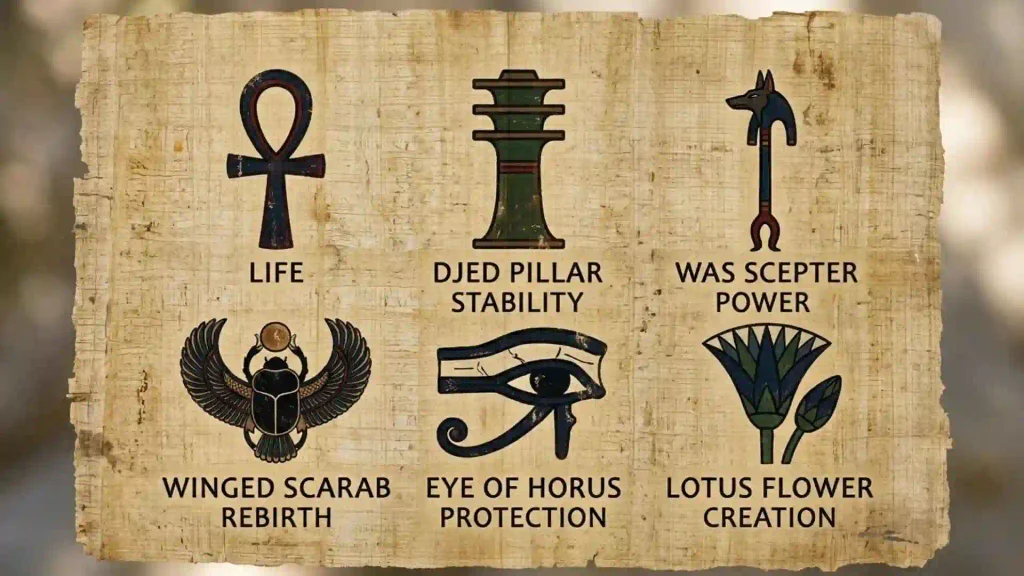
Egyptian art often used eyes to represent protection, healing, and divine awareness. The Eye of Horus is a famous example.
This creates a symbolic parallel with the Sharingan and Byakugan. All three connect sight with power, although Naruto’s eyes focus more heavily on combat, inherited abilities, and emotional suffering.
Ancient Greece
Greek mythology frequently warns that knowledge and power carry consequences. Figures such as Prometheus and Oedipus suffer because of what they possess or discover.
That idea resembles the Sharingan’s burden. Greater perception may reveal truth, but truth can be painful.
Roman Culture
Roman military standards identified legions and inspired loyalty among soldiers.
Naruto village emblems perform a similar social role. A marked forehead protector shows who a shinobi serves, while a scratched symbol can announce rejection of that authority.
Eastern Traditions
Spirals, circles, seals, and hand gestures appear throughout Hindu, Buddhist, Daoist, and Japanese spiritual traditions.
Naruto uses comparable visual forms in fictional ways. Chakra systems, hand seals, and circular eye patterns suggest balance, concentration, energy, and changing states of consciousness. These are creative fantasy elements rather than exact copies of any single religion.
Indigenous Traditions
Many Indigenous cultures use clan signs, animals, colors, and sacred patterns to preserve community history. These traditions vary greatly and should not be treated as one system.
The broad parallel lies in the role of symbols as carriers of ancestry, responsibility, and belonging. Naruto’s clan crests serve a similar storytelling function inside its fictional world.
Modern Interpretations
Today, Naruto symbols often represent perseverance, emotional healing, friendship, and rebellion.
Fans may choose the Akatsuki cloud because of its striking design, the Leaf emblem because they value loyalty, or the Uchiha crest because they relate to complicated family histories.
Similar Symbols and Their Meanings
| Naruto Symbol | Related Symbol | Similarity | Main Difference |
| Sharingan | Protective eye symbols | Sight and awareness | Sharingan is linked to battle, copying, and trauma |
| Uzumaki spiral | Spiral motifs | Cycles, energy, movement | The Uzumaki spiral identifies a specific clan |
| Uchiha fan | Japanese uchiwa | Fire, air, authority | The crest represents inherited clan identity |
| Akatsuki cloud | Storm clouds | Conflict and change | It specifically remembers bloodshed in Amegakure |
| Village headband | Military insignia | Loyalty and group identity | It belongs to a fictional ninja society |
| Cursed seal | Magical mark | Power and transformation | It involves manipulation by Orochimaru |
A common misconception is that all Naruto symbols have ancient religious meanings. Many contain cultural echoes, but their official meaning comes primarily from the manga’s story, characters, and fictional history.
Naruto Symbols in Mythology and Folklore
Naruto draws from a wide range of Japanese legends and religious ideas.
The Nine-Tailed Fox resembles kitsune, supernatural foxes from Japanese folklore. Such beings may be clever, dangerous, protective, or spiritually powerful. In Naruto, Kurama first appears as a destructive monster but gradually becomes a complex individual capable of trust.
The three legendary Sannin also echo the Japanese tale of Jiraiya, Tsunade, and Orochimaru. Their animal connections to the toad, slug, and snake become major visual and symbolic motifs.
The tomoe seen in the Sharingan resembles a curved comma-shaped design found in Japanese art, religious imagery, family emblems, and ancient objects. In Naruto, Kishimoto transforms the familiar shape into a sign of supernatural vision and Uchiha heritage.
Naruto Symbols in Art, Literature, Movies, and Pop Culture
Naruto symbols function like visual storytelling tools.
In manga panels and animation, a single emblem can reveal loyalty before a character speaks. A crossed-out village symbol tells viewers that a ninja has broken from their community. An Akatsuki cloak creates immediate tension. An evolving eye pattern shows psychological and physical transformation.
In tattoos, the symbols often become personal statements. The Uzumaki spiral may represent resilience. The Sharingan may express awareness after hardship. The Leaf emblem can honor friendship, home, or personal ambition.
Fashion brands, cosplay creators, gamers, and digital artists also use these designs because they remain recognizable even in simplified form.
Spiritual and Dream Meaning of Naruto Symbols
Dreaming about Naruto symbols usually reflects personal associations rather than a fixed supernatural message.
A Leaf Village symbol may suggest a desire for belonging or protection. A Sharingan may reflect vigilance, mistrust, or the feeling that you must notice every detail. An Akatsuki cloud may point to anger, grief, rebellion, or unresolved conflict.
The Uzumaki spiral may appear during periods of repeated change. It can suggest that life feels circular, but it can also represent growth, since a spiral continues moving instead of returning to exactly the same point.
Dream interpretations are subjective. The most useful question is not “What does this always mean?” but “What emotion did the symbol create in me?”
Positive and Negative Meanings of Naruto Symbols
| Positive Meaning | Negative Meaning |
| Loyalty | Blind obedience |
| Heritage | Family pressure |
| Awareness | Hypervigilance |
| Power | Corruption |
| Perseverance | Refusal to let go |
| Transformation | Loss of identity |
| Community | Social division |
| Justice | Revenge |
| Memory | Unresolved grief |
| Ambition | Obsession |
The same symbol can hold light and shadow. The Uchiha fan represents family pride, yet it also carries painful expectations. The Akatsuki cloud remembers victims, but it becomes linked with violence. Context decides which meaning becomes strongest.
Why Humans Are Attracted to Naruto Symbols
Humans naturally search for patterns and attach meaning to repeated shapes.
Symbols also make emotional ideas easier to remember. We may forget a long speech, but we remember a red cloud on a black cloak. The brain connects that image with danger, sorrow, and mystery.
Naruto symbols are especially powerful because they change with the story. A headband can begin as a uniform and later become proof of friendship. A feared seal can become a source of cooperation. An eye associated with hatred can eventually help protect others.
Their meanings are not static. Like people, they evolve.
Modern Uses of Naruto Symbols
Naruto symbols now appear in:
- Tattoos: Used to represent strength, grief, loyalty, identity, or personal growth.
- Jewelry: Pendants, rings, bracelets, and earrings feature clan crests and village signs.
- Fashion: Hoodies, shirts, hats, shoes, and jackets use Akatsuki clouds and ninja emblems.
- Cosplay: Forehead protectors and cloaks help recreate recognizable characters.
- Social media: Fans use symbols in profile images, usernames, banners, and reaction art.
- Home decor: Posters, wall signs, lamps, rugs, and collectible displays celebrate the series.
- Personal expression: Some fans combine symbols to represent their own values or life experiences.
Interesting Facts About Naruto Symbols
- The Uchiha crest is a fan, not a Poké Ball, despite the common visual comparison.
- A scratched village headband usually marks a missing-nin who has rejected or abandoned that village.
- Akatsuki means “dawn,” creating an intentional contrast between the group’s hopeful beginnings and darker later actions.
- Different Mangekyō Sharingan users have unique eye patterns.
- The Uzumaki spiral appears on Hidden Leaf clothing because of the bond between the two communities.
- Forehead protectors are often worn around the neck, arm, waist, or over one eye rather than strictly on the forehead.
- Clan crests work like visual family histories.
- Eye symbols in Naruto often link knowledge with emotional cost.
- Many symbols gain new meanings as characters mature.
- The most popular designs remain understandable even when reduced to simple lines and colors.
Frequently Asked Questions
What is the most famous Naruto symbol?
The Hidden Leaf Village emblem is probably the most recognized. It appears on Naruto’s forehead protector and represents Konoha, loyalty, community, and the Will of Fire.
What does the Naruto spiral symbol mean?
The red spiral represents the Uzumaki clan. It is associated with whirlpools, sealing techniques, strong life force, endurance, and the continuing movement of life.
What does the Akatsuki cloud symbolize?
The red cloud remembers the bloodshed suffered by Amegakure during war. It originally represented pain and justice, although it later became associated with the organization’s violent actions.
Why do rogue ninja scratch their headbands?
A horizontal cut through a village emblem shows that the ninja has rejected or broken ties with that village. It turns a symbol of loyalty into a symbol of separation and rebellion.
Is the Sharingan a real Japanese symbol?
The Sharingan is fictional. However, its tomoe shapes resemble motifs found in Japanese art, ancient objects, religious imagery, and family crests.
What is the best Naruto symbol for a tattoo?
The best choice depends on your personal meaning. The Leaf emblem suits loyalty, the Uzumaki spiral represents resilience, the Sharingan suggests awareness, and the Akatsuki cloud can symbolize pain, rebellion, or remembrance.
Conclusion
Naruto symbols are powerful because they carry entire histories inside simple visual forms.
They reveal where characters come from, what they value, what they fear, and how they change.
From the hopeful Leaf emblem to the sorrowful Akatsuki cloud, each design reminds us that power and identity always have deeper layers.
Their lasting message is clear: our past may mark us, but the meaning of that mark can still change.
 Sarah Thompson
 John Mercer