
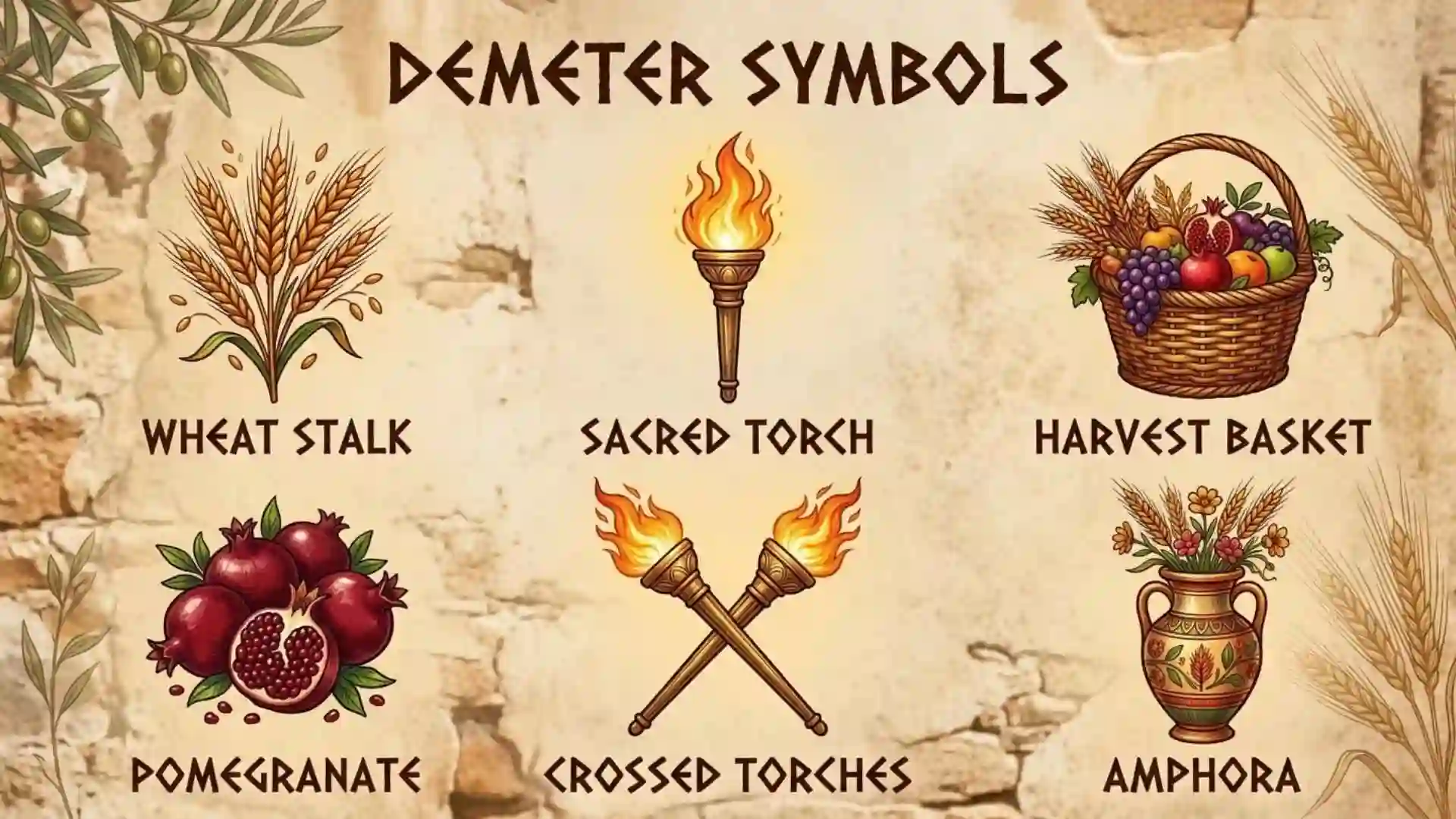
Demeter symbols reveal the powerful connection between agriculture, fertility, motherhood, and the cycles of life in ancient Greek mythology. Demeter was the Greek goddess of agriculture, grain, harvest, and the fertility of the earth. As one of the most important Olympian goddesses, she represented the nourishment that sustained human life and the natural rhythms that governed planting, growth, and harvest. Symbols such as wheat, barley, poppies, torches, and cornucopias help explain her role as a guardian of crops and a provider of abundance.
Each symbol associated with Demeter carries a deeper mythological and spiritual meaning. Grain and wheat represent nourishment, prosperity, and the agricultural cycle, while poppies are linked to fertility, sleep, and the earth’s renewal. Torches recall Demeter’s search for her daughter, Persephone, after Hades took her to the underworld. The cornucopia, or horn of plenty, reflects abundance and the gifts of nature. Together, these symbols tell stories of maternal love, loss, hope, and the seasonal changes that shape the natural world.
In this complete guide to Demeter symbols and their meanings, you will discover the history, mythology, and cultural significance behind her most recognizable emblems. You will also explore how these symbols connect to the myth of Demeter and Persephone, the changing seasons, ancient Greek religious practices, and the Eleusinian Mysteries. Whether you are studying Greek mythology, researching ancient goddesses, or exploring the spiritual meanings of harvest symbols, this guide will help you understand why Demeter remains a lasting symbol of nourishment, renewal, and the enduring bond between humanity and the earth..
Quick Answer
Demeter symbols are sacred objects, plants, animals, and images linked to Demeter, the Greek goddess of agriculture, grain, fertility, and the harvest. Her best-known symbols include wheat, cornucopias, torches, poppies, serpents, pigs, and bread. Together, they represent nourishment, motherhood, seasonal death, renewal, abundance, and the bond between humans and the earth.
Quick Facts About Demeter Symbols
| Aspect | Information |
| Origin | Ancient Greek religion and mythology |
| Historical Significance | Connected with farming, food security, fertility, and the Eleusinian Mysteries |
| Main Meaning | Harvest, grain, motherhood, nourishment, and abundance |
| Spiritual Meaning | Renewal, transformation, grief, rebirth, and sacred connection with nature |
| Cultural Importance | Demeter’s worship shaped agricultural festivals and religious rituals across the Greek world |
| Modern Usage | Tattoos, jewelry, literature, feminist symbolism, spiritual art, and nature-based practices |
What Are Demeter Symbols?
Demeter symbols are visual signs and sacred objects associated with Demeter, one of the major Olympian goddesses in Greek mythology. She ruled over cultivated land, grain, agriculture, fertility, and the harvest.
Her name is often interpreted as meaning “Earth Mother” or “Mother of Grain,” although scholars continue to debate its exact linguistic origin. What remains clear is that Demeter represented the life-giving power of the cultivated earth.
Her importance grew in a world where failed crops could mean hunger, migration, or death. Wheat, barley, bread, and seasonal rainfall were not ordinary parts of life. They were matters of survival.
As a result, Demeter’s symbols became deeply emotional. A sheaf of grain could stand for prosperity, but it could also remind people that food depended on forces beyond human control.
The myth of Demeter and her daughter Persephone gave these symbols even greater meaning. When Persephone was taken to the underworld by Hades, Demeter grieved and stopped the earth from producing crops. After mother and daughter were partly reunited, fertility returned.
This story connected Demeter’s symbols with both harvest and loss. They came to represent the rhythm of growth, decline, death, and rebirth.
Deep Symbolic Meaning of Demeter Symbols
Spiritual Level
On a spiritual level, Demeter symbols represent the sacred relationship between giving and receiving.
The earth gives grain, fruit, and nourishment, but humans must cultivate it with patience and respect. This relationship reflects gratitude, responsibility, and trust in natural cycles.
Wheat symbolizes spiritual abundance and the promise that life can return after hardship. A seed must be buried in darkness before it rises into the light. For this reason, grain can represent death, initiation, and rebirth.
The torch symbolizes guidance through darkness. In myth, Demeter carried torches while searching for Persephone. Spiritually, the torch represents the human search for truth, healing, and reunion.
Poppies may symbolize rest, sleep, grief, and the thin boundary between life and death. Their connection to Demeter reflects both sorrow and comfort.
Psychological Level
Psychologically, Demeter is often understood as a mother archetype. In Jungian thought, archetypes are deep patterns of meaning that appear across myths, dreams, and human behavior.
The Demeter archetype represents the urge to protect, feed, teach, and care for others. It can appear in parents, caregivers, teachers, healers, farmers, and anyone who finds meaning through nurturing.
However, this archetype also has a shadow side. A person may become so focused on caring for others that they lose their own identity. Love can become control, and protection can become fear of separation.
The story of Persephone reflects a universal emotional struggle. Parents must eventually allow children to grow, leave, and form independent lives. Demeter’s grief shows how painful this transition can feel.
Her symbols therefore speak to attachment, separation, depression, resilience, and emotional renewal.
Cultural Level
Culturally, Demeter symbols expressed the shared dependence of communities on agriculture.
Harvest festivals brought people together to honor the land, share food, and seek divine protection. Grain was not only a private possession. It supported cities, armies, trade, religion, and family life.
Demeter’s symbols also carried social meaning for women. Several festivals connected with her worship were led or attended mainly by women. These rituals linked fertility, marriage, childbirth, food production, and community survival.
Through Demeter, ordinary acts such as planting, grinding grain, baking bread, and feeding children gained sacred value.
Types and Variations of Demeter Symbols
Wheat and Grain
Visual description: Golden stalks, grain bundles, barley heads, or a sheaf held in the goddess’s hand.
Meaning: Food, fertility, civilization, and abundance.
Symbolism: Wheat represents the transformation of seed into nourishment. It reflects patience, labor, and the promise of future life.
Cultural connection: Grain offerings were central to Greek religious practice and agricultural festivals.
Where it appears: Ancient statues, pottery, coins, temple carvings, paintings, tattoos, and harvest imagery.
The Cornucopia
Visual description: A curved horn overflowing with grain, fruit, flowers, and other foods.
Meaning: Plenty, prosperity, generosity, and agricultural wealth.
Symbolism: The cornucopia shows nature as a source of overflowing nourishment.
Cultural connection: It became a popular symbol of abundance in Greek and Roman art.
Where it appears: Sculptures, mosaics, public monuments, seasonal decorations, and modern logos.
Torches
Visual description: One or two burning torches carried upright.
Meaning: Search, hope, truth, guidance, and reunion.
Symbolism: The torch recalls Demeter’s search for Persephone. It represents light carried through emotional or spiritual darkness.
Cultural connection: Torches were associated with mystery rituals, nighttime ceremonies, and sacred journeys.
Where it appears: Greek vase paintings, ritual art, literary retellings, spiritual imagery, and tattoos.
Poppies
Visual description: Red flowers with delicate petals, sometimes shown beside wheat.
Meaning: Sleep, grief, peace, death, and consolation.
Symbolism: Poppies may represent Demeter’s sorrow and the rest that follows emotional pain.
Cultural connection: Poppies grew among grain fields and were linked with sleep because of their natural properties.
Where it appears: Ancient art, floral crowns, paintings, jewelry, poetry, and remembrance imagery.
Serpents
Visual description: Coiled snakes, paired serpents, or snakes near baskets and ritual objects.
Meaning: Earth power, fertility, rebirth, protection, and the underworld.
Symbolism: Because snakes shed their skin and live close to the ground, they became signs of renewal and hidden knowledge.
Cultural connection: Serpents appeared in Greek fertility worship and mystery traditions.
Where it appears: Sacred art, ritual vessels, mythology, temple decoration, and modern spiritual symbols.
Pigs
Visual description: Piglets or sacrificial pigs shown in agricultural and religious scenes.
Meaning: Fertility, purification, sacrifice, and soil renewal.
Symbolism: Pigs were associated with the earth because they root in the ground and reproduce in large numbers.
Cultural connection: Pig sacrifices played an important role in the Thesmophoria, a festival honoring Demeter and Persephone.
Where it appears: Ancient ritual accounts, pottery, reliefs, and reconstructions of Greek religious festivals.
Bread
Visual description: Loaves, cakes, grain offerings, or baskets of baked food.
Meaning: Nourishment, community, generosity, and survival.
Symbolism: Bread is grain transformed through human effort. It joins nature, labor, skill, and sharing.
Cultural connection: Bread offerings expressed gratitude for the harvest and dependence on divine favor.
Where it appears: Religious ceremonies, family meals, festivals, paintings, and modern harvest celebrations.
Demeter Symbols Across Different Cultures
Ancient Egypt
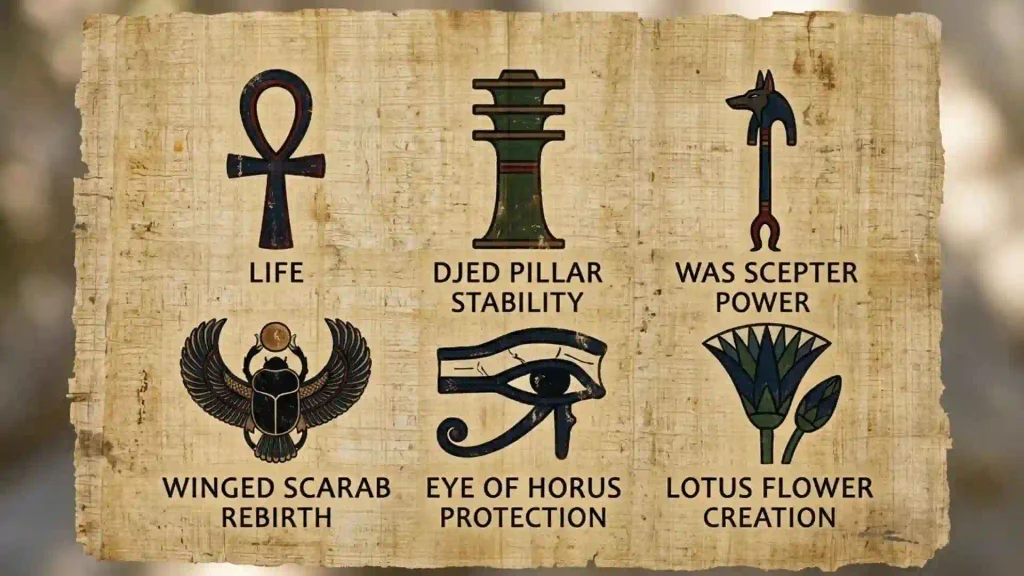
Ancient Egypt did not worship Demeter, but Egyptians honored deities with similar agricultural roles. Osiris was linked with vegetation, death, and renewal, while Isis represented motherhood and protection.
Grain growing from the earth could symbolize the return of life after death. This resembles the seasonal meaning found in Demeter and Persephone’s myth.
Ancient Greece
In Greece, Demeter symbols were directly connected with grain farming and sacred ritual.
Wheat, torches, poppies, and pigs appeared in festivals such as the Thesmophoria. Demeter was also central to the Eleusinian Mysteries, secret religious rites held at Eleusis.
These mysteries promised initiates a deeper understanding of life, death, and possibly a more hopeful fate after death.
Roman Culture
The Romans identified Demeter with Ceres, goddess of agriculture, grain, and maternal care.
The word “cereal” comes from the name Ceres. Roman art often showed her holding wheat, a torch, or a cornucopia.
Her festivals supported both religious devotion and public concern for the grain supply.
Eastern Traditions
Eastern traditions contain many agricultural symbols that resemble Demeter’s themes, although they developed independently.
Rice in East and South Asian cultures often represents fertility, prosperity, and divine blessing. Earth goddesses and grain spirits also appear in several regional traditions.
Like Demeter’s wheat, rice can symbolize both physical survival and sacred abundance.
Indigenous Traditions
Many Indigenous cultures honor the earth through planting, harvest rituals, seasonal ceremonies, and stories about plant spirits.
These traditions should not be treated as direct versions of Greek mythology. However, they share a respect for food as a gift involving land, ancestors, community, and responsibility.
Corn, maize, seeds, and sacred planting cycles may carry meanings similar to Demeter’s grain symbols.
Modern Interpretations
Today, Demeter symbols often represent environmental awareness, motherhood, feminine strength, food justice, and sustainable agriculture.
They may also express personal recovery after grief. A torch or wheat tattoo can symbolize surviving a dark period and returning to life with greater wisdom.
Similar Symbols and Their Meanings
| Symbol | Similarity to Demeter Symbols | Key Difference |
| Persephone’s pomegranate | Represents seasonal cycles and the underworld | Focuses more strongly on marriage, transformation, and divided identity |
| Gaia’s earth | Represents nature, fertility, and life | Gaia symbolizes the earth itself, while Demeter rules cultivated land and grain |
| Ceres’ wheat | Represents agriculture and abundance | Ceres is the Roman counterpart of Demeter |
| Osiris grain imagery | Connects vegetation with death and rebirth | Comes from Egyptian religion and has a different mythological background |
| Cornucopia of Fortuna | Represents wealth and plenty | Fortuna connects abundance with luck and fate |
| Triple Goddess imagery | Represents feminine life cycles | Comes from modern spiritual systems rather than ancient Demeter worship |
A common misconception is that Demeter and Gaia are the same goddess. Gaia personifies the earth as a cosmic being, while Demeter is more closely connected with farming, grain, harvest, and maternal loss.
Demeter Symbols in Mythology and Folklore
The most important Demeter myth tells how Hades took Persephone into the underworld. Demeter wandered across the world searching for her, carrying torches and refusing comfort.
Her grief caused the earth to become barren. Crops failed, hunger spread, and humans could no longer offer sacrifices to the gods.
Zeus finally intervened. Persephone was allowed to return, but because she had eaten pomegranate seeds in the underworld, she had to spend part of each year there.
When Persephone returned to Demeter, plants grew again. When she departed, the earth became less fertile.
This myth shaped the symbolic meaning of torches, grain, seeds, flowers, and seasonal change. It gave ancient people a story through which they could understand winter, grief, separation, and hope.
Another story connects Demeter with Triptolemus, a prince of Eleusis. According to tradition, Demeter taught him the art of agriculture and sent him to spread grain cultivation.
This made farming appear not only as human labor, but as sacred knowledge given by a goddess.
Demeter Symbols in Art, Literature, Movies, and Pop Culture
Ancient artists often showed Demeter as a mature, dignified woman holding wheat, a torch, or a scepter. She sometimes appears beside Persephone, emphasizing their bond.
In Renaissance and Neoclassical art, Demeter or Ceres became a symbol of harvest abundance. Painters used fruit, grain, flowers, and golden fields to suggest prosperity.
In literature and poetry, Demeter’s story often represents maternal grief. Writers also use it to explore depression, separation, ecological destruction, and the return of hope.
Modern novels and television series may reinterpret Demeter as a powerful mother, an earth-centered deity, or a figure whose love becomes controlling.
In tattoos, wheat can represent growth and gratitude. A torch may show guidance through grief. Poppies may honor loss, while the Demeter and Persephone pairing can symbolize the changing relationship between mothers and daughters.
Fashion and jewelry often use grain patterns, floral crowns, serpents, and classical goddess images to express feminine power and connection with nature.
Spiritual and Dream Meaning of Demeter Symbols
Dreaming of wheat may suggest growth, reward, fertility, or a project nearing completion. Dry or damaged grain may point to fear, exhaustion, or neglected needs.
A torch in a dream can represent guidance, truth, or the search for something emotionally lost.
Poppies may suggest rest, grief, memory, or the need to escape pressure. Their meaning depends on the dreamer’s feelings and personal experiences.
Dreaming of Demeter herself may reflect concerns about caregiving, motherhood, food, security, separation, or personal identity.
Spiritually, her symbols can encourage patience. They remind us that not every season is meant for visible growth. Some periods are for rest, mourning, and inner change.
However, these images can also carry a caution. Caring for others should not require complete self-erasure. Healthy nourishment includes feeding one’s own mind, body, and spirit.
Positive and Negative Meanings of Demeter Symbols
| Positive Meaning | Negative Meaning |
| Abundance | Scarcity |
| Maternal love | Overprotectiveness |
| Nourishment | Emotional dependence |
| Fertility | Fear of loss |
| Renewal | Seasonal decline |
| Guidance | Desperate searching |
| Community | Pressure to sacrifice oneself |
| Patience | Stagnation |
| Grief transformed into wisdom | Grief that becomes isolation |
The same symbol can carry both light and shadow. Wheat may represent abundance when it is full and golden, but famine when fields are empty. A mother’s care may feel safe, yet become restrictive when fear prevents growth.
Why Humans Are Attracted to Demeter Symbols
People are drawn to Demeter symbols because they express experiences nearly everyone understands.
We all depend on food. We all face change. Many people know the pain of separation, the need to care for others, and the hope that life will improve after a difficult season.
The human mind naturally recognizes patterns. Seeds disappear into soil and return as plants. Leaves fall and grow again. Darkness gives way to morning.
These cycles create powerful emotional symbols because they make loss feel less final.
Demeter also speaks to cultural memory. For thousands of years, human communities survived by watching the seasons and protecting stored grain. The fear of scarcity and the joy of harvest remain deeply rooted in our imagination.
Her symbols allow people to turn private feelings into visible images. A stalk of wheat can become a reminder of resilience. A torch can represent the strength to keep searching. A poppy can hold grief without needing words.
Modern Uses of Demeter Symbols
Demeter symbols remain popular in many forms of personal expression.
In tattoos, wheat, torches, poppies, and goddess portraits often represent motherhood, recovery, abundance, or personal rebirth.
In jewelry, grain-shaped pendants and serpent designs may symbolize fertility, protection, or connection to the earth.
Fashion designers use classical goddess imagery, floral crowns, harvest colors, and botanical patterns to suggest natural beauty and feminine strength.
Brands connected with organic food, farming, wellness, and sustainability may use wheat or cornucopia images to communicate nourishment and abundance.
On social media, Demeter is often discussed in mythology communities, spiritual spaces, book groups, and conversations about feminine archetypes.
In home decor, dried wheat, harvest wreaths, poppies, and earth-toned goddess art create a feeling of warmth and seasonal connection.
Contemporary spiritual practitioners may place bread, grain, flowers, or candles on altars inspired by Demeter. Such practices are modern interpretations and may differ greatly from ancient Greek religion.
Interesting Facts About Demeter Symbols
- Demeter was one of the twelve major Olympian deities, yet much of her power came from the ordinary human need for food.
- Barley may have been just as important as wheat in ancient Greek ritual and daily life.
- The Eleusinian Mysteries connected Demeter and Persephone with secret teachings about life and death.
- Ancient initiates were forbidden from publicly revealing key details of the mysteries.
- The Thesmophoria was an important women’s festival connected with fertility and agriculture.
- Piglets were used in certain Demeter rituals because pigs symbolized fertility and contact with the earth.
- Demeter’s Roman equivalent, Ceres, gave English the word “cereal.”
- Torches symbolize both Demeter’s grief and her refusal to stop searching.
- Poppies appear beside grain because they naturally grow in cultivated fields.
- Demeter’s mythology is often used today to discuss ecological grief and the emotional effects of environmental destruction.
Frequently Asked Questions
What is Demeter’s main symbol?
Demeter’s main symbol is grain, especially wheat or barley. It represents agriculture, fertility, nourishment, abundance, and the seasonal cycle of life.
Why is the torch a symbol of Demeter?
The torch represents Demeter’s search for Persephone. It symbolizes hope, guidance, truth, determination, and the journey through grief or spiritual darkness.
Why are poppies associated with Demeter?
Poppies grew among grain fields and were linked with sleep and rest. They became symbols of Demeter’s sorrow, comfort, death, and emotional healing.
What animal represents Demeter?
Pigs and serpents are strongly associated with Demeter. Pigs symbolize fertility and agricultural ritual, while serpents represent the earth, renewal, and hidden underworld power.
What does a Demeter tattoo mean?
A Demeter tattoo may symbolize motherhood, nourishment, grief, resilience, abundance, nature, feminine power, or rebirth after emotional loss.
Are Demeter and Gaia the same?
No. Gaia is the ancient personification of the earth itself. Demeter is the goddess of cultivated land, grain, agriculture, harvest, and maternal care.
Conclusion
Demeter symbols tell a timeless story about the earth’s generosity and the emotional cost of loving deeply.
Wheat, torches, poppies, serpents, pigs, and bread each reveal a different part of her power.
Together, they remind us that grief and growth often belong to the same cycle.
Like a seed hidden in dark soil, hope may remain alive even when nothing seems to be growing.
 Sarah Thompson
 Michael Rivera