
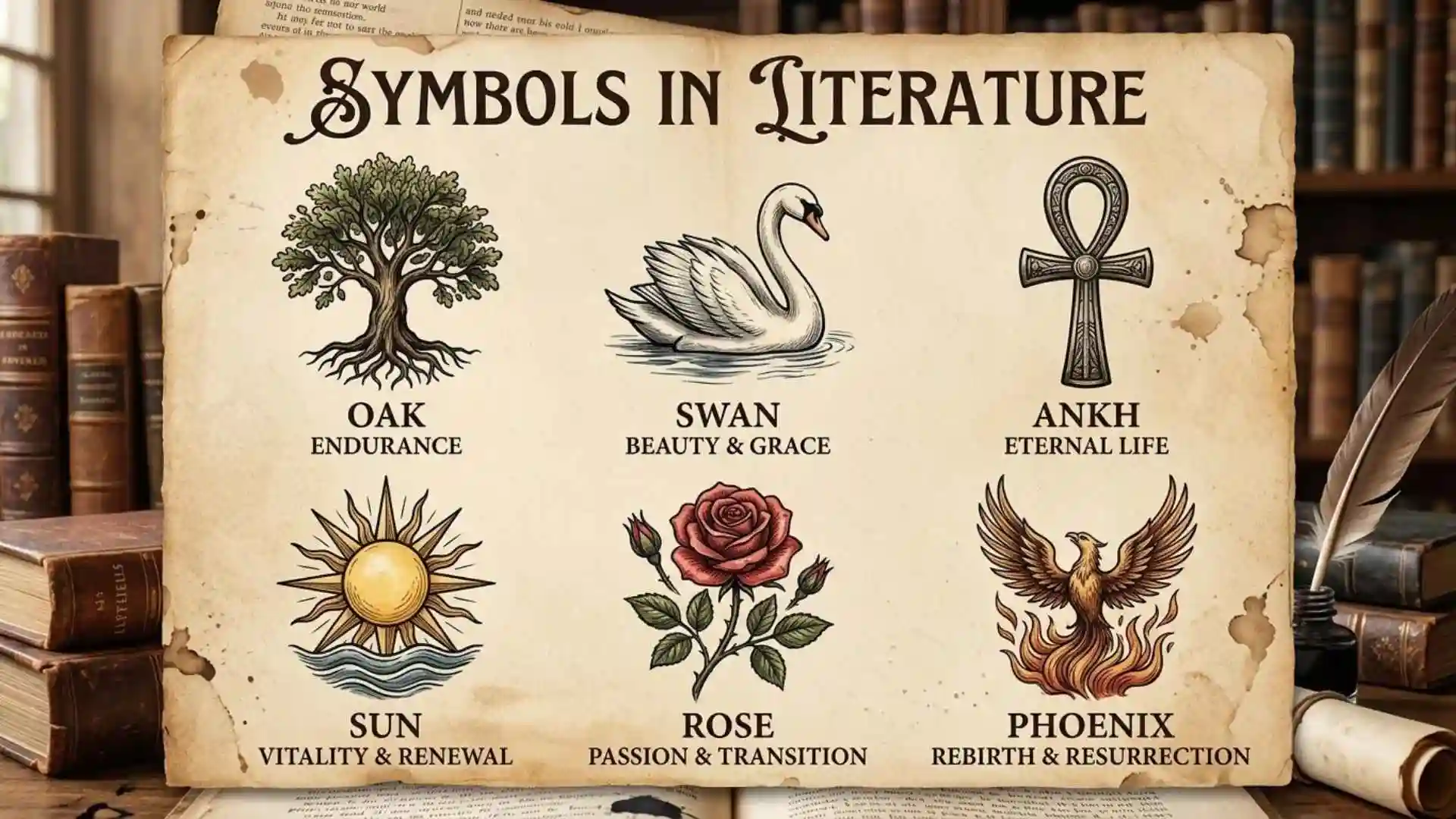
Symbols in literature help writers express deeper meanings, emotions, and ideas through objects, characters, colors, places, and events. Instead of explaining everything directly, authors use symbols to give readers clues about a story’s hidden messages. A rose might represent love, a storm could suggest conflict, and a journey may symbolize personal growth or change. These details make stories more meaningful and encourage readers to look beyond the surface of the text.
Literary symbols appear in novels, short stories, poems, plays, and even modern fiction. Some symbols are widely recognized, such as light representing hope or darkness suggesting fear and uncertainty. Others gain their meaning from a story’s characters, setting, culture, or historical background. Understanding these symbols can help readers recognize themes, explore character development, and discover the deeper ideas an author wants to communicate.
In this complete guide to symbols in literature, you will explore common literary symbols and their meanings, discover famous examples from classic and modern works, and learn how authors use symbolism to bring stories to life. Whether you are a student studying English literature, a teacher explaining literary devices, or a reader who wants to understand stories more deeply, this guide will help you identify symbols and interpret their significance with confidence.
Quick Answer
Symbols in literature are people, objects, colors, settings, animals, or actions that represent ideas beyond their literal meaning. Writers use them to communicate themes, emotions, cultural beliefs, and psychological conflicts. For example, light may symbolize hope, while darkness may represent fear, ignorance, or moral uncertainty.
Quick Facts About Symbols in Literature
| Aspect | Information |
| Origin | Symbolic storytelling began in ancient myths, oral traditions, religious texts, and early poetry |
| Historical Significance | Symbols helped cultures preserve beliefs, moral lessons, and shared memories |
| Main Meaning | A visible detail that represents a deeper idea, emotion, or theme |
| Spiritual Meaning | Symbols may represent faith, transformation, death, rebirth, or the soul |
| Cultural Importance | Meanings often reflect the beliefs and history of a society |
| Modern Usage | Common in novels, poetry, films, television, advertising, tattoos, and digital media |
What Are Symbols in Literature?
Symbols in literature are details that carry both a literal meaning and a deeper suggested meaning. A river can simply be a body of water, but within a story it may also represent time, change, cleansing, or the boundary between life and death.
Literary symbolism developed long before written novels existed. Ancient communities used stories, cave images, rituals, and oral traditions to explain nature and human experience. The sun represented life. Winter represented death or hardship. Spring suggested renewal.
Ancient texts are filled with symbolic language. In Egyptian beliefs, the scarab beetle represented rebirth and the rising sun. Greek myths used labyrinths, storms, monsters, and journeys to explore fear, destiny, pride, and self-discovery. Biblical literature used gardens, deserts, bread, water, and light to communicate spiritual ideas.
Over time, poets and novelists expanded these traditions. William Shakespeare used blood, weather, clothing, disease, and darkness to reveal inner conflict. Romantic poets turned mountains, birds, and oceans into symbols of freedom, imagination, and the sublime. Modern writers often use broken objects, empty rooms, machines, and fragmented landscapes to express alienation or social pressure.
Symbolism matters because human experience is difficult to explain through facts alone. Symbols allow writers to make invisible emotions visible.
Deep Symbolic Meaning of Symbols in Literature
Spiritual Meaning
On a spiritual level, literary symbols often express the movement of the soul. A journey may represent spiritual growth. Water may suggest purification. Fire can symbolize divine power, destruction, punishment, or renewal.
Death in literature does not always mean a final ending. It may represent the death of an old identity before personal transformation. This pattern appears in myths, religious stories, fairy tales, and modern fiction.
A character who enters a dark forest, faces danger, and returns changed may be following a symbolic path of initiation. The forest becomes more than a setting. It becomes a place where certainty disappears and deeper truth is discovered.
Psychological Meaning
Psychologically, symbols help readers understand emotions that characters cannot express directly. A cracked mirror may represent a divided identity. A caged bird may show emotional imprisonment. A storm can reflect confusion, anger, or fear.
Swiss psychologist Carl Jung argued that certain symbolic patterns appear across cultures because they grow from shared structures in the human mind. He called these patterns archetypes. Common examples include the hero, the shadow, the wise guide, the mother, the trickster, and the journey into darkness.
Writers often use these archetypal symbols because readers respond to them instinctively. We understand that a doorway suggests transition, even before the story explains what lies beyond it.
Cultural Meaning
Symbols also carry social and cultural meaning. Their interpretation may change depending on time and place.
White commonly represents purity in many Western traditions, yet it is associated with mourning in several Eastern cultures. An owl may symbolize wisdom in one tradition but danger or death in another. A snake may represent evil, healing, rebirth, sexuality, or sacred knowledge.
Therefore, literary symbols should never be interpreted without context. The author’s culture, historical period, genre, and personal background all influence meaning.
Types and Variations of Symbols in Literature
Natural Symbols
Natural symbols include trees, rivers, mountains, flowers, seasons, storms, and celestial bodies.
A tree may represent life, ancestry, wisdom, or connection between heaven and earth. Rivers often symbolize change because water is always moving. Mountains may represent spiritual achievement, isolation, or a difficult challenge.
These symbols appear in mythology, religion, poetry, dreams, and ancient traditions.
Color Symbols
Colors create emotional meaning quickly.
Red can suggest love, passion, blood, violence, or danger. White may represent purity, emptiness, innocence, or death. Black can symbolize grief, mystery, power, evil, or the unknown. Green may suggest nature, youth, envy, sickness, or renewal.
The correct meaning depends on how the color appears and what happens around it.
Animal Symbols
Animals often represent human qualities.
A lion may symbolize courage or authority. A fox can suggest cleverness. A wolf may represent danger, independence, appetite, or loyalty to a group. Birds frequently symbolize freedom, the soul, or escape.
In George Orwell’s Animal Farm, animals are not merely farm creatures. They represent political groups, leaders, workers, and systems of power.
Object Symbols
Everyday objects can become powerful symbols through repetition.
A key may represent access, freedom, knowledge, or control. A mirror may suggest truth, vanity, memory, or identity. A clock can symbolize mortality and the pressure of time. A chain may represent oppression, duty, or emotional attachment.
Objects become symbolic when the story gives them unusual attention or connects them with important events.
Setting Symbols
A house, garden, city, road, prison, or wilderness can reflect a character’s inner condition.
A decaying house may represent family decline or buried trauma. A garden can suggest innocence, order, fertility, or lost paradise. A road often represents choice, movement, and the direction of life.
Character Symbols
Sometimes a character represents an idea larger than one individual.
A ruler may symbolize corruption. A child may represent innocence or the future. A stranger can represent change, danger, or hidden knowledge. However, strong literary characters usually remain complex people rather than simple labels.
Symbols in Literature Across Different Cultures
Ancient Egypt
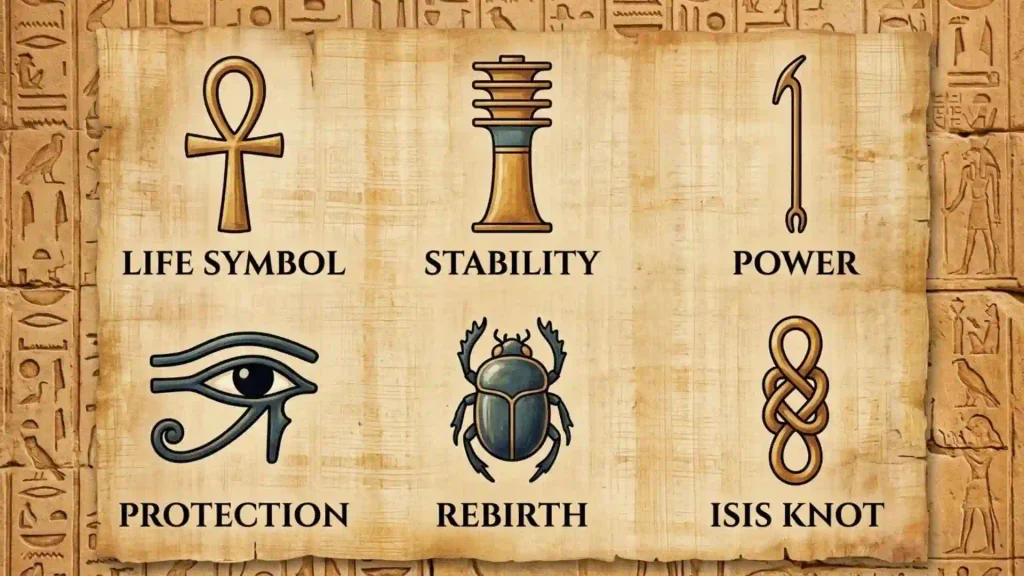
Egyptian stories and religious writings used symbols connected to death and eternal life. The sun represented divine order and renewal. The Nile symbolized fertility and survival. The ankh represented life, while the scarab reflected rebirth.
These meanings grew from Egypt’s landscape and spiritual beliefs.
Ancient Greece
Greek mythology used symbolic journeys, monsters, and sacred objects. The labyrinth represented confusion and confrontation with fear. Fire could symbolize knowledge and divine power, as seen in the story of Prometheus.
The sea often represented uncertainty, fate, and forces beyond human control.
Roman Culture
Roman literature inherited many Greek symbols but connected them to empire, law, duty, and public honor. The eagle represented authority and military power. Laurel wreaths symbolized victory and achievement.
Roman writers also used ruined cities and fallen heroes to examine pride and political decline.
Eastern Traditions
Chinese and Japanese literature often draws symbolic meaning from seasons, flowers, animals, and natural balance. Cherry blossoms represent beauty and the brief nature of life. Bamboo can symbolize resilience and moral strength. The lotus represents purity rising from difficult conditions.
In Indian traditions, rivers may represent sacred cleansing, while the wheel can symbolize cosmic order, time, or the cycle of existence.
Indigenous Traditions
Indigenous storytelling traditions are diverse and should not be treated as one system. However, many use animals, landscapes, weather, and ancestral figures to express relationships between people, nature, community, and the sacred.
A symbol may carry ceremonial meaning tied to a particular nation or community. Its interpretation should be approached with cultural respect rather than separated from its original tradition.
Modern Interpretations
Modern literature often transforms older symbols. A screen may represent connection and isolation at the same time. A machine can symbolize progress, control, or loss of humanity. A crowded city may represent opportunity, loneliness, or social inequality.
New symbols emerge as human life changes.
Similar Symbols and Their Meanings
| Symbol | Common Meaning | Important Difference |
| Light | Hope, truth, knowledge | Can also expose painful realities |
| Darkness | Fear, ignorance, mystery | May also represent rest or protection |
| Water | Life, cleansing, emotion | Floods can symbolize chaos or destruction |
| Fire | Passion, knowledge, renewal | Can also represent violence and punishment |
| Road | Choice, progress, life journey | A blocked road may represent limitation |
| Door | Opportunity, transition, secrecy | A locked door suggests exclusion or fear |
| Mirror | Identity, truth, self-awareness | A broken mirror may suggest fragmentation |
| Bird | Freedom, spirit, escape | A caged bird represents restricted freedom |
A common mistake is assuming that every appearance of an object has the same universal meaning. Symbols are shaped by context. Fire in one story may bring warmth, while in another it destroys a home.
Symbols in Literature, Mythology, and Folklore
Myths and folklore created many symbolic patterns still used by writers today.
The heroic journey often begins when a character leaves home and enters an unfamiliar world. This movement represents separation from safety and the beginning of inner growth.
Dragons may symbolize chaos, greed, forbidden power, or a challenge that must be overcome. The phoenix represents destruction followed by rebirth. The labyrinth suggests confusion and the search for self-knowledge.
Fairy tales also rely on symbolic places and objects. Forests represent danger and transformation. Glass slippers suggest identity and recognition. Poisoned fruit may symbolize temptation hidden beneath beauty.
These stories shaped modern fantasy, horror, romance, and adventure fiction.
Symbols in Art, Literature, Movies, and Pop Culture
Symbols allow different art forms to communicate without lengthy explanations.
In F. Scott Fitzgerald’s The Great Gatsby, the green light suggests Gatsby’s hope, desire, and unreachable dream. In Nathaniel Hawthorne’s The Scarlet Letter, the letter “A” changes meaning as the story develops, moving from shame toward identity and strength.
In poetry, a single image may carry the weight of an entire emotional experience. A fading flower can suggest lost youth. Evening may represent aging or approaching death.
Movies use visual symbols in similar ways. Repeated colors, reflections, costumes, weather, and objects can quietly reveal a character’s emotional state. Television series often use symbolic locations or props to connect different stages of a story.
Tattoos, fashion, and modern design also borrow literary imagery. Ravens, roses, moons, swords, and open books can express grief, beauty, mystery, courage, or personal transformation.
Spiritual and Dream Meaning of Literary Symbols
Dreams and literature both communicate through images rather than direct explanations.
A house in a dream may represent the self. Different rooms can suggest memories, hidden feelings, or unexplored parts of the mind. Water may reflect emotion. Falling may suggest fear or loss of control. Flying can represent freedom or escape.
Spiritual interpretations often view recurring symbols as invitations to reflect. A bridge may suggest transition. A candle may represent hope or guidance. A snake may point toward healing, danger, or transformation.
Still, dream symbols are not fixed predictions. Their meaning depends on personal memories, emotions, beliefs, and present circumstances.
Positive and Negative Meanings of Symbols in Literature
| Positive Meaning | Negative Meaning |
| Light as hope and understanding | Light as exposure or harsh judgment |
| Fire as renewal and passion | Fire as destruction and rage |
| Water as healing and life | Water as danger and emotional overwhelm |
| Forest as discovery | Forest as fear and confusion |
| Bird as freedom | Bird as fragility or escape from responsibility |
| Crown as leadership | Crown as pride, control, or corruption |
| Silence as peace | Silence as repression or isolation |
The same symbol can hold both light and shadow. This tension makes symbolism powerful because human emotions are rarely simple.
Why Humans Are Attracted to Symbols in Literature
Human beings naturally search for patterns. We connect events, images, memories, and emotions to make sense of life.
Symbols satisfy this need because they turn abstract ideas into things we can picture. Grief becomes winter. Hope becomes sunrise. Fear becomes a dark room. Freedom becomes an open sky.
They also connect personal experience with cultural memory. A reader may understand a storm through a society’s traditional beliefs while also connecting it to a private moment of emotional chaos.
Most importantly, symbols invite participation. The writer provides the image, but the reader helps complete its meaning.
Modern Uses of Symbols in Literature
Symbolic language appears far beyond printed books.
Writers use it in novels, short stories, poetry, graphic novels, and song narratives. Filmmakers repeat colors and visual objects to build themes. Brands use symbolic shapes to suggest trust, speed, luxury, or freedom.
On social media, emojis function as small symbolic signs. Tattoos and jewelry allow people to carry stories about identity, grief, love, family, or survival. Home decor may use trees, moons, mandalas, or inspirational words to create personal meaning.
Contemporary spirituality also uses literary and mythological symbols as tools for meditation and self-reflection.
Interesting Facts About Symbols in Literature
- A symbol can develop meaning gradually rather than being explained at once.
- Repetition often signals that an object or image may be symbolic.
- Not every detail is a symbol. Sometimes a tree is simply a tree.
- Symbols may mean different things to different characters within the same story.
- Authors sometimes use traditional meanings and then reverse them.
- Titles often contain the central symbol of a literary work.
- Weather frequently mirrors emotion, a technique sometimes called pathetic fallacy.
- Universal symbols are never completely universal because culture changes interpretation.
- A symbol can change meaning as a character grows.
- Readers may discover valid meanings that the author did not consciously plan.
Frequently Asked Questions
What is a simple example of symbolism in literature?
A rising sun can represent hope, renewal, or a new beginning. Its literal meaning is sunrise, while its symbolic meaning relates to emotional or spiritual change.
What are the most common symbols in literature?
Common symbols include light, darkness, water, fire, roads, doors, mirrors, seasons, birds, trees, flowers, storms, and colors.
How can you identify symbols in a story?
Look for details that appear repeatedly, receive unusual attention, connect with major themes, or change meaning during important moments.
What is the difference between a symbol and a metaphor?
A metaphor directly compares one thing with another. A symbol is an object, character, place, or action that repeatedly suggests a larger idea.
Can one symbol have several meanings?
Yes. Water can represent life, cleansing, emotion, birth, danger, or death. The surrounding events determine its most likely meaning.
Why do authors use symbols in literature?
Authors use symbols to add emotional depth, develop themes, reveal character conflicts, connect stories with culture, and encourage readers to interpret meaning.
Conclusion
Symbols in literature help stories speak beyond their literal words.
They connect ordinary images with deep questions about love, identity, fear, faith, freedom, and mortality.
By noticing repeated objects, colors, settings, and actions, readers can uncover layers that might otherwise remain hidden.
A powerful symbol does not simply decorate a story. It gives the story another voice.
 Michael Rivera
 John Mercer