
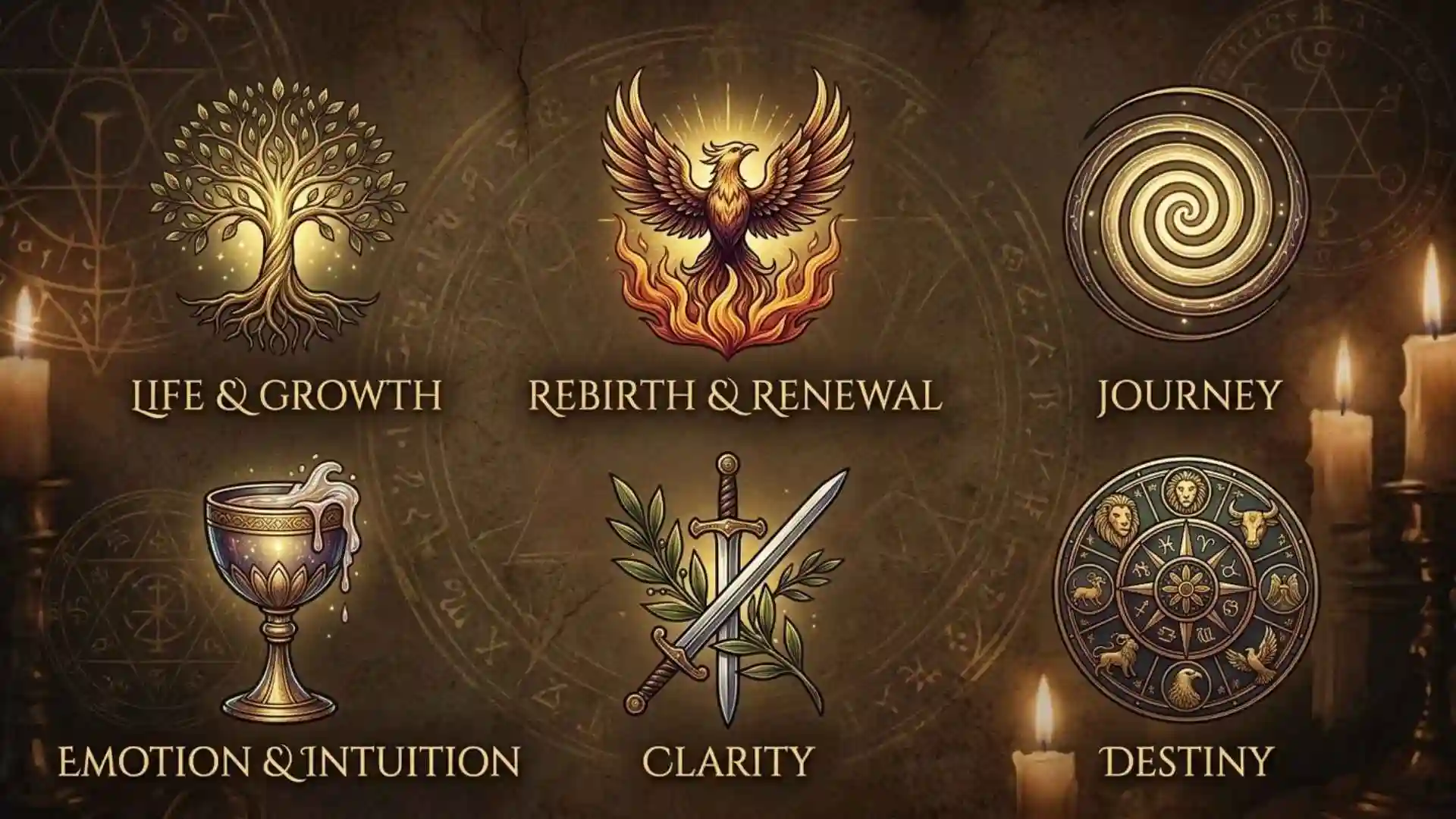
Tarot symbols hold a fascinating world of meanings, spiritual insights, and timeless wisdom hidden within each card. From the mysterious High Priestess and the powerful Sun to symbolic animals, sacred numbers, celestial bodies, and ancient objects, every detail in a tarot deck can offer clues about life, emotions, relationships, and personal growth. Whether you are a beginner learning to read tarot or an experienced reader exploring deeper interpretations, understanding these symbols can help you appreciate the rich language behind the cards.
Each tarot symbol carries its own traditional associations, shaped by history, mythology, religion, astrology, numerology, and artistic traditions. The Moon often represents intuition, mystery, and the unknown, while the Sun is associated with joy, clarity, and vitality. Colors, flowers, swords, cups, staffs, and pentacles also contribute to a card’s meaning. However, interpretations can vary between tarot decks and reading traditions, making the surrounding cards and the reader’s approach important parts of understanding a spread.
In this complete guide to tarot symbols and their meanings, you will explore the Major and Minor Arcana, discover the symbolism of common animals and objects, and learn how colors, numbers, elements, and planetary associations influence tarot interpretations. You will also uncover the deeper meanings behind popular cards and understand how their imagery can encourage reflection, self-awareness, and spiritual exploration. Whether you are curious about tarot history or want to strengthen your reading skills, this guide will help you understand the symbolic language woven throughout the cards.
Quick Answer
Tarot symbols are visual images, objects, colors, animals, numbers, and natural elements that communicate deeper meanings within tarot cards. They represent emotions, spiritual lessons, psychological archetypes, life cycles, and cultural ideas. Their meaning depends on the card, position, surrounding cards, artistic deck, and personal interpretation.
Quick Facts About Tarot Symbols
| Aspect | Information |
| Origin | Early European playing cards, especially those created in northern Italy during the 15th century |
| Historical Significance | First used in card games, then gradually connected with divination, mysticism, and occult philosophy |
| Main Meaning | A symbolic language for understanding life experiences, emotions, choices, and personal growth |
| Spiritual Meaning | Inner awakening, transformation, intuition, destiny, and connection with the unconscious |
| Cultural Importance | Blends Christian imagery, classical mythology, astrology, alchemy, folklore, and social symbolism |
| Modern Usage | Tarot readings, meditation, journaling, therapy-inspired reflection, art, fashion, tattoos, and storytelling |
What Are Tarot Symbols?
Tarot symbols are meaningful visual details found across the 78 cards of a traditional tarot deck. They include people, animals, tools, plants, buildings, colors, numbers, landscapes, and celestial bodies.
A standard deck contains 22 Major Arcana cards and 56 Minor Arcana cards. The Major Arcana presents powerful life themes such as transformation, justice, love, temptation, hope, and spiritual awakening. The Minor Arcana focuses more closely on daily situations, relationships, work, emotions, and decisions.
The earliest surviving tarot decks appeared in 15th-century Italy. Wealthy families commissioned hand-painted cards for games. Decks such as the Visconti-Sforza tarot included religious figures, rulers, virtues, and social roles familiar to European audiences.
Tarot was not originally created as an ancient Egyptian oracle or secret magical book. Those ideas became popular much later, especially during the 18th and 19th centuries. French occultists such as Antoine Court de Gébelin and Éliphas Lévi connected tarot with Egyptian wisdom, Kabbalah, astrology, and ceremonial magic.
In 1909, the Rider-Waite-Smith deck transformed modern tarot imagery. Artist Pamela Colman Smith filled even the numbered Minor Arcana cards with detailed scenes. Her illustrations made symbolic interpretation more emotional, visual, and accessible.
Deep Symbolic Meaning of Tarot Symbols
Spiritual Level
On a spiritual level, tarot symbols often describe a journey of inner growth. The Fool begins with trust and openness. The Hermit turns inward for wisdom. Death represents release and transformation. The Star offers renewal after hardship.
These cards can be understood as stages of consciousness rather than literal events. A mountain may represent spiritual effort. A river may suggest emotional flow. A crown can symbolize mastery, while a broken tower may show the collapse of false beliefs.
Tarot symbolism does not demand one religious belief. Some readers treat the cards as sacred tools, while others use them as reflective images. In both cases, the symbols encourage people to pause, listen inwardly, and examine what their lives may be teaching them.
Psychological Level
Tarot symbols also work as psychological mirrors. Carl Jung used the term “archetype” for universal patterns that appear in dreams, myths, stories, and human behavior.
The Emperor resembles the ruler archetype. The Empress reflects the nurturing mother. The Magician represents focused will and creative power. The Shadow can be seen in cards such as the Devil, where hidden desires, attachments, and fears come into view.
People are often drawn to certain cards because the images activate memory and emotion. A person facing a difficult choice may connect strongly with The Lovers. Someone feeling trapped may recognize themselves in the Eight of Swords.
The card does not create the feeling. It gives the feeling a visible form.
Cultural Level
Tarot is a cultural mosaic. Its imagery includes Christian virtues, medieval social ranks, Greco-Roman gods, astrological signs, alchemical ideas, and European folklore.
Justice carries scales like the Roman goddess Justitia. The Wheel of Fortune echoes the medieval idea that fate raises and lowers human beings. The Sun recalls ancient solar worship, while the World resembles sacred images of cosmic order.
As tarot traveled across countries and generations, artists added new cultural themes. Today, decks may feature African spirituality, Asian philosophy, feminist symbolism, Indigenous-inspired art, modern cities, animals, plants, or fantasy worlds.
Types and Variations of Tarot Symbols
Celestial Symbols
The sun, moon, and stars appear throughout tarot.
The sun commonly represents clarity, confidence, truth, joy, and life force. The moon points toward dreams, uncertainty, intuition, fear, and hidden knowledge. Stars suggest guidance, hope, spiritual protection, and renewal.
These images appear in mythology, religion, dreams, poetry, and astrology because humans have always looked upward for meaning.
Animal Symbols
Animals often represent instinctive qualities.
The lion may symbolize courage, passion, power, or controlled strength. Dogs can represent loyalty, instinct, companionship, or warning. Horses suggest movement and drive. Birds may show freedom, messages, thought, or spiritual elevation.
A white horse often carries ideas of purity or victory, while a black animal may suggest mystery, shadow, or unconscious power.
Plant and Flower Symbols
Roses represent love, beauty, desire, secrecy, and spiritual unfolding. Lilies often suggest purity, innocence, or sacred intention. Pomegranates can symbolize fertility, abundance, mystery, and the myth of Persephone.
Trees may represent growth, ancestry, knowledge, stability, and the connection between heaven and earth.
Objects and Tools
The four Minor Arcana suits carry strong symbolic meaning:
- Wands represent energy, ambition, creativity, passion, and action.
- Cups represent feelings, relationships, intuition, and imagination.
- Swords represent thought, truth, conflict, language, and decision-making.
- Pentacles represent money, work, the body, nature, and material security.
Keys suggest access or secret knowledge. Lanterns represent guidance. Chains may symbolize attachment. Crowns often indicate authority, achievement, or responsibility.
Colors
Color adds emotional meaning.
Red suggests passion, courage, desire, anger, or action. Blue often represents calmness, truth, reflection, or spiritual awareness. White can mean purity, openness, or new beginnings. Black may symbolize mystery, endings, protection, or the unknown.
However, meanings change according to the card and artistic tradition.
Numbers
Numbers create repeating patterns across tarot.
One represents beginnings and personal power. Two suggests balance, choice, or partnership. Three often means growth and creation. Four represents structure and stability. Five may bring conflict or change. Ten often shows completion before a new cycle begins.
Tarot Symbols Across Different Cultures
Ancient Egypt
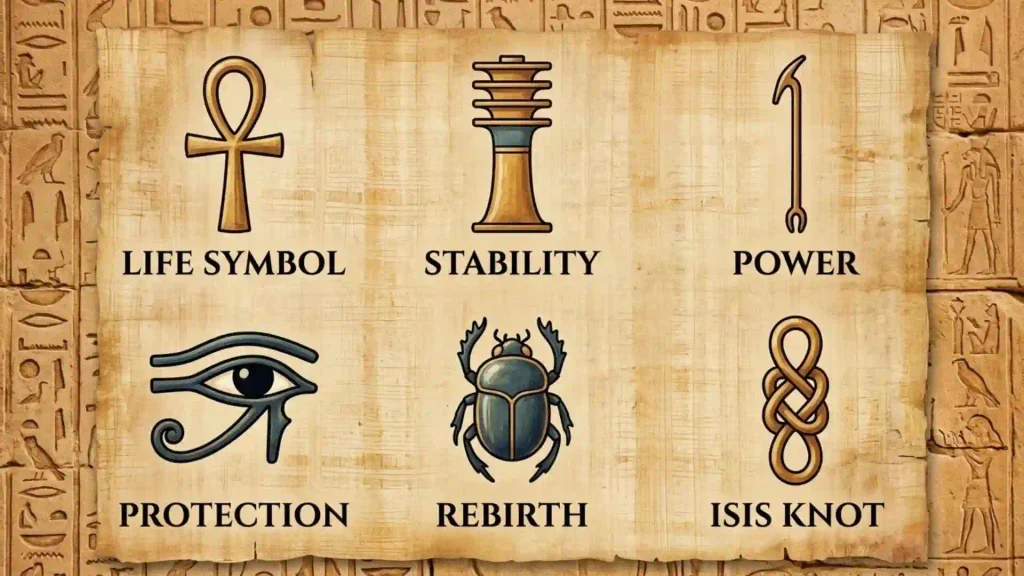
Traditional tarot did not begin in ancient Egypt, but Egyptian symbolism greatly influenced later occult decks. Sphinxes, ankhs, pyramids, and solar imagery became associated with mystery, initiation, death, and rebirth.
The sphinxes on some versions of The Chariot symbolize opposing forces that must be directed with discipline.
Ancient Greece
Greek mythology appears in many tarot interpretations. The High Priestess is sometimes linked with Persephone, Hecate, or Artemis. The Empress may resemble Demeter or Aphrodite. The Hermit can echo wise figures such as Diogenes.
Greek myths help explain themes of fate, sacrifice, desire, wisdom, and transformation.
Roman Culture
Roman concepts appear through figures such as Justice, Fortune, and imperial rulers. The Emperor reflects law, order, leadership, and worldly authority.
The Wheel of Fortune connects closely with Fortuna, the Roman goddess whose turning wheel symbolized the changing nature of luck.
Eastern Traditions
Modern tarot decks often include Buddhist, Hindu, Taoist, and yogic symbolism. Lotuses may represent awakening. Chakras symbolize energy centers. Yin and yang express balance between complementary forces.
These elements are later additions rather than part of early European tarot, but they have expanded modern spiritual interpretations.
Indigenous Traditions
Some contemporary decks use animals, ancestors, sacred landscapes, and seasonal cycles inspired by Indigenous worldviews. These themes may highlight relationship with the land, community, memory, and natural wisdom.
Such imagery should be approached respectfully. Sacred symbols belong to living cultures and should not be treated as decoration without context.
Modern Interpretations
Modern tarot often replaces medieval kings and queens with diverse figures, ordinary people, mythical beings, or abstract forms. The core archetypes remain, but the visual language changes to reflect new identities, values, and social experiences.
Similar Symbols and Their Meanings
| Symbol | Common Meaning | Similar Symbol | Main Difference |
| Sun | Joy, truth, success | Star | The Sun brings full clarity, while the Star offers hope and guidance |
| Moon | Intuition, illusion, mystery | High Priestess | The Moon emphasizes uncertainty, while the High Priestess suggests inner knowing |
| Tower | Sudden disruption | Death | The Tower breaks structures quickly, while Death represents transition and release |
| Lion | Courage and passion | Horse | The lion reflects inner power, while the horse suggests movement and drive |
| Crown | Authority and achievement | Throne | A crown marks status, while a throne emphasizes position and responsibility |
| Water | Emotion and intuition | Cup | Water is emotional energy, while the cup contains and expresses it |
A common mistake is to assume that every dark image is negative. Death rarely predicts physical death. The Devil does not automatically represent evil. The Tower does not always mean disaster. These cards often expose truth, break unhealthy patterns, or clear space for change.
Tarot Symbols in Mythology and Folklore
Tarot imagery draws heavily from legendary stories.
The Hanged Man resembles myths of sacrifice for wisdom. Odin hung from the world tree Yggdrasil before receiving knowledge of the runes. The card therefore connects surrender with deeper understanding.
The Empress carries themes found in fertility goddesses such as Demeter, Isis, and Freyja. The Devil recalls horned figures, wild nature spirits, temptation myths, and medieval Christian art.
The Wheel of Fortune reflects ancient beliefs that human life moves through changing cycles. Kings rise, kingdoms fall, winter becomes spring, and loss can eventually lead to renewal.
These stories shaped tarot because myths turn complex human truths into memorable images.
Tarot Symbols in Art, Literature, Movies, and Pop Culture
Tarot imagery appears in paintings, novels, poetry, films, television, tattoos, fashion, and graphic design.
Writers use cards such as Death, The Lovers, and The Fool as symbols of fate or personality. Filmmakers often show tarot readings before major plot changes. Unfortunately, horror stories sometimes present tarot as a tool that causes danger, rather than a symbolic system used for interpretation.
In art and fashion, tarot cards offer dramatic figures, rich colors, sacred geometry, and mysterious visual language. Tattoos may represent personal turning points. The Strength card can honor survival. The Star may mark healing. The Fool may celebrate freedom and a new beginning.
Spiritual and Dream Meaning of Tarot Symbols
Seeing tarot-like symbols in dreams may reflect emotions already active in the unconscious.
A tower may suggest instability. A moonlit road may represent uncertainty. A cup may point toward love or emotional needs. A locked door may symbolize an opportunity that feels unavailable.
During meditation, a tarot image can become a focus for reflection. A person might imagine walking into the card, speaking with a figure, or exploring the landscape.
Dream and spiritual meanings should remain flexible. Context matters more than a fixed definition. The same snake may represent healing, fear, wisdom, temptation, or renewal depending on the dreamer’s feelings.
Positive and Negative Meanings of Tarot Symbols
| Positive Meaning | Negative Meaning |
| Transformation | Fear of change |
| Intuition | Confusion or illusion |
| Authority | Control or rigidity |
| Love | Dependency or difficult choices |
| Ambition | Impulsiveness |
| Reflection | Isolation |
| Hope | Unrealistic expectations |
| Material success | Greed or attachment |
| Courage | Aggression |
| Freedom | Lack of direction |
Tarot symbols contain both light and shadow because human experiences do too. Fire can warm or destroy. Water can heal or overwhelm. A crown can represent earned leadership or harmful pride.
Meaning depends on context, question, emotional response, and surrounding cards.
Why Humans Are Attracted to Tarot Symbols
Humans naturally search for patterns. We look for faces in clouds, meaning in dreams, and lessons in stories.
Tarot gives that pattern-seeking mind a structured collection of images. Its cards show familiar human experiences: love, grief, temptation, hope, conflict, work, family, failure, and renewal.
The symbols also create emotional distance. It may be difficult to say, “I feel powerless.” It may be easier to look at the Eight of Swords and recognize the feeling through the image.
Tarot is attractive because it combines mystery with self-reflection. It allows personal meaning to meet cultural memory.
Modern Uses of Tarot Symbols
Today, tarot symbols appear far beyond traditional readings.
People wear tarot-inspired jewelry for protection, confidence, love, or remembrance. Fashion designers use suns, moons, eyes, stars, and card figures to create mystical designs.
Brands may use tarot imagery to suggest mystery, creativity, rebellion, or personal transformation. Social media creators share daily card pulls, symbolic explanations, and journaling prompts.
In contemporary spirituality, tarot supports meditation, ritual, shadow work, and intention setting. In home decor, card prints can represent values such as strength, justice, hope, or abundance.
Some therapists and coaches also use picture-based cards as conversation tools, although tarot should not replace professional mental health care.
Interesting Facts About Tarot Symbols
- Tarot began as a European card game, not as an ancient fortune-telling system.
- The word “arcana” comes from a Latin term connected with secrets or mysteries.
- Pamela Colman Smith created the influential images of the Rider-Waite-Smith deck.
- The Major Arcana can be read as a symbolic life journey called the Fool’s Journey.
- The four tarot suits are sometimes linked with the four classical elements.
- Wands often connect with fire, Cups with water, Swords with air, and Pentacles with earth.
- The number 13 card, Death, usually symbolizes transformation rather than physical death.
- Reversed cards do not always mean the opposite of upright cards. They may show blocked, internal, delayed, or weakened energy.
- Symbol meanings can change between decks because artists reinterpret traditional imagery.
- Personal associations matter, but historical and cultural knowledge can make readings deeper and more responsible.
Frequently Asked Questions
What do tarot symbols represent?
They represent emotions, archetypes, spiritual lessons, life events, relationships, choices, fears, and stages of personal development.
What is the most powerful symbol in tarot?
There is no single most powerful symbol. The Sun, World, Magician, High Priestess, Death, and Tower can all feel powerful depending on the question and reading.
Do tarot symbols predict the future?
Tarot symbols are usually better understood as tools for reflection, pattern recognition, and exploring possible outcomes. They do not provide scientifically proven predictions.
Why are there so many animals in tarot cards?
Animals express instinct, natural energy, personality traits, and unconscious forces. Lions may show courage, dogs loyalty, horses movement, and birds freedom or messages.
What do snakes mean in tarot?
Snakes may symbolize wisdom, temptation, healing, sexuality, danger, renewal, or transformation. Their meaning depends on the card and surrounding imagery.
Can tarot symbols have different meanings for different people?
Yes. Traditional meanings provide a foundation, but personal memories, culture, emotions, and life circumstances can change how a symbol is experienced.
Conclusion
Tarot symbols form a visual language shaped by history, mythology, religion, art, psychology, and personal experience. Their power does not come from one fixed definition, but from the way each image invites reflection. A symbol can reveal both hope and fear, strength and vulnerability, beginnings and endings. When approached with curiosity and respect, tarot becomes less about predicting life and more about understanding it.
 Sarah Thompson
 John Mercer