
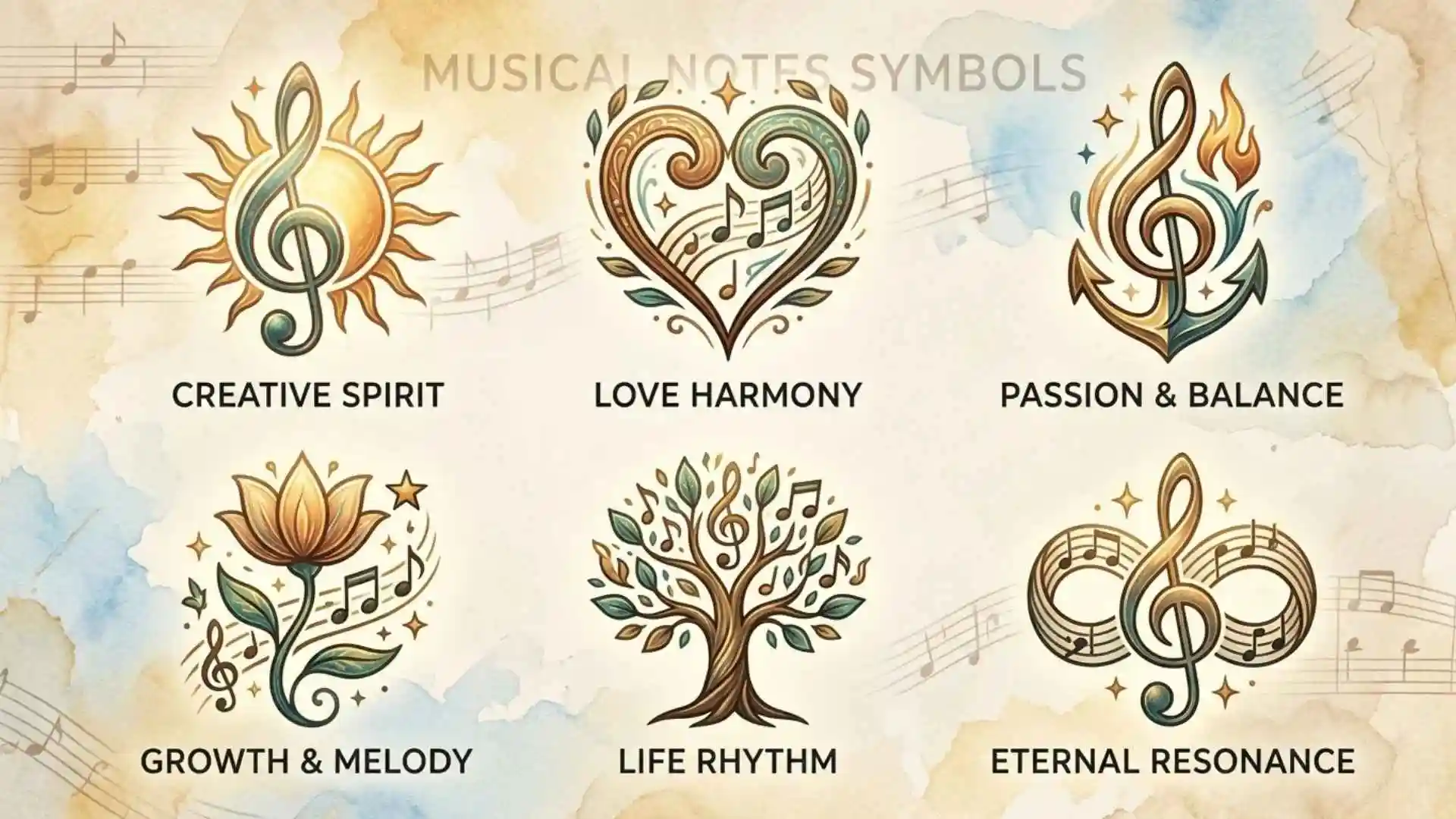
Musical notes symbols are the universal language of music, helping musicians read melodies, understand rhythms, and express emotions through sound. From the familiar quarter note (♩) and eighth note (♪) to treble clefs, bass clefs, sharps, flats, and rests, each symbol has a specific role in written music. Whether you are learning an instrument, studying music theory, or simply curious about musical notation, understanding these symbols can help you discover how written signs become beautiful melodies and rhythms.
Every musical symbol carries important information about pitch, timing, duration, or expression. Notes tell musicians which sounds to play and how long to hold them, while rests indicate moments of silence. Accidentals such as sharps (♯) and flats (♭) change a note’s pitch, and dynamic markings guide musicians on how softly or loudly to perform. Beyond their technical purpose, musical notes also hold cultural and emotional significance, often representing creativity, harmony, freedom, inspiration, and the power of human expression.
In this complete guide to musical notes symbols, you will explore their meanings, history, different types, and uses in modern music. You will learn how to recognize common notes, understand rests and musical signs, read basic notation, and discover the symbolism associated with music in art, tattoos, jewelry, and popular culture. Whether you are a beginner, a music enthusiast, or someone searching for meaningful musical symbols to express a personal connection to music, this guide will help you understand these fascinating signs.
Quick Answer
Musical notes symbols are written signs used to show the pitch, length, timing, and expression of sounds in music. Common examples include the whole note, half note, quarter note, eighth note, treble clef, bass clef, sharp, flat, and natural signs. Symbolically, they often represent harmony, creativity, emotion, and personal freedom.
Quick Facts About Musical Notes Symbols
| Aspect | Information |
| Origin | Early marks developed from ancient Greek notation and medieval European neumes |
| Historical Significance | They allowed melodies, chants, and compositions to be preserved and performed accurately |
| Main Meaning | Pitch, rhythm, duration, silence, and musical expression |
| Spiritual Meaning | Harmony, divine order, emotional healing, and connection with the soul |
| Cultural Importance | Used to preserve religious, classical, folk, and popular music |
| Modern Usage | Sheet music, digital notation, tattoos, logos, jewelry, emojis, fashion, and social media |
What Are Musical Notes Symbols?
Musical notes symbols are visual signs that tell musicians what to play and how to play it. A note can show how high or low a sound should be, how long it should last, and where it belongs within a rhythm.
Modern Western music places notes on a staff made of five horizontal lines. Their position on the staff identifies pitch, while their shape helps determine duration. Other symbols, including clefs, rests, accidentals, time signatures, and dynamic markings, add further instructions.
The story of musical writing reaches back thousands of years. Ancient Greek musicians used letters and special marks to record pitch. However, early notation systems were limited and often depended on oral teaching.
During the Middle Ages, Christian monks developed signs called neumes to help singers remember the direction of Gregorian chants. These marks first showed whether the melody moved upward or downward. Later, lines were added to make pitch more exact.
Guido of Arezzo, an Italian music teacher from the 11th century, played an important role in developing staff notation. His teaching methods helped singers learn music faster and laid the foundation for the system used today.
As music became more complex, written notation evolved. Composers needed symbols for rhythm, harmony, tempo, volume, and expression. By the Renaissance and Baroque periods, notation had become a detailed language capable of preserving large musical works.
Deep Symbolic Meaning of Musical Notes Symbols
Spiritual Meaning
On a spiritual level, music notes often represent harmony between the visible and invisible worlds. A written note is silent, yet it contains the possibility of sound. Because of this, it can symbolize hidden potential, awakening, and the movement from thought into reality.
Many religious traditions use music to support prayer, meditation, and communal worship. A musical note may therefore suggest devotion, sacred order, or connection with something greater than the individual.
A rising melody can symbolize spiritual growth, hope, or the soul reaching upward. A descending melody may represent grounding, surrender, reflection, or a return to inner stillness.
Music also brings separate sounds into a meaningful whole. For this reason, musical notation can represent unity, balance, and the belief that different lives can exist together in harmony.
Psychological Meaning
Psychologically, musical notes are closely tied to memory and emotion. A few familiar tones can bring back a childhood scene, a relationship, or a moment that seemed forgotten.
Carl Jung’s idea of archetypes suggests that certain patterns repeatedly appear in human stories and inner life. Music can work in a similar way. Rhythm may remind us of a heartbeat, while repetition creates safety, expectation, and emotional structure.
Musical notes can also symbolize emotions that words cannot fully express. A joyful melody may communicate excitement without explanation. A minor passage can carry sadness, longing, or mystery even when no lyrics are present.
People who choose music-note tattoos or jewelry often associate them with identity, healing, creativity, or a loved one. The symbol becomes a visible form of an invisible emotional experience.
Cultural Meaning
Culturally, musical notes represent communication across boundaries. Languages differ, but rhythm and melody can still create shared feeling.
Written notation also preserves cultural memory. It allows sacred chants, national songs, classical compositions, and family traditions to survive beyond the lives of their original performers.
At the same time, Western musical notation is only one system. Indian classical music, Chinese traditions, Japanese music, Arabic maqam, and many Indigenous cultures use different methods of teaching and recording sound. Some rely heavily on oral transmission, patterns, syllables, or specialized symbols.
Therefore, musical notes can symbolize both universal expression and the unique musical identity of a community.
Types and Variations of Musical Notes Symbols
Whole Note
The whole note looks like an open oval without a stem. In common time, it normally lasts for four beats.
Its long, sustained quality can symbolize completeness, patience, stability, and wholeness. It appears in sheet music, music education, logos, and minimalist designs.
Half Note
A half note has an open oval head with a stem. It usually lasts for two beats in common time.
It represents balance between movement and stillness. Symbolically, it may suggest transition, moderation, or something that is only partly complete.
Quarter Note
The quarter note has a filled note head and a straight stem. It normally lasts for one beat in common time.
Because it often forms the steady pulse of a piece, it may symbolize progress, regularity, discipline, and the rhythm of everyday life.
Eighth Note
An eighth note looks like a quarter note with one flag. Two or more eighth notes may be connected by a beam.
Its shorter duration creates speed and motion. It is often associated with energy, playfulness, dancing, excitement, and creative freedom.
Sixteenth Note
A sixteenth note has two flags or two beams and usually lasts half as long as an eighth note.
It can symbolize fast thought, complexity, skill, urgency, or intense emotional movement. It often appears in energetic classical passages, jazz, rock, and electronic music.
Beamed Notes
When eighth notes or shorter notes are grouped, they are often connected with horizontal beams.
Visually, beamed notes suggest relationship and cooperation. Several individual sounds become part of one rhythmic pattern, making them a fitting symbol of teamwork and connection.
Dotted Note
A dot placed after a note increases its duration by half of its original value.
Symbolically, the dotted note represents extension and transformation. A small mark changes the entire rhythmic meaning, reminding us that small details can have a powerful effect.
Grace Note
A grace note appears smaller than a regular note and decorates the main melody.
It symbolizes beauty, ornament, spontaneity, and subtle expression. Like a thoughtful gesture in daily life, it may be brief but emotionally meaningful.
Musical Notes Symbols Across Different Cultures
Ancient Egypt
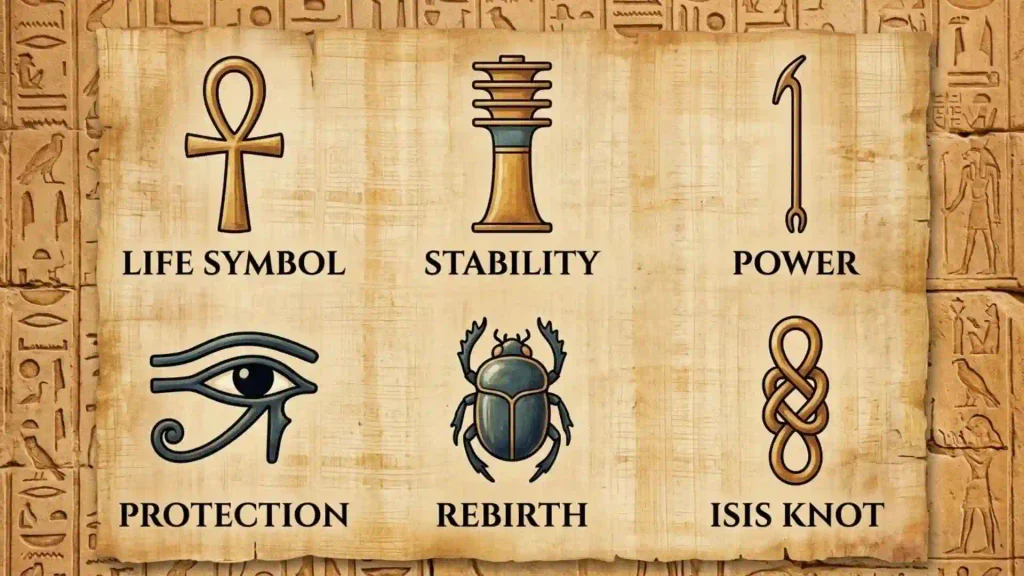
Music played a major role in Egyptian religious ceremonies, royal courts, celebrations, and funerary practices. Images show harps, flutes, drums, and other instruments.
Although no complete Egyptian notation system survives like modern sheet music, musical imagery represented joy, worship, social order, and connection with the gods. Hathor, a goddess linked with music and dance, reflects the sacred role of sound in Egyptian life.
Ancient Greece
The ancient Greeks developed systems that used letters and signs to represent musical pitches. Music was connected with education, mathematics, poetry, theater, and philosophy.
The philosopher Pythagoras explored numerical relationships between musical intervals. This helped establish the lasting idea that music reflects order within the universe.
Greek mythology also linked music with divine power. Apollo represented music, reason, and harmony, while the Muses inspired artistic creation.
Roman Culture
Roman music borrowed heavily from Greek traditions. It appeared in theaters, military events, religious ceremonies, banquets, and public celebrations.
Musical signs were less standardized than those used today, but music itself represented authority, entertainment, ritual, and civic identity. Trumpets and horns were especially important in military communication.
Eastern Traditions
Eastern musical cultures developed their own systems and philosophies. Indian classical music uses svara syllables, including Sa, Re, Ga, Ma, Pa, Dha, and Ni. Ragas organize melodic movement and are linked with moods, seasons, and times of day.
Traditional Chinese music was influenced by ideas of balance, nature, and social harmony. Systems such as gongche notation used written characters to guide performers.
Japanese notation varies by instrument and tradition. Music for instruments such as the shamisen, shakuhachi, and koto may use specialized signs or number-based systems.
Indigenous Traditions
Many Indigenous cultures preserve music mainly through oral teaching rather than written symbols. Songs may carry history, spiritual teachings, healing practices, community identity, and relationships with the natural world.
In such traditions, music is not simply a performance. It may be part of ceremony, storytelling, ancestry, and collective memory. The absence of Western-style notes does not mean the music lacks structure. Instead, knowledge is preserved through listening, repetition, movement, and lived participation.
Modern Interpretations
Today, musical notes symbols appear far beyond printed scores. They are used in digital apps, emojis, tattoos, logos, posters, clothing, and social media captions.
The symbols ♪, ♫, ♬, and ♩ commonly express singing, happiness, entertainment, or a musical mood. Their meaning is often emotional rather than technical.
Similar Symbols and Their Meanings
| Symbol | Main Function | Common Symbolic Meaning |
| Musical note | Represents a sound and its duration | Creativity, emotion, rhythm |
| Treble clef | Identifies higher pitch ranges | Beauty, elegance, melody |
| Bass clef | Identifies lower pitch ranges | Strength, depth, foundation |
| Sharp sign | Raises a note by a semitone | Growth, intensity, upward movement |
| Flat sign | Lowers a note by a semitone | Softness, calm, descent |
| Natural sign | Cancels a sharp or flat | Restoration, truth, return to balance |
| Rest symbol | Shows measured silence | Peace, pause, reflection |
| Fermata | Extends a note or rest | Suspension, freedom, timelessness |
| Repeat sign | Directs music to return to a section | Memory, cycles, second chances |
A common misconception is that every musical symbol is a note. Clefs, rests, accidentals, bar lines, and dynamic marks are part of musical notation, but they serve different purposes.
Musical Notes Symbols in Mythology and Folklore
Ancient myths rarely describe modern note shapes because those symbols developed much later. However, the symbolic power of music appears throughout mythology.
In Greek legend, Orpheus played music so beautiful that animals, trees, and even stones responded. His songs could soften hearts and cross the boundary between life and death. This story helped shape the idea that music has supernatural emotional power.
Apollo’s lyre represented harmony, artistic skill, reason, and divine order. In contrast, the music of Dionysian festivals was linked with ecstasy, movement, and freedom from ordinary limits.
The Greek Sirens used song to enchant sailors. Their myth presents music’s darker side, showing that beauty can attract, persuade, and even endanger.
In many folk traditions, songs protect communities, guide rituals, tell ancestral stories, or open symbolic contact with the spirit world. Modern musical note symbols inherit some of this ancient sense of mystery and power.
Musical Notes Symbols in Art, Literature, Movies, and Pop Culture
In paintings and illustrations, floating notes often show that music is filling a room or shaping a character’s mood. Artists may place notes around a singer, instrument, bird, or dancing figure to make sound visible.
In literature and poetry, musical language is often used to describe emotion. Writers speak of life’s rhythm, the music of nature, or the harmony between people. Notes may symbolize a message that cannot be expressed through ordinary speech.
Movies use musical notation in posters, animated sequences, and visual transitions. A cheerful note may signal comedy or romance, while distorted notation may suggest confusion, obsession, or emotional tension.
Music-note tattoos can honor a favorite song, a musician, a family member, or a turning point in life. Some people combine notes with names, dates, heartbeats, flowers, birds, or meaningful lyrics.
Fashion and jewelry use musical notes because the shapes are simple, graceful, and instantly recognizable. In branding, they often identify music schools, streaming platforms, studios, concerts, and entertainment services.
Spiritual and Dream Meaning of Musical Notes Symbols
Dreaming of musical notes may reflect a desire for harmony, emotional release, or creative expression. The meaning depends on how the notes appear and how the dream feels.
Clear, beautiful notes may suggest inner balance, inspiration, or a positive message that is beginning to take shape. Confused or unreadable notes may point to difficulty expressing emotions or understanding a situation.
Missing notes can symbolize incompleteness, lost communication, or the feeling that something important is absent. Repeating notes may reflect a recurring thought, habit, memory, or life lesson.
Hearing music without seeing its source can represent intuition or an emotion rising from the unconscious. However, dream meanings are personal rather than fixed predictions. Your memories, beliefs, and current emotional state matter most.
During meditation, imagined notes may symbolize concentration, inner rhythm, or the mind’s effort to create order. A peaceful musical image can be used as a personal focus for calm and self-reflection.
Positive and Negative Meanings of Musical Notes Symbols
| Positive Meaning | Negative Meaning |
| Harmony and unity | Conflict or lack of harmony |
| Creative inspiration | Creative frustration |
| Emotional healing | Emotional overwhelm |
| Freedom of expression | Escapism |
| Joy and celebration | Painful memories |
| Communication | Misunderstanding |
| Rhythm and stability | Repetition or feeling trapped |
| Spiritual connection | Manipulation through emotion |
The same symbol can carry light or shadow. A musical note may remind one person of love and another of loss. Context, personal history, and surrounding imagery shape its meaning.
Why Humans Are Attracted to Musical Notes Symbols
Humans naturally look for patterns. Rhythm offers order, while melody gives movement to emotion. Musical notes turn these invisible patterns into something the eyes can recognize.
The symbols are also attractive because they seem alive. A curved flag suggests motion, while a group of beamed notes looks as though it is dancing across the page.
Music is deeply connected with cultural memory. Lullabies, wedding songs, national anthems, religious chants, and funeral music become part of important life moments. A small note symbol can awaken an entire emotional story.
People also give notes personal meaning. One person may see discipline from years of piano lessons. Another may remember singing with a parent. Someone else may view the symbol as proof that healing can begin through creativity.
Modern Uses of Musical Notes Symbols
Musical notes are common tattoo designs because they can represent passion, identity, memory, and freedom. They may also reproduce the opening notes of a meaningful melody.
In jewelry, note-shaped pendants, earrings, bracelets, and rings often celebrate a love of music. They are popular gifts for singers, composers, teachers, dancers, and instrumentalists.
Fashion designers place musical notation on shirts, scarves, bags, and shoes. Home decor may feature framed sheet music, wall decals, metal signs, or vintage scores.
Brands use note symbols to communicate sound, entertainment, rhythm, and creativity. On social media, musical note emojis can show that someone is singing, listening to a song, feeling cheerful, or quoting lyrics.
In contemporary spirituality, some people connect musical notes with sound healing, meditation, chanting, singing bowls, and ideas about energetic vibration. These practices can support relaxation, although spiritual claims should not be confused with established medical treatment.
Interesting Facts About Musical Notes Symbols
- The earliest Western neumes did not show exact rhythm or pitch as clearly as modern notation.
- Guido of Arezzo helped develop a four-line staff before the five-line staff became standard.
- The names do, re, mi, fa, sol, and la developed from syllables in a Latin hymn used for music teaching.
- A note’s stem may point upward or downward depending on its position on the staff, but the direction usually does not change its duration.
- A dot after a note adds half of the note’s original value.
- Two dots add three-quarters of the original value in total.
- The familiar eighth-note emoji often represents music generally, even when it is not being used with technical accuracy.
- Silence has its own written symbols. Musical rests receive measured time just as notes do.
- Standard notation can describe pitch and rhythm precisely, yet performers still shape music through tone, phrasing, and interpretation.
- Musical notation continues to evolve through digital composition software, graphic scores, tablature, chord charts, and experimental systems.
Frequently Asked Questions
What do musical notes symbols mean?
They show the pitch and duration of sounds. Their shapes, positions, stems, flags, and dots tell musicians when a sound occurs and how long it should last.
What does the musical note symbol represent spiritually?
Spiritually, it often represents harmony, inner awakening, creativity, healing, and the connection between emotion and the soul.
What do ♪ and ♫ mean?
The symbol ♪ usually shows a single eighth note, while ♫ shows two connected eighth notes. In everyday messages, both commonly mean music, singing, happiness, or a playful mood.
What is the most common musical note symbol?
The quarter note is among the most commonly recognized symbols because it often represents one steady beat in beginner music and common time.
What does a music-note tattoo symbolize?
A music-note tattoo may represent love of music, creative identity, emotional healing, freedom, a favorite song, or remembrance of someone important.
Are musical notes universal?
Music is universal as a human activity, but notation is not. Different cultures use staff notation, letters, numbers, syllables, characters, special signs, or oral teaching systems.
Conclusion
Musical notes symbols form a visual language that allows sound to travel across time, place, and generations.
They carry practical meanings related to pitch and rhythm, but they also represent creativity, memory, harmony, and emotional truth.
From medieval chants to digital emojis, these signs continue to change while preserving their human power.
A musical note may look small on the page, yet it can hold an entire world of feeling within it.
 Sarah Thompson
 Michael Rivera