
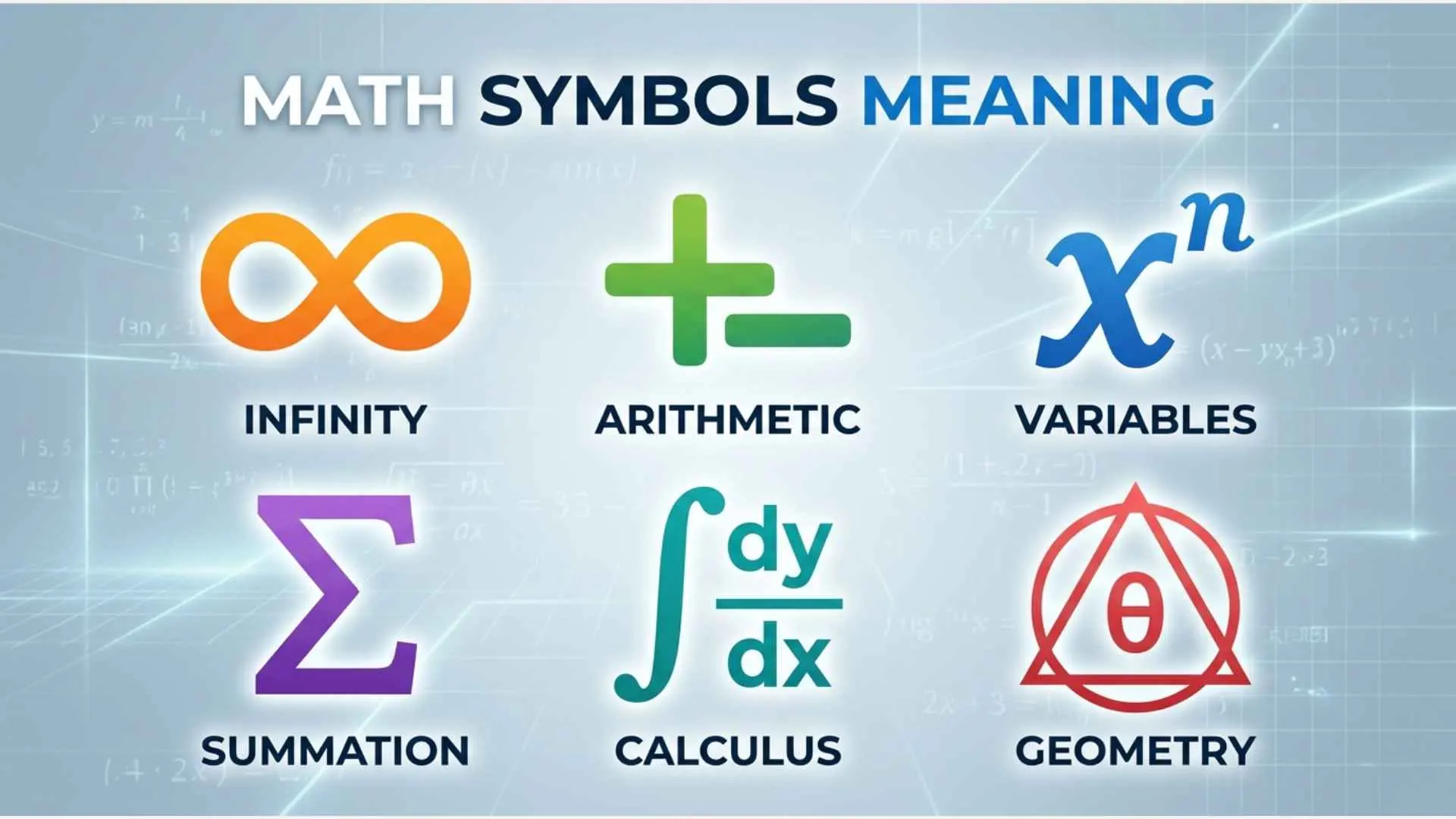
Mathematical symbols are the visual language of math. From the familiar plus (+) and minus (−) signs to symbols such as π, ∞, √, ≠, and ∑, each one represents a specific idea, operation, relationship, or mathematical concept. Learning their meanings can make equations easier to read and help students understand how mathematicians communicate complex ideas in a simple form.
The history of mathematical symbols is also fascinating. Many signs developed over centuries as mathematicians searched for faster and clearer ways to write calculations and express relationships. Some symbols became widely accepted through the work of influential mathematicians, while others evolved from older forms of notation. As a result, a simple symbol can have an interesting story behind its modern meaning and use.
In this guide, you will discover the meanings, names, uses, and history of common math symbols. We will cover arithmetic signs, comparison symbols, algebraic notation, geometry symbols, calculus symbols, set theory, logic, statistics, and other important mathematical signs. Whether you are a student, teacher, researcher, or simply curious about the hidden significance of mathematical notation, this guide will help you understand what these symbols mean and when they are used.
Quick Answer
Math symbols meaning refers to the definitions and concepts represented by mathematical signs such as +, −, ×, ÷, =, %, √, ∞, and π. These symbols communicate mathematical ideas, relationships, and operations. They form a universal language used worldwide in education, science, technology, and logical reasoning.
Quick Facts About Math Symbols Meaning
| Aspect | Information |
| Origin | Developed through ancient civilizations including Babylonian, Egyptian, Greek, Indian, and Arabic mathematical traditions |
| Historical Significance | Created to simplify calculations, explain scientific theories, and communicate mathematical ideas universally |
| Main Meaning | Represent numbers, operations, relationships, measurements, and abstract concepts |
| Spiritual Meaning | Often associated with harmony, balance, order, infinity, and the structure of the universe |
| Cultural Importance | Mathematics symbols connect different cultures through a shared language of logic and discovery |
| Modern Usage | Used in education, programming, artificial intelligence, engineering, physics, finance, and research |
What Are Math Symbols?
Definition of Math Symbols
Math symbols are visual signs used to represent mathematical ideas, operations, values, and relationships. Instead of writing long explanations, mathematicians use symbols to communicate complex information quickly and accurately.
For example:
- The plus sign (+) means addition.
- The minus sign (−) means subtraction.
- The equal sign (=) shows that two values are the same.
- The infinity symbol (∞) represents something without an end.
- The square root symbol (√) represents finding a number that produces a given value when multiplied by itself.
These symbols make mathematics easier to understand and allow people from different languages and cultures to communicate through numbers.
Origin and Historical Background
The history of mathematical symbols is thousands of years old. Ancient civilizations developed early counting systems and mathematical notation to solve practical problems related to trade, astronomy, architecture, and agriculture.
The ancient Egyptians used mathematical symbols and methods for measuring land and constructing monuments. Babylonian mathematicians developed advanced number systems and astronomical calculations. Greek scholars such as Euclid and Pythagoras helped establish mathematical theories that influenced modern mathematics.
Many symbols used today appeared much later. The plus (+) and minus (−) signs became common in Europe during the 15th century. The equal sign (=) was introduced in 1557 by Welsh mathematician Robert Recorde because he believed no two things could be more equal than parallel lines.
Evolution of Mathematical Symbols
Over time, mathematical symbols evolved from simple counting marks into a sophisticated universal language.
Modern mathematics uses symbols for:
- Algebra
- Geometry
- Calculus
- Probability
- Statistics
- Logic
- Computer science
- Quantum physics
Symbols allow scientists to describe invisible concepts such as time, space, energy, probability, and infinity.
Deep Symbolic Meaning of Math Symbols
Mathematical symbols have practical meanings, but they also carry deeper philosophical and psychological interpretations.
Spiritual Level
Symbols of Universal Order
Many cultures have viewed mathematics as a reflection of universal harmony. Ancient philosophers believed numbers and patterns revealed hidden structures behind nature.
The concept of mathematical order appears in:
- Planetary movements
- Natural patterns
- Music frequencies
- Geometric shapes
- Biological structures
The idea of sacred geometry connects mathematical patterns with spiritual beliefs about balance and creation.
Infinity Symbol and Eternal Connection
The infinity symbol (∞) is one of the most recognized mathematical symbols. Beyond mathematics, it represents:
- Endless possibilities
- Eternal existence
- Infinite knowledge
- Continuous cycles
In spiritual traditions, infinity is often connected with ideas of timelessness and the endless nature of consciousness.
Psychological Level
Human Attraction to Patterns
Humans naturally search for patterns and meaning. Mathematical symbols satisfy this psychological need by creating structure from complexity.
A symbol like “=” provides a sense of balance and certainty. A symbol like “∞” inspires curiosity because it represents something beyond human limits.
Psychologist Carl Jung explored how humans connect with universal symbols and archetypes. Mathematical patterns can be viewed as examples of humanity’s desire to understand order and meaning.
Emotional Connection With Numbers
Numbers and symbols often create emotional responses:
- A perfect equation can represent harmony.
- A geometric pattern can create feelings of beauty.
- A complex formula can represent human achievement.
Mathematics is not only logical. It also reflects creativity and imagination.
Cultural Level
Mathematics as a Universal Language
Unlike spoken languages, mathematical symbols can be understood across borders. A scientist in Japan and a researcher in Brazil can interpret the same equation.
This universal quality gives mathematical symbols cultural importance. They represent cooperation, discovery, and shared human knowledge.
Types and Variations of Math Symbols
Arithmetic Symbols
Plus Sign (+)
Visual Description: A horizontal line crossed by a vertical line.
Meaning: Addition or combining quantities.
Symbolism: Represents growth, connection, and bringing things together.
Cultural Connection: Used worldwide in education, science, finance, and daily calculations.
Where It Appears:
- School mathematics
- Accounting
- Programming
- Science formulas
Minus Sign (−)
Visual Description: A simple horizontal line.
Meaning: Subtraction or reduction.
Symbolism: Represents removal, balance, and comparison.
Where It Appears:
- Algebra
- Measurements
- Financial calculations
Multiplication Sign (×)
Visual Description: Two diagonal lines crossing each other.
Meaning: Repeated addition or product calculation.
Symbolism: Represents expansion and connection.
Division Sign (÷)
Visual Description: A horizontal line with dots above and below.
Meaning: Separating quantities into equal parts.
Symbolism: Represents sharing, balance, and distribution.
Relationship Symbols
Equal Sign (=)
Meaning: Two expressions have the same value.
Symbolism: Balance, fairness, and harmony.
The equal sign has become a cultural symbol beyond mathematics, often representing equality and justice.
Not Equal Sign (≠)
Meaning: Two values are different.
Symbolism: Difference, uniqueness, and comparison.
Greater Than (>) and Less Than (<)
Meaning: Show comparison between values.
Symbolism: Measurement, ranking, and relationships.
Advanced Mathematical Symbols
Pi Symbol (π)
Meaning: Represents the ratio of a circle’s circumference to its diameter.
Symbolism: Mystery, discovery, and the hidden patterns of nature.
Cultural Connection:
Pi appears in:
- Engineering
- Physics
- Architecture
- Astronomy
Square Root Symbol (√)
Meaning: Represents the value that produces a given number when multiplied by itself.
Symbolism: Discovery, foundation, and hidden answers.
Summation Symbol (Σ)
Meaning: Represents adding a series of values.
Symbolism: Unity, collection, and the power of many parts becoming one.
Integral Symbol (∫)
Meaning: Represents accumulation and continuous change.
Symbolism: Growth, transformation, and connection.
Math Symbols Across Different Cultures
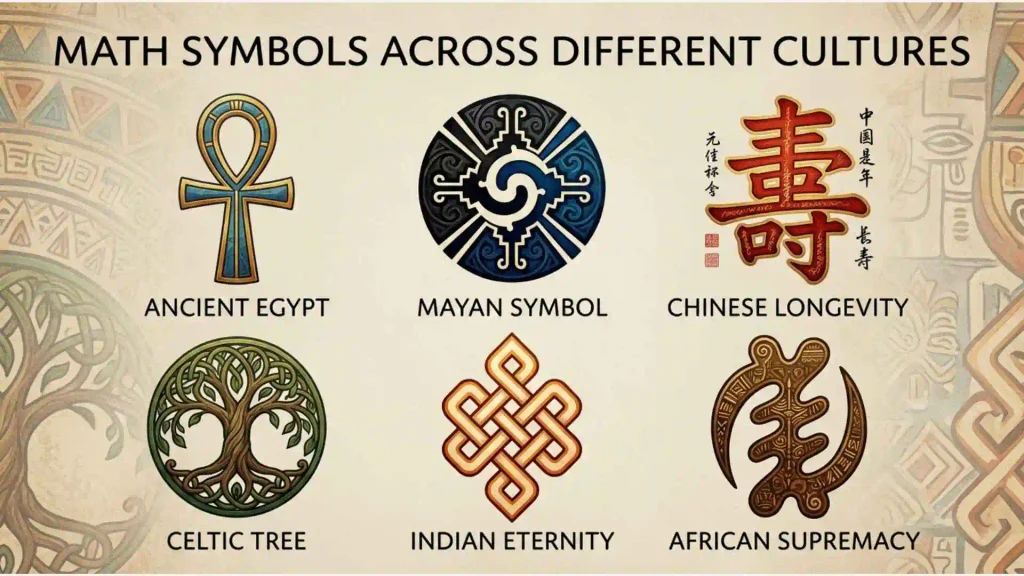
Ancient Egypt
Ancient Egyptians used mathematics for:
- Architecture
- Land measurement
- Astronomy
- Engineering
Their mathematical systems helped create structures like the pyramids of Giza. Numbers and measurements were closely connected with cosmic order.
Ancient Greece
Greek mathematicians transformed mathematics into a structured discipline.
Important contributions include:
- Geometry
- Mathematical proofs
- Number theory
- Logical reasoning
Greek thinkers viewed mathematics as a path toward understanding reality.
Roman Culture
Romans used numerical systems such as Roman numerals:
- I
- V
- X
- L
- C
- D
- M
Although Roman numerals are less practical for modern calculations, they remain important in clocks, history, and architecture.
Eastern Traditions
Indian mathematicians made groundbreaking contributions, especially the concept of zero and the decimal system.
Mathematical ideas from India traveled through Arabic scholars and influenced global mathematics.
Chinese mathematics also developed advanced methods for solving equations and measuring quantities.
Indigenous Traditions
Many Indigenous cultures used mathematical thinking through:
- Astronomy
- Architecture
- Calendars
- Natural observations
Mathematics was often connected with understanding nature and community life.
Modern Interpretations
Today, mathematical symbols represent:
- Innovation
- Scientific progress
- Technology
- Human intelligence
They appear everywhere from smartphones to space exploration.
Similar Symbols and Their Meanings
| Symbol | Meaning | Similar Concept | Difference |
| = | Equality | Balance | Shows exact value relationship |
| ≈ | Approximately equal | Similarity | Shows close but not exact value |
| ∞ | Infinity | Eternity | Represents endlessness |
| π | Circle ratio | Geometry | Represents a specific mathematical constant |
| √ | Root | Discovery | Finds hidden numerical relationships |
Math Symbols in Mythology and Folklore
Although mathematical symbols themselves are modern inventions, numbers have appeared in mythology for centuries.
Sacred Numbers
Many cultures considered certain numbers meaningful:
- Three often represented completeness.
- Seven appeared in religious and mythological traditions.
- Twelve represented cycles, such as months and zodiac signs.
Ancient philosophers believed numbers contained deeper truths about existence.
Pythagorean Beliefs
The followers of Pythagoras believed numbers were the foundation of reality. They connected mathematical relationships with music, nature, and cosmic harmony.
Math Symbols in Art, Literature, Movies, and Pop Culture
Mathematical symbols appear widely in creative fields.
Art
Artists use:
- Geometric patterns
- Symmetry
- Mathematical proportions
The Golden Ratio has influenced architecture and visual design.
Literature
Writers use mathematical ideas as metaphors for:
- Logic
- Mystery
- Infinite possibilities
Movies and Television
Mathematical symbols often represent:
- Intelligence
- Scientific discovery
- Future technology
They appear in stories about artificial intelligence, space exploration, and problem-solving.
Tattoos and Fashion
People choose mathematical symbols as personal expressions.
Popular choices include:
- Infinity symbols for eternal connections
- Pi symbols for curiosity
- Equations representing intelligence or creativity
Spiritual and Dream Meaning of Math Symbols
Dreams involving mathematical symbols may represent:
- Searching for answers
- Finding balance
- Solving personal challenges
- Understanding life patterns
Seeing an equation in a dream may symbolize a problem that needs resolution. An infinity symbol may represent endless opportunities or personal growth.
In meditation and spiritual practices, geometric patterns are sometimes used to encourage focus and awareness.
Positive and Negative Meanings of Math Symbols
| Positive Meaning | Negative Meaning |
| Order | Rigidity |
| Intelligence | Overthinking |
| Balance | Fear of mistakes |
| Discovery | Complexity |
| Infinite possibilities | Feeling overwhelmed |
A symbol can represent different ideas depending on personal experiences and cultural context.
Why Humans Are Attracted to Math Symbols
Humans are naturally drawn to symbols because they simplify complicated ideas.
Mathematical symbols attract people because they represent:
- Knowledge
- Discovery
- Hidden patterns
- Human creativity
- Universal truth
A single symbol can communicate an idea that would require many sentences to explain.
Mathematics also gives people a feeling of control. In a world full of uncertainty, equations and patterns provide structure.
Modern Uses of Math Symbols
Tattoos
Mathematical symbols are popular because they combine beauty with personal meaning.
Examples include:
- Infinity symbols for relationships
- Pi symbols for passion toward learning
- Equations representing important life moments
Jewelry
Infinity necklaces and geometric designs often symbolize:
- Love
- Connection
- Continuity
Branding
Technology companies frequently use mathematical ideas to communicate:
- Innovation
- Intelligence
- Precision
Social Media
Symbols are used in usernames, designs, captions, and digital communication.
Home Decor
Geometric mathematical patterns are popular in modern interior design because they create visual balance.
Interesting Facts About Math Symbols
- The equal sign (=) was created because Robert Recorde wanted a simple way to avoid repeatedly writing “is equal to.”
- The infinity symbol (∞) comes from the Latin word “infinitas,” meaning unlimited.
- The pi symbol (π) was introduced in mathematics in the 18th century.
- Zero, one of the most important mathematical concepts, was developed significantly through ancient Indian mathematics.
- The plus and minus signs became widely used in Europe during the Renaissance period.
- Mathematical symbols allow scientists from different countries to communicate without translating entire languages.
- The Golden Ratio has influenced famous artworks, architecture, and design.
Frequently Asked Questions
What is the meaning of math symbols?
Math symbols are signs used to represent mathematical ideas, operations, relationships, and values in a simple visual form.
Why are mathematical symbols important?
Mathematical symbols make complex ideas easier to communicate and help people solve problems in science, technology, and everyday life.
What is the most famous mathematical symbol?
The equal sign (=), infinity symbol (∞), and pi symbol (π) are among the most recognized mathematical symbols worldwide.
Do math symbols have spiritual meanings?
Yes. Many people connect mathematical symbols with ideas such as balance, harmony, infinity, and the hidden patterns of the universe.
Who invented mathematical symbols?
No single person invented all mathematical symbols. They developed gradually through contributions from civilizations including Egypt, Greece, India, China, and Europe.
Conclusion
Math symbols meaning reveals that these simple marks represent much more than calculations. They tell the story of human curiosity, creativity, and the search for understanding. From ancient civilizations studying the stars to modern scientists exploring the universe, mathematical symbols remain a powerful language of discovery. These symbols connect logic with imagination and remind us that patterns exist everywhere around us.
 Sarah Thompson
 John Mercer