
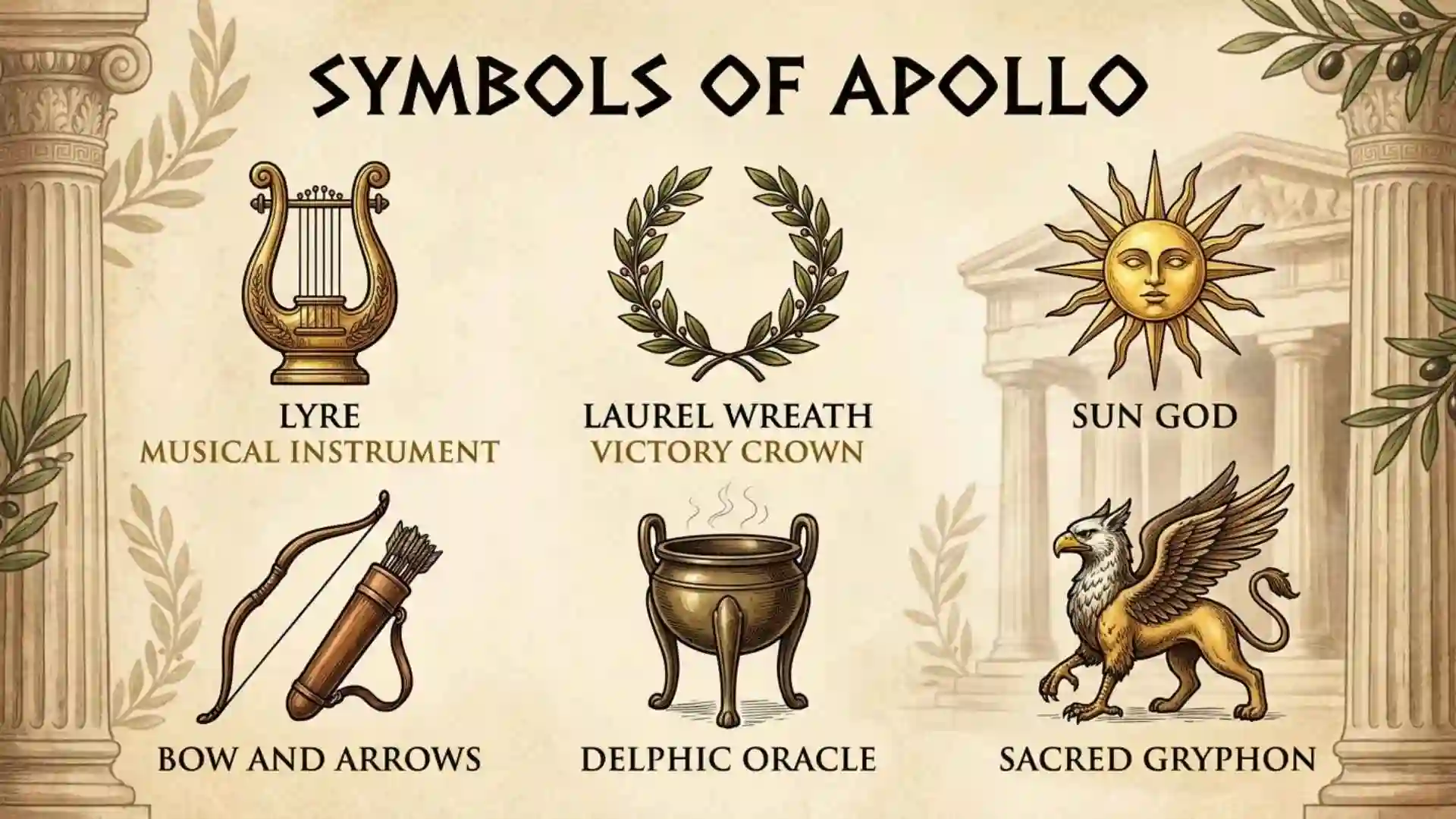
The symbols of Apollo reveal the fascinating world of ancient Greek mythology and the many powers associated with one of its most celebrated gods. Apollo was the Greek god of light, music, prophecy, healing, poetry, and archery. His most recognizable symbols include the sun, lyre, laurel wreath, bow and arrows, raven, and tripod. Each emblem represents a different part of his divine identity, reflecting qualities such as wisdom, artistic inspiration, truth, victory, and protection.
In Greek mythology, Apollo was the son of Zeus and Leto and the twin brother of Artemis. He was closely connected with the Oracle of Delphi, where his prophetic power influenced kings, warriors, and ordinary people seeking guidance. His lyre represented music and harmony, while the laurel wreath symbolized victory and honor. Other symbols, including the swan, wolf, python, and golden arrows, reveal additional stories about his relationships with nature, healing, prophecy, and divine power.
Understanding the symbols of Apollo helps you explore more than just their visual meanings. Each object and animal connects to ancient myths, religious traditions, artistic representations, and cultural beliefs. In this guide, you will discover Apollo’s most important symbols, their hidden meanings, mythological origins, and spiritual significance. Whether you are interested in Greek mythology, ancient art, symbolism, or the stories of the Olympian gods, these symbols offer a deeper look into Apollo’s timeless legacy.
Quick Answer
The main symbols of Apollo are the lyre, laurel wreath, bow and arrows, sun, raven, swan, dolphin, python, tripod, and omphalos stone. Together, they represent music, prophecy, healing, intellectual clarity, discipline, divine punishment, artistic inspiration, and the human search for truth.
Quick Facts About Symbols of Apollo
| Aspect | Information |
| Origin | Ancient Greek religion and mythology |
| Historical Significance | Connected with Delphi, prophecy, music, healing, poetry, and civic order |
| Main Meaning | Light, truth, harmony, reason, creativity, and divine knowledge |
| Spiritual Meaning | Inner clarity, purification, healing, and guidance |
| Cultural Importance | Influenced Greek worship, Roman religion, Renaissance art, literature, and philosophy |
| Modern Usage | Tattoos, jewelry, logos, fashion, music, literature, film, and spiritual symbolism |
What Are the Symbols of Apollo?
The symbols of Apollo are sacred objects, animals, plants, and natural forces associated with Apollo, one of the most important gods in ancient Greek religion. He was the son of Zeus and Leto and the twin brother of Artemis, goddess of the hunt.
Apollo ruled over several areas that may seem unrelated at first. He was the god of music, poetry, prophecy, healing, archery, purification, and youthful beauty. He could protect people from disease, yet some myths also describe him sending plague through his arrows.
His most famous sanctuary stood at Delphi, where the Pythia delivered prophecies believed to come from Apollo. The site became a major spiritual, political, and cultural center in the ancient Mediterranean world.
Apollo’s symbols developed through mythology, worship, public festivals, sculpture, pottery, coins, and poetry. Each image expressed one part of his personality. The lyre represented harmony, while the bow showed distance, precision, and punishment. The laurel marked victory and purification, while the tripod represented prophecy.
Over time, these symbols became larger ideas. They came to represent the disciplined mind, inspired creativity, moral order, and the difficult search for self-knowledge.
Deep Symbolic Meaning of the Symbols of Apollo
Spiritual Meaning
On a spiritual level, the symbols of Apollo represent illumination. This is not only physical sunlight. It is the light of awareness that reveals what was hidden.
Apollo’s association with prophecy suggests that true vision requires more than guessing the future. It requires honesty, purification, and the courage to face uncomfortable truths.
The laurel wreath symbolizes spiritual achievement after struggle. The tripod suggests a sacred connection between the human and divine worlds. The lyre represents the harmony that becomes possible when emotions, thoughts, and actions work together.
Apollo’s symbols also remind us that healing and truth can be painful. Just as sunlight exposes both beauty and decay, spiritual insight may reveal weaknesses that must be understood before growth can begin.
Psychological Meaning
Psychologically, Apollo often represents reason, self-control, structure, and focused consciousness. In discussions influenced by Carl Jung, Apollonian qualities are associated with order, clarity, restraint, and the shaping of chaos into meaningful form.
The bow reflects concentration. An archer must become still before releasing the arrow. This makes it a powerful image for intention, decision-making, and emotional discipline.
The lyre represents balance between different inner forces. Separate strings produce different sounds, yet harmony appears when they are tuned correctly. In human life, this can symbolize balancing ambition with compassion, logic with emotion, and individuality with community.
Apollo also has a shadow side. Too much control can become coldness, pride, perfectionism, or emotional distance. His myths warn that intelligence without humility may lead to cruelty.
Cultural Meaning
In ancient Greek culture, Apollo’s symbols stood for civilized order. Music, poetry, athletic discipline, prophecy, and law were not viewed as separate parts of life. Together, they helped create a well-ordered person and society.
The laurel crown honored poets, athletes, generals, and respected leaders. The lyre connected artistic performance with education and moral character. Delphi offered religious guidance that could influence personal choices and political decisions.
Apollo therefore became more than a mythological figure. He represented the cultural belief that beauty, truth, discipline, and knowledge should support one another.
Types and Variations of the Symbols of Apollo
The Lyre
The lyre is a small stringed instrument with two curved arms joined by a crossbar. According to myth, Hermes invented it and later gave it to Apollo.
It represents music, poetry, harmony, education, and artistic inspiration. Apollo’s lyre appears in Greek vase paintings, Roman sculpture, Renaissance art, poetry, logos, and musical designs.
Its deeper symbolism comes from creating order out of separate tones. It suggests that beauty is not accidental. It grows from practice, proportion, and careful attention.
The Laurel Wreath
The laurel wreath is made from the leaves of the bay laurel tree. Its connection with Apollo comes from the myth of Daphne, a nymph who was transformed into a laurel tree while escaping his pursuit.
Apollo declared the laurel sacred and wore its leaves as a crown. Because of this story, the wreath can represent love, loss, transformation, poetic achievement, purification, and victory.
Laurel crowns later became honors for poets, rulers, athletes, and military leaders. The word “laureate” still reflects this tradition.
The Bow and Arrows
Apollo’s bow is usually shown as elegant and powerful. His arrows could destroy enemies, punish arrogance, or spread disease.
The bow symbolizes precision, distance, intention, authority, and sudden judgment. Unlike a sword, which requires close combat, an arrow reaches its target from far away. This reflects Apollo’s mysterious ability to influence events without being physically present.
Spiritually, the arrow can represent a focused goal or truth moving directly toward its destination.
The Sun and Rays of Light
Apollo is widely associated with the sun, although the earlier Greek sun god was Helios. In later Greek and Roman traditions, Apollo increasingly absorbed solar qualities.
The sun represents truth, consciousness, vitality, beauty, and intellectual illumination. In art, Apollo may appear with a radiant crown or golden halo.
Modern interpretations often treat sunlight as Apollo’s central symbol because it captures his role as a revealer of truth and enemy of darkness.
The Raven
The raven was sacred to Apollo because of its intelligence and association with messages. One myth says the raven originally had white feathers but was turned black after bringing Apollo painful news.
This bird represents prophecy, observation, communication, hidden knowledge, and the consequences of truth. It also shows that messengers may be blamed for messages people do not wish to hear.
The Swan
The swan represents grace, music, beauty, purity, and poetic inspiration. Ancient writers connected swans with sacred song and with Apollo’s mythical northern land, Hyperborea.
Its white feathers reflect light, while its movement across water suggests emotional calm. In later symbolism, the swan became linked with the “swan song,” a final beautiful expression before death.
The Dolphin
Apollo was worshipped under the title Delphinios, which may connect him with dolphins and sea travel. In the Homeric Hymn to Apollo, he takes the form of a dolphin while guiding Cretan sailors to Delphi.
The dolphin symbolizes guidance, protection, transformation, and safe passage. It also represents Apollo’s ability to lead people toward sacred knowledge.
The Python
Python was the serpent or dragon associated with the ancient sacred site at Delphi. Apollo killed Python and established his oracle there.
The serpent represents ancient earth power, danger, instinct, and hidden wisdom. Apollo’s victory symbolizes the replacement or transformation of older religious forces by a new divine order.
However, Python should not be seen only as evil. The story also suggests that new systems often rise by absorbing the sacred power of what came before.
The Tripod
The Delphic tripod was the sacred seat on which the Pythia delivered oracles. It usually had three legs and was placed near the center of Apollo’s sanctuary.
The tripod represents prophecy, spiritual authority, divine communication, and stability. Its three supports can also suggest balance among body, mind, and spirit, although this is mainly a modern interpretation.
The Omphalos Stone
The omphalos was a sacred stone at Delphi whose name means “navel.” Greeks believed Delphi marked the center of the world.
It symbolizes sacred geography, cosmic balance, identity, and connection between heaven and earth. Psychologically, it can represent finding one’s inner center.
Symbols of Apollo Across Different Cultures
Ancient Greece
In Greece, Apollo’s symbols were directly tied to worship. Laurel branches were used in purification, lyres accompanied poetry, and the Delphic tripod represented divine prophecy. His imagery supported ideals of education, athletic discipline, musical skill, and civic order.
Ancient Egypt
Apollo was sometimes compared with Egyptian solar deities, especially Horus and Ra, by later Greek writers. These gods were not identical, but they shared connections with light, kingship, vision, and cosmic order.
In Greco-Egyptian culture, religious ideas often blended. Apollo’s solar imagery could be understood alongside Egyptian beliefs about divine light and protection.
Roman Culture
The Romans adopted Apollo with relatively little change to his name or identity. Emperor Augustus strongly promoted Apollo after his victory at Actium in 31 BCE.
In Roman culture, Apollo’s lyre, laurel, sun imagery, and bow became symbols of imperial order, artistic achievement, healing, and political legitimacy.
Eastern Traditions
There is no exact Eastern equivalent of Apollo. Still, his symbols can be compared with broader ideas found in Hindu and Buddhist traditions, such as sacred sound, enlightened awareness, disciplined practice, and healing knowledge.
These are symbolic parallels rather than direct historical identities. Apollo should not be treated as the same figure as Surya, Saraswati, or any Buddhist deity.
Indigenous Traditions
Many Indigenous cultures honor the sun, sacred music, healing plants, birds, and visions. However, these traditions have their own meanings and should not be reduced to Greek mythology.
Modern comparisons can highlight shared human experiences, but respectful interpretation must preserve cultural differences.
Modern Interpretations
Today, Apollo often represents creative confidence, masculine beauty, rational thought, personal excellence, and intellectual light. His symbols appear in psychology, space exploration, universities, theaters, medical organizations, tattoos, and fashion.
Similar Symbols and Their Meanings
| Apollo Symbol | Related Symbol | Similarity | Key Difference |
| Sun | Helios’ solar chariot | Both represent light | Helios originally personified the physical sun |
| Lyre | Orpheus’ lyre | Both represent music | Orpheus emphasizes emotional and magical music |
| Bow | Artemis’ bow | Both show precision | Apollo’s bow often carries prophecy and punishment |
| Laurel | Olive wreath | Both honor achievement | Laurel is especially linked with Apollo and poetry |
| Raven | Owl of Athena | Both symbolize knowledge | Raven suggests prophecy, while the owl suggests wisdom |
| Python | Serpent of Asclepius | Both involve snakes | Python represents conquered sacred power, while Asclepius’ serpent represents healing |
A common misconception is that Apollo was always the original sun god. Helios held that role in early Greek mythology, while Apollo gained stronger solar associations in later periods.
Symbols of Apollo in Mythology and Folklore
Apollo’s myths explain why his symbols carry both beauty and danger. His lyre expresses divine music, but his bow brings plague to the Greek camp in Homer’s Iliad. His laurel crown honors Daphne, yet it also preserves the memory of rejected desire.
At Delphi, Apollo defeats Python and claims the oracle. He then establishes the Pythian Games, which included musical and athletic contests. These stories joined prophecy, competition, religion, and artistic excellence.
Another myth tells of Marsyas, who challenged Apollo to a musical contest. Apollo won and punished him severely. The tale warns against pride, but it also reveals the darker side of power and perfection.
Symbols of Apollo in Art, Literature, Movies, and Pop Culture
Ancient artists often showed Apollo as a youthful, beardless man holding a lyre or bow. Classical sculptures emphasized ideal physical proportions, calm expression, and controlled movement.
Renaissance and Neoclassical artists used Apollo to represent poetry, artistic genius, sunlight, and reason. Writers later used the contrast between Apollo and Dionysus to explore order versus ecstasy, restraint versus emotion, and form versus instinct.
In modern films, novels, television series, and video games, Apollo may appear as a radiant archer, musician, healer, or proud divine figure. His laurel, golden light, and bow make him easy to recognize.
Apollo-inspired tattoos commonly combine the god’s face with sun rays, laurel leaves, musical instruments, snakes, or Greek temple designs. These images may express discipline, creativity, healing, ambition, or the pursuit of truth.
Spiritual and Dream Meaning of the Symbols of Apollo
Dreaming of Apollo or his symbols may suggest a need for clarity, confidence, creative expression, or disciplined action. A bright sun may represent awakening, while a lyre may point to emotional harmony or an ignored artistic gift.
A bow and arrow can symbolize a goal that requires concentration. A laurel wreath may reflect recognition, personal success, or a desire for approval.
A raven may bring an uncomfortable truth. A python may represent buried fear, instinct, or old wisdom that must be faced rather than avoided.
Dream meanings are personal, not fixed predictions. The strongest interpretation usually comes from your emotions, experiences, and current life situation.
Positive and Negative Meanings of the Symbols of Apollo
| Positive Meaning | Negative Meaning |
| Truth and clarity | Harsh judgment |
| Healing and purification | Disease and punishment |
| Music and creativity | Pride in talent |
| Self-control | Emotional coldness |
| Prophecy and wisdom | Fear of the future |
| Beauty and harmony | Obsession with perfection |
| Achievement | Arrogance |
| Focus and precision | Ruthlessness |
Apollo’s symbolism includes both light and shadow because clarity can heal or expose, discipline can strengthen or restrict, and power can protect or punish.
Why Humans Are Attracted to the Symbols of Apollo
People are naturally drawn to light, music, beauty, and clear patterns. These things help the mind feel safe and connected.
Apollo’s symbols promise that chaos can be shaped into order. The lyre turns separate sounds into music. The bow transforms stillness into action. The sun reveals what darkness hides.
His imagery also speaks to the human desire to become better. We want to understand ourselves, master our talents, heal our wounds, and receive recognition for our efforts.
Yet Apollo remains fascinating because he is not purely gentle. His myths remind us that perfection has a cost and that truth must be balanced with compassion.
Modern Uses of the Symbols of Apollo
Apollo’s symbols are used in tattoos to express creativity, strength, discipline, and enlightenment. Laurel wreaths appear in university seals, awards, logos, and graduation designs.
The lyre remains a symbol of music, poetry, theater, and cultural education. Sun imagery appears in jewelry, clothing, home decor, spiritual artwork, and personal branding.
Apollo’s name is also associated with scientific ambition and exploration. NASA’s Apollo program used the god’s name for missions that carried humans to the Moon, linking ancient symbolism with modern discovery.
On social media, Apollo-inspired imagery often communicates confidence, artistic identity, intellectual power, or classical beauty.
Interesting Facts About the Symbols of Apollo
- Apollo’s association with the sun became stronger over time, while Helios was the earlier personification of the sun.
- The laurel connection comes from Daphne, whose transformation turned a tragic story into a lasting symbol of honor.
- The Pythia at Delphi delivered Apollo’s prophecies while seated on a sacred tripod.
- The word “Pythian” comes from Python, the serpent Apollo defeated at Delphi.
- Ravens were connected with Apollo as prophetic messengers and symbols of difficult truth.
- The dolphin appears in Apollo’s mythology as a guiding form that leads sailors toward his sanctuary.
- Apollo could cause illness with his arrows, but he was also worshipped as a healer.
- His son Asclepius became one of the most important healing figures in Greek religion.
- Laurel wreaths later inspired the words “laureate” and “baccalaureate.”
- The Apollo space program gave an ancient divine name to one of humanity’s greatest scientific achievements.
Frequently Asked Questions
What is Apollo’s most important symbol?
The lyre is often considered Apollo’s most recognizable symbol because it represents music, harmony, poetry, education, and civilized order.
Why is the laurel sacred to Apollo?
The laurel became sacred after Daphne was transformed into a laurel tree. Apollo adopted its leaves as a lasting symbol of love, loss, victory, and poetic honor.
Is the sun really a symbol of Apollo?
Yes, especially in later Greek and Roman traditions. However, Helios was the earlier Greek god who directly personified the physical sun.
What animal represents Apollo?
Several animals represent Apollo, including the raven, swan, dolphin, wolf, and snake. Each reflects a different aspect of prophecy, music, guidance, protection, or transformation.
What do Apollo’s bow and arrows symbolize?
They symbolize precision, focused intention, divine authority, punishment, disease, protection, and the power to influence events from a distance.
What do the symbols of Apollo mean spiritually?
Spiritually, they represent illumination, healing, purification, creative awakening, disciplined action, self-knowledge, and the search for divine truth.
Conclusion
The symbols of Apollo reveal a god whose power reaches far beyond sunlight and music.
His lyre, bow, laurel, raven, tripod, and sacred animals express both harmony and danger.
Together, they show that truth requires courage, creativity requires discipline, and healing often begins with honest self-awareness.
Apollo’s lasting message is that real light does not hide life’s shadows. It helps us understand them.
 Michael Rivera
 John Mercer