
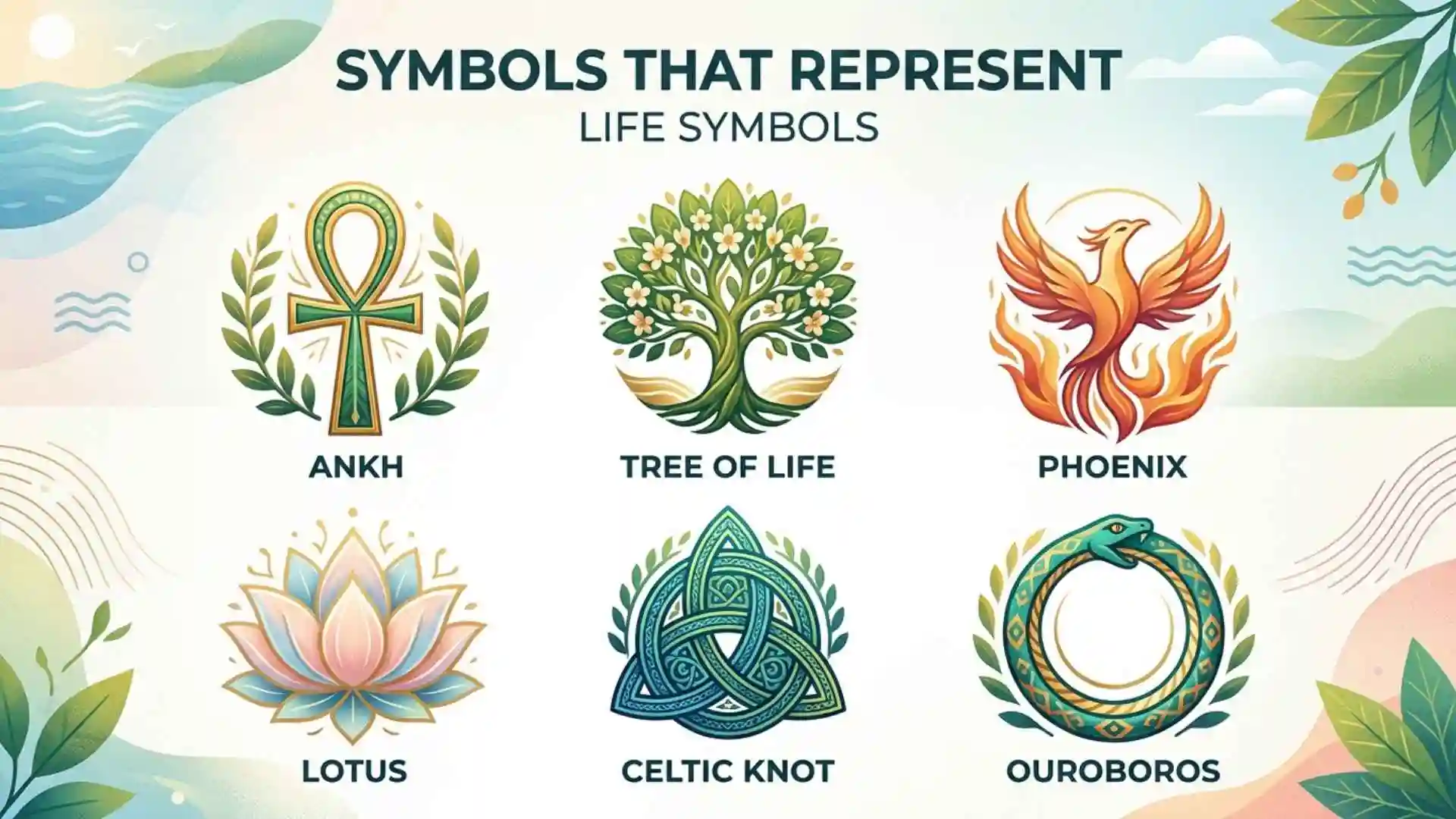
Symbols have a unique way of expressing ideas, emotions, beliefs, and messages without using words. From ancient cultural emblems to modern signs, each symbol can carry meanings that connect with human experiences, traditions, and values. A heart may represent love, a dove can symbolize peace, and a phoenix often stands for rebirth and transformation. These visual representations help people communicate powerful ideas through simple yet meaningful images.
Throughout history, different civilizations have used symbols to represent emotions, spiritual beliefs, personal qualities, and important life experiences. Some symbols express strength, courage, freedom, hope, and wisdom, while others represent fear, death, healing, protection, loyalty, and new beginnings. Their meanings can vary across cultures, religions, historical periods, and personal experiences. Understanding these differences reveals why certain symbols remain meaningful across generations.
In this complete guide, you will discover symbols that represent powerful ideas, emotions, and hidden meanings from different cultures and traditions. Explore their origins, historical backgrounds, spiritual associations, and modern interpretations. Whether you are searching for a meaningful tattoo, exploring cultural symbolism, studying ancient traditions, or simply curious about what different images represent, this guide will help you understand the deeper messages behind these fascinating symbols.
Quick Answer
Symbols that represent ideas are visual forms, objects, animals, colors, gestures, or patterns used to communicate meanings beyond their physical appearance. A dove may represent peace, a lion can symbolize courage, and a tree often represents life, growth, ancestry, or spiritual connection.
Quick Facts About Symbols That Represent Ideas
| Aspect | Information |
| Origin | Prehistoric art, ritual objects, natural observation, gestures, and early writing systems |
| Historical Significance | Symbols preserved religious beliefs, political authority, identity, knowledge, and cultural traditions |
| Main Meaning | They communicate emotions, values, ideas, warnings, beliefs, and relationships |
| Spiritual Meaning | Symbols may represent the soul, divine presence, enlightenment, protection, rebirth, or transformation |
| Cultural Importance | They connect communities through shared stories, customs, ceremonies, and collective identity |
| Modern Usage | Tattoos, logos, jewelry, fashion, social media, architecture, art, films, and personal expression |
What Are Symbols That Represent Ideas?
Symbols that represent ideas are signs that carry meanings beyond what they physically show. A flame is simply burning fire, but symbolically it may represent passion, knowledge, purification, danger, or spiritual presence.
Some symbols are icons, meaning they resemble the thing they represent. A drawing of a tree looks like a real tree. Others are ideograms, which communicate an entire idea rather than a single sound or object. Research on visual communication describes ideograms as symbols that express concepts simply and make complex ideas easier to understand.
The earliest symbolic expressions appear in prehistoric cave paintings, carved stones, burial objects, handprints, and animal figures. These images probably served several purposes, including storytelling, ritual practice, identity, teaching, and communication.
As civilizations developed, symbols became more organized. Ancient Egyptians used hieroglyphs. Greek and Roman societies connected animals, plants, and objects with gods and moral qualities. Religious traditions created crosses, wheels, stars, crescents, sacred letters, and geometric patterns.
Today, symbols continue to evolve. A heart appears in romantic messages, a raised fist communicates resistance, and a recycling symbol encourages environmental responsibility. Digital icons now help people recognize tools, files, actions, and functions, although many technology icons do not have one universal standard.
Deep Symbolic Meaning of Symbols That Represent Human Experience
Spiritual Level
On a spiritual level, symbols help people explore realities that cannot easily be seen or measured.
Light may represent divine wisdom. Water can symbolize purification, emotional renewal, or spiritual rebirth. A mountain may stand for a difficult path toward enlightenment. The circle often represents eternity because it has no visible beginning or ending.
Sacred symbols also provide focus during prayer, meditation, ritual, and reflection. Their power does not always come from the shape alone. It comes from the stories, beliefs, and personal experiences connected to it.
A lotus, for example, grows from muddy water yet rises above the surface in beauty. For many people, it becomes a meaningful image of spiritual awakening, resilience, and inner transformation.
Psychological Level
Psychologically, symbols allow the human mind to turn difficult emotions into recognizable images.
A storm may represent inner conflict. A locked door can express fear, secrecy, or emotional distance. A bridge may symbolize transition, reconciliation, or movement from one stage of life to another.
Swiss psychiatrist Carl Jung believed that some symbolic patterns appear repeatedly because humans share deep psychological structures called archetypes. Figures such as the hero, shadow, wise elder, mother, child, and trickster appear in myths and stories across different cultures.
Symbols can also hold private meaning. A seashell may remind one person of childhood safety, while it may remind another person of grief or separation. Therefore, symbolic interpretation depends on both collective tradition and individual memory.
Cultural Level
Cultures use symbols to protect identity and pass knowledge from one generation to the next.
Flags represent nations. Wedding rings symbolize commitment. Family crests communicate ancestry. Traditional clothing patterns may identify a tribe, region, profession, belief system, or social role.
However, symbolic meaning can change across communities. White is linked with weddings and purity in many Western societies, but it may be associated with mourning in parts of Asia. An owl can symbolize wisdom in one tradition and death or warning in another.
This is why symbols should be interpreted with cultural context rather than treated as having one fixed meaning.
Types and Variations of Symbols That Represent Meaning
The Heart
Visual description: A rounded shape with two upper curves and a pointed base.
Meaning and symbolism: Love, affection, emotional life, compassion, romance, and connection.
Cultural connection: The heart is one of the most recognized emotional symbols in modern culture. It appears in religious art, romantic cards, jewelry, poetry, tattoos, and digital messages.
Although its exact visual origin remains debated, the heart became strongly associated with emotional and romantic love through European art and literature.
The Dove
Visual description: A small white or pale bird, sometimes carrying an olive branch.
Meaning and symbolism: Peace, innocence, hope, reconciliation, purity, freedom, and divine presence.
Cultural connection: The dove appears in Jewish, Christian, classical, political, and artistic traditions. In modern imagery, a dove carrying an olive branch is widely recognized as a peace symbol.
The Lion
Visual description: A powerful large cat, often shown with a full mane.
Meaning and symbolism: Courage, leadership, strength, authority, royalty, protection, and pride.
Cultural connection: Lions appear in ancient Egyptian art, Greek mythology, biblical stories, royal crests, national emblems, and modern sports branding.
The Tree
Visual description: A trunk with roots, branches, and leaves.
Meaning and symbolism: Life, family, stability, wisdom, growth, fertility, ancestry, and connection between worlds.
Cultural connection: Sacred trees appear in Norse mythology, Buddhism, Christianity, Celtic traditions, Indigenous worldviews, and many creation stories.
The Butterfly
Visual description: A winged insect with a delicate and often colorful pattern.
Meaning and symbolism: Transformation, freedom, rebirth, beauty, the soul, and personal growth.
Cultural connection: Its development from caterpillar to chrysalis to butterfly makes it a natural symbol of profound change.
The Circle
Visual description: A continuous curved line with no beginning or end.
Meaning and symbolism: Wholeness, unity, eternity, perfection, cycles, protection, and balance.
Cultural connection: Circles appear in wedding rings, halos, mandalas, sacred architecture, celestial diagrams, and ritual spaces.
The Phoenix
Visual description: A magnificent bird rising from fire or ashes.
Meaning and symbolism: Rebirth, renewal, survival, immortality, and recovery after destruction.
Cultural connection: Phoenix-like birds appear in Greek, Roman, Egyptian, Persian, and later Christian traditions.
The Anchor
Visual description: A heavy metal object with curved arms used to secure ships.
Meaning and symbolism: Stability, hope, loyalty, grounding, safety, and strength during difficulty.
Cultural connection: Anchors appear in maritime traditions, Christian art, military insignia, tattoos, and jewelry.
Symbols That Represent Ideas Across Different Cultures
Ancient Egypt
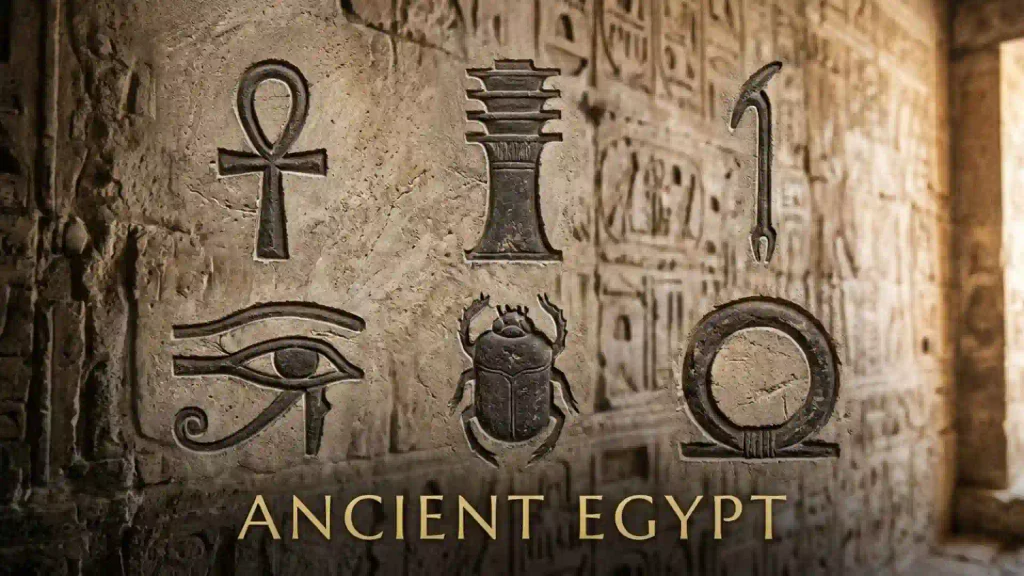
Ancient Egyptians filled temples, tombs, jewelry, and manuscripts with symbols.
The ankh represented life and continued existence. The scarab beetle symbolized renewal and the rising sun. The Eye of Horus represented healing, protection, and restored order.
These symbols were not simple decorations. They were connected to religious beliefs about divine power, kingship, death, and the afterlife.
Ancient Greece
Greek symbols often came from mythology.
The owl of Athena represented wisdom and strategic thought. The laurel wreath symbolized victory, honor, and achievement. The labyrinth became associated with confusion, danger, self-discovery, and the difficult search for truth.
Greek myths helped establish symbolic patterns that still influence books, films, psychology, and Western art.
Roman Culture
Romans adopted many Greek symbols but adapted them to Roman politics, warfare, and social life.
The eagle represented imperial authority, military strength, courage, and victory. The fasces, a bundle of rods surrounding an axe, symbolized political authority and collective power.
Laurel wreaths continued to represent triumph, while household symbols honored ancestors and protective spirits.
Eastern Traditions
In Chinese culture, the dragon traditionally represents power, prosperity, good fortune, and control over natural forces. This differs from many European stories, where dragons often appear as dangerous creatures.
In Buddhism, the lotus represents purity and awakening. The Dharma wheel symbolizes Buddhist teaching and the path toward liberation.
In Hindu traditions, Om represents sacred sound, spiritual reality, and the unity of existence.
Indigenous Traditions
Indigenous symbolism varies widely among nations and should never be treated as one single system.
Animals, natural forces, directions, colors, plants, and geometric patterns may express relationships with land, ancestors, community, spiritual beings, or seasonal cycles.
An eagle may represent spiritual vision or connection with the sacred in some traditions, while a bear may symbolize protection, healing, strength, or leadership. Meanings should be understood through the specific nation and cultural tradition from which they come.
Modern Interpretations
Modern people often combine traditional symbols with personal meanings.
Someone may wear a phoenix tattoo after surviving illness, loss, or emotional hardship. A tree necklace may honor family roots. A semicolon tattoo may represent continuation, survival, and the decision to keep living.
These examples show how old symbols gain new life through individual experience.
Similar Symbols and Their Meanings
| Symbol | Common Meaning | Similar Symbol | Important Difference |
| Heart | Love and affection | Rose | A rose often emphasizes romance, beauty, or passion |
| Dove | Peace and innocence | Olive branch | The olive branch focuses more directly on peace and reconciliation |
| Lion | Courage and authority | Bear | A bear often adds protection, solitude, healing, or endurance |
| Butterfly | Transformation | Phoenix | The phoenix emphasizes rebirth after destruction |
| Tree | Life and growth | Flower | A flower often represents beauty, fragility, emotion, or a life stage |
| Circle | Unity and eternity | Spiral | A spiral suggests movement, development, and an unfolding journey |
| Anchor | Stability and hope | Rock | A rock suggests firmness, endurance, and an unchanging foundation |
A common misconception is that symbols have universal definitions. Some images are widely recognized, but their emotional and cultural meanings still depend on context.
Symbols That Represent Ideas in Mythology and Folklore
Mythology gave many symbols their lasting emotional power.
The phoenix became a picture of life returning after death. The world tree connected heaven, earth, and the underworld in several mythic traditions. The serpent represented healing, wisdom, danger, temptation, renewal, and immortality because it sheds its skin.
The Greek story of Pandora’s box turned the container into a symbol of dangerous curiosity and unintended consequences. The tale of Icarus made wings a symbol of ambition, freedom, pride, and the danger of ignoring limits.
Folklore also shaped everyday beliefs. Horseshoes became signs of protection or luck. Ravens became messengers, omens, or symbols of intelligence. Mirrors represented truth, identity, vanity, portals, or spiritual danger.
These stories continue to influence how modern audiences interpret symbolic images.
Symbols That Represent Meaning in Art, Literature, Movies, and Pop Culture
Artists use symbols to communicate ideas without directly explaining them.
In paintings, light may suggest hope or divine presence. Shadows may represent guilt, fear, secrecy, or death. Wilting flowers can symbolize fading beauty and mortality.
Writers use recurring objects as literary symbols. A road may represent choice. A river may stand for time or change. A cage can symbolize oppression, emotional restriction, or loss of freedom.
Movies use color, weather, costume, architecture, music, and repeated objects to build symbolic meaning. A broken mirror may suggest a damaged identity. A red door might signal danger, desire, secrecy, or transformation.
In tattoos, fashion, and jewelry, people carry symbols directly on their bodies. Common visual symbols include hearts, doves, roses, ravens, trees, and owls.
Spiritual and Dream Meaning of Symbols That Represent Ideas
Dream symbols often reflect emotions, memories, fears, hopes, and current life situations rather than fixed predictions.
A door may represent a new opportunity or an unknown future.
A snake may suggest healing, fear, hidden danger, sexuality, or transformation.
A bird may represent freedom, spiritual longing, escape, or a message.
A house may symbolize the dreamer’s mind, identity, family, or emotional condition.
A bridge may indicate transition, reconciliation, or personal growth.
During meditation, symbolic images can emerge from memory, imagination, belief, or emotional processing. Their meaning should be explored carefully.
Ask what the symbol means to you, how it made you feel, and what was happening around it. Personal context is often more useful than a universal dream dictionary.
Positive and Negative Meanings of Symbols That Represent Ideas
| Symbol | Positive Meaning | Negative Meaning |
| Fire | Passion, warmth, purification, knowledge | Destruction, anger, danger |
| Water | Healing, life, renewal, emotional flow | Chaos, grief, fear, loss of control |
| Snake | Transformation, healing, wisdom | Deception, danger, temptation |
| Moon | Intuition, cycles, mystery, feminine energy | Illusion, uncertainty, emotional instability |
| Crown | Leadership, dignity, achievement | Pride, domination, abuse of power |
| Raven | Intelligence, prophecy, transformation | Death, misfortune, fear |
| Darkness | Rest, mystery, hidden potential | Evil, confusion, isolation |
One symbol can represent both light and shadow because human experience contains both. Fire warms a home but can also destroy it. Water supports life but may become overwhelming. Meaning depends on story, culture, purpose, and emotional context.
Why Humans Are Attracted to Symbols That Represent Meaning
Humans naturally search for patterns. We connect shapes, colors, animals, sounds, and events with ideas because symbols make the world easier to understand.
A symbol compresses a complicated story into one memorable image. A wedding ring expresses commitment. A national flag carries history, identity, sacrifice, conflict, and pride. A memorial poppy can communicate grief and remembrance without a long explanation.
Symbols also create emotional belonging. When a group shares a symbol, members feel connected to something larger than themselves.
Personal symbols provide comfort as well. A person may carry a small object once owned by a loved one. To others, it looks ordinary. To that person, it represents memory, safety, grief, and continuing love.
Modern Uses of Symbols That Represent Ideas
Today, meaningful symbols appear almost everywhere:
- Tattoos: Express identity, healing, loss, belief, or personal transformation.
- Jewelry: Represents love, protection, faith, family, or commitment.
- Fashion: Communicates cultural identity, rebellion, status, or group membership.
- Branding: Creates instant recognition and emotional associations.
- Social media: Emojis express reactions, emotions, objects, and concepts in digital communication.
- Contemporary spirituality: Sacred geometry, crystals, animals, and celestial images support reflection and ritual.
- Home decor: Trees, mandalas, moons, inspirational signs, and protective symbols create emotional atmosphere.
- Personal expression: People combine symbols to create meanings connected to their own experiences.
Because symbols can belong to religious or cultural traditions, they should be used with knowledge and respect. Researching their history helps prevent misunderstanding or cultural misuse.
Interesting Facts About Symbols That Represent Meaning
- The same symbol may have opposite meanings in different cultures.
- Many symbols began as ordinary objects before gaining spiritual or emotional importance.
- Ancient symbols often combined religion, politics, astronomy, and social identity.
- Circles appear in sacred art across many civilizations because they suggest unity and endlessness.
- Animals become symbols partly because people associate their natural behavior with human qualities.
- Flower meanings became especially detailed in nineteenth-century Europe, when bouquets could communicate coded emotional messages.
- Yellow roses are commonly associated with friendship, while poppies often represent remembrance.
- Digital icons are modern symbolic tools that help users navigate technology quickly.
- Symbolic meaning can change after major political, religious, or historical events.
- Personal experience can become more important than traditional meaning when someone chooses a tattoo, gift, or memorial symbol.
Frequently Asked Questions
What are common symbols that represent strength?
Common symbols of strength include the lion, bear, oak tree, mountain, sword, shield, bull, eagle, and thunderbolt. Their meanings may emphasize courage, endurance, protection, authority, or physical power.
What symbols represent hope?
The anchor, sunrise, dove, rainbow, candle, star, butterfly, and lotus commonly represent hope. They often suggest guidance, renewal, survival, peace, or the arrival of better conditions.
What symbols represent love?
The heart, rose, wedding ring, swan, red string, dove, harp, and Celtic love knot can represent love. Their meanings range from romance and passion to loyalty, unity, spiritual connection, and lasting commitment.
Can one symbol have several meanings?
Yes. A symbol may have spiritual, psychological, political, cultural, and personal meanings at the same time. Its interpretation depends on its setting, history, color, tradition, and the person viewing it.
Are symbolic meanings universal?
Some symbols are widely understood, but few meanings are completely universal. Culture, religion, history, and personal experience can greatly change how a symbol is interpreted.
How do I choose a meaningful personal symbol?
Choose an image connected to your values, memories, goals, culture, or life story. Research its historical and cultural meaning before using it in tattoos, jewelry, branding, or spiritual practice.
Conclusion
Symbols that represent human ideas allow us to communicate feelings that words cannot always capture.
They connect ancient history with modern identity, personal memory, spirituality, and shared cultural experience.
Their meanings may change across societies, yet their emotional power remains strong.
A symbol becomes truly meaningful when its history and your own story meet in the same image.
 Sarah Thompson
 John Mercer