
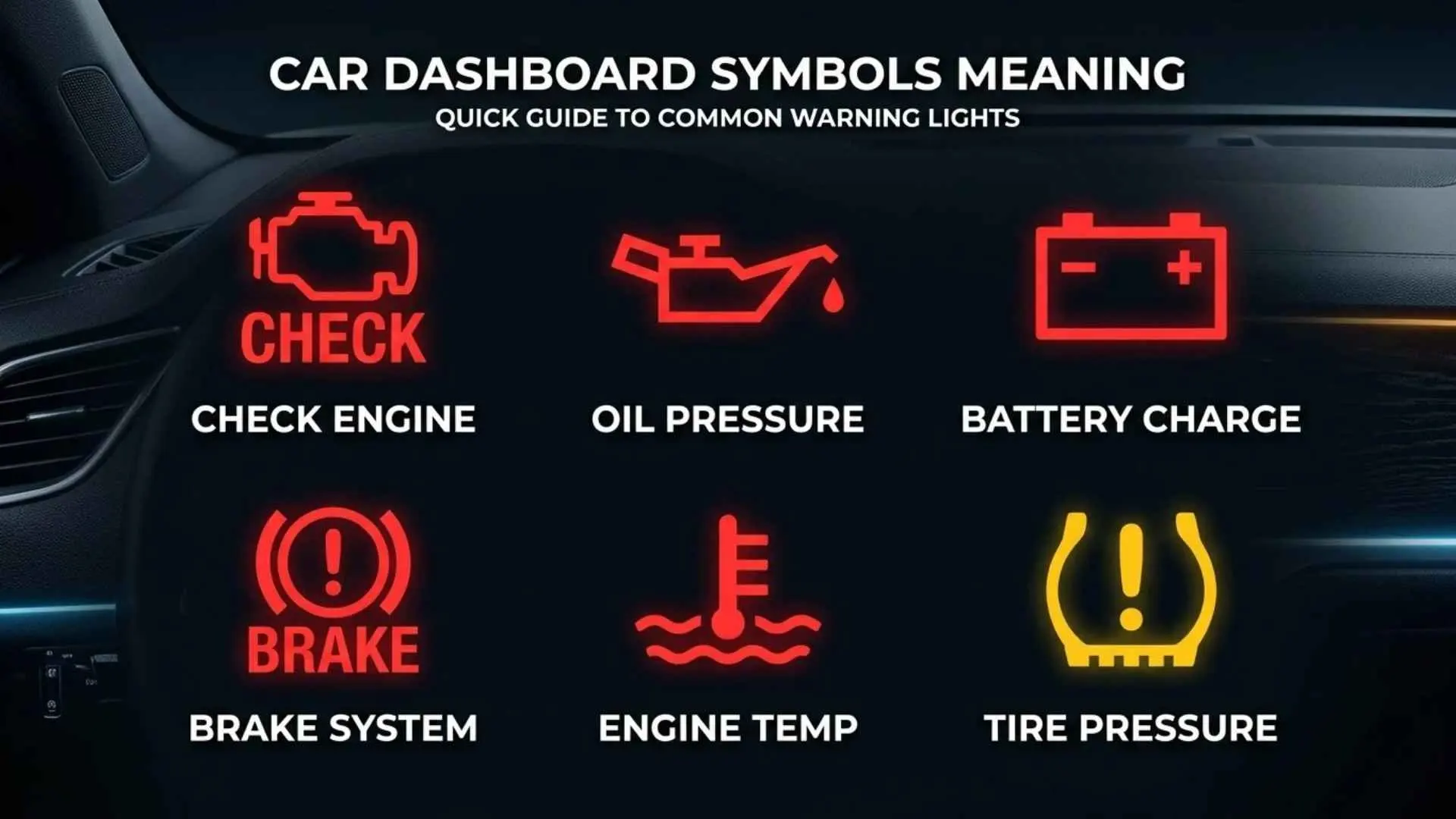
Car dashboard symbols help you understand your vehicle’s condition, identify potential problems, and drive more safely. From the familiar check engine light to the battery warning, oil pressure symbol, and tire pressure indicator, each dashboard light communicates important information about your car. Some symbols simply remind you to perform routine maintenance, while others warn you about problems that need immediate attention. Knowing what these lights mean can help you avoid costly repairs and make smarter decisions on the road.
Understanding car dashboard symbols becomes easier when you know their colors and levels of urgency. Red warning lights often indicate serious problems that require you to stop safely or take immediate action. Yellow or amber lights typically signal a fault that needs investigation, while green and blue indicators usually show that a feature is active. However, the exact meaning can vary by vehicle make, model, and year, so your owner’s manual remains the best source for confirming unfamiliar symbols.
In this complete guide to car dashboard symbols and their meanings, you’ll learn how to recognize common warning lights, understand what triggers them, and know what to do when they appear. We’ll cover engine warnings, brake system alerts, battery problems, tire pressure indicators, temperature warnings, safety system symbols, and helpful dashboard indicators. Whether you drive a Toyota, Honda, Ford, Hyundai, or another vehicle, this guide will help you interpret dashboard warnings and respond with greater confidence.
Quick Answer
Car dashboard symbols are illuminated icons that communicate your vehicle’s condition, active features, maintenance needs, or safety problems. Red symbols usually require immediate attention, yellow or orange lights suggest caution or inspection, and green or blue lights normally show that a system is operating. Exact meanings can vary by manufacturer and model.
Quick Facts About Car Dashboard Symbols Meaning
| Aspect | Information |
| Origin | Early vehicle dashboards used basic gauges and mechanical warning lamps |
| Historical Significance | Symbols made vehicle information easier to understand across different languages |
| Main Meaning | They show warnings, system status, maintenance needs, and active driving features |
| Spiritual Meaning | Not traditionally spiritual, but they can symbolize awareness, caution, control, and responsibility |
| Cultural Importance | Standardized icons help drivers around the world understand vehicle conditions |
| Modern Usage | Used in gasoline, diesel, hybrid, electric, and autonomous-driving systems |
What Are Car Dashboard Symbols?
Car dashboard symbols are visual alerts displayed on the instrument panel, digital cluster, head-up display, or infotainment screen. They represent important systems such as the engine, brakes, battery, tires, airbags, transmission, lights, and driver-assistance technology.
Early automobiles relied mainly on mechanical gauges. Drivers watched separate dials for fuel level, oil pressure, speed, and engine temperature. As vehicles became more complex, manufacturers added warning lamps to alert drivers when a system moved outside its normal operating range.
Over time, dashboard icons became more standardized. A driver may not speak the language used in a vehicle’s manual, but a picture of an oil can, battery, thermometer, or fuel pump can still communicate a basic message.
Modern cars may display dozens of symbols. Some disappear after the engine starts, which is usually part of a normal system check. A light that remains illuminated, flashes, or appears while driving may require attention.
The owner’s manual remains the most reliable source because icon designs and meanings can differ between makes, models, and production years.
Dashboard Warning Light Colors and Their Meaning
Color is often the fastest way to judge the seriousness of a dashboard light.
| Color | General Meaning | Recommended Response |
| Red | Serious warning, safety problem, or immediate action required | Stop safely and investigate |
| Yellow or Orange | Caution, malfunction, or maintenance needed | Drive carefully and arrange inspection |
| Green | A feature or system is active | Usually no action required |
| Blue | A lighting or operating feature is active | Check that its use is appropriate |
| White or Gray | Information, setting, or system status | Review the displayed message |
A red light does not always mean the engine will fail immediately, but it should never be ignored. For example, a red oil pressure light can indicate that critical engine parts are not receiving proper lubrication.
Yellow lights generally allow more time to react. However, a flashing yellow symbol can be more urgent than a steady one. A flashing check engine light may indicate severe misfiring that could damage the catalytic converter.
Most Important Car Dashboard Symbols and Meanings
Check Engine Light
Visual description: An outline shaped like an engine, sometimes accompanied by the words “CHECK ENGINE.”
Meaning: The engine control system has detected a fault involving emissions, ignition, fuel delivery, sensors, or another monitored component.
A steady light usually means the vehicle should be diagnosed soon. A flashing check engine light may indicate an active engine misfire.
What to do: Tighten the fuel cap if it is loose, reduce heavy acceleration, and arrange a diagnostic scan. Stop driving if the engine shakes, loses power, overheats, or produces unusual sounds.
Oil Pressure Warning Light
Visual description: A red oil can with a drop coming from its spout.
Meaning: The engine may have dangerously low oil pressure.
This warning is not merely an oil-change reminder. Low oil pressure can prevent proper lubrication and cause severe engine damage within a short time.
What to do: Pull over safely, switch off the engine, and check the oil level after the engine has cooled. Do not continue driving if the light remains on after adding the correct oil.
Battery or Charging System Light
Visual description: A rectangular battery with positive and negative symbols.
Meaning: The charging system is not supplying power correctly. Possible causes include the alternator, drive belt, battery terminals, wiring, or battery itself.
What to do: Turn off unnecessary electrical equipment and drive to a safe location or repair facility. If steering becomes heavy or the temperature rises, stop immediately because a broken belt may affect other systems.
Engine Temperature Warning
Visual description: A thermometer above wavy lines.
Meaning: The engine coolant temperature is too high.
What to do: Turn off the air conditioner, pull over safely, and shut down the engine. Never remove a hot radiator cap because pressurized coolant can cause severe burns.
Brake System Warning Light
Visual description: An exclamation mark or the word “BRAKE” inside a circle.
Meaning: The parking brake may be engaged, the brake fluid may be low, or the hydraulic braking system may have a fault.
What to do: Confirm that the parking brake is fully released. If the light stays on, or the brake pedal feels soft, stop driving and seek professional help.
Anti-Lock Braking System Light
Visual description: The letters “ABS” inside a circle.
Meaning: The anti-lock braking system has detected a malfunction.
The regular brakes may still work, but the wheels could lock during hard braking. Electronic stability functions may also be limited.
What to do: Drive carefully and have the vehicle inspected promptly.
Tire Pressure Monitoring System Light
Visual description: An exclamation mark inside a tire-shaped outline.
Meaning: One or more tires may be underinflated. A flashing light may indicate a fault in the tire pressure monitoring system.
What to do: Check all tire pressures when the tires are cold. Inflate them to the pressure listed on the driver-side door label, not the maximum number printed on the tire.
Airbag Warning Light
Visual description: A seated person with a circle representing an airbag.
Meaning: The supplemental restraint system may have a problem involving an airbag, seat sensor, wiring connection, or seat-belt pretensioner.
What to do: Arrange an inspection. The airbags may not deploy correctly during a collision.
Seat Belt Reminder
Visual description: A seated person wearing a diagonal belt.
Meaning: The driver or a passenger has not fastened a seat belt. A bag or heavy object placed on a seat can sometimes activate the passenger reminder.
What to do: Fasten all occupied-seat belts and secure loose objects.
Traction Control and Stability Control Light
Visual description: A car with curved skid marks beneath it.
Meaning: A flashing symbol normally means the system is actively helping prevent wheel spin or loss of control. A steady symbol may indicate the system is switched off or has developed a fault.
What to do: Slow down on slippery roads. If the light remains on in dry conditions, have the system checked.
Power Steering Warning
Visual description: A steering wheel, sometimes with an exclamation mark.
Meaning: The hydraulic or electric power steering system may not be assisting normally.
What to do: Grip the steering wheel firmly, reduce speed, and stop safely. Steering may require much greater physical effort.
Transmission Temperature Warning
Visual description: A thermometer inside or near a gear-shaped icon.
Meaning: The transmission fluid or transmission system is overheating.
What to do: Stop safely and allow the vehicle to cool. Towing, steep hills, heavy loads, and low fluid can contribute to overheating.
Low Fuel Warning
Visual description: A fuel pump.
Meaning: The fuel level has reached the reserve range.
A small arrow beside the fuel pump icon often points toward the side of the vehicle where the fuel door is located.
What to do: Refuel soon. Frequently driving with very little fuel can place extra strain on certain fuel-system components.
Diesel Particulate Filter Warning
Visual description: A filter-shaped box with dots or exhaust lines.
Meaning: The diesel particulate filter has accumulated soot and may need regeneration.
What to do: Follow the vehicle manufacturer’s regeneration instructions. Continued neglect may lead to reduced performance or expensive repairs.
Glow Plug Light
Visual description: A yellow coil.
Meaning: In diesel vehicles, the glow plugs are heating the combustion chambers before startup. If the symbol flashes or stays on while driving, a fault may be present.
What to do: Wait for the light to turn off before starting a cold diesel engine. Seek diagnosis if it behaves abnormally.
Electric Vehicle Battery Warning
Visual description: A battery symbol, charging plug, turtle, or reduced-power message.
Meaning: The high-voltage battery may be low, overheated, too cold, or experiencing a system fault.
What to do: Charge the vehicle or follow the displayed instructions. A turtle icon often means that performance has been limited to conserve energy or protect the battery.
Common Information and Lighting Symbols
Not every illuminated dashboard icon signals a malfunction.
High Beam Indicator
A blue headlamp icon with straight lines means the high beams are active. Use them only when they will not blind other drivers.
Low Beam Indicator
A green headlamp icon with downward-sloping lines shows that the dipped headlights are on.
Fog Light Indicator
A green or amber lamp symbol with a wavy vertical line indicates front or rear fog lights. Rear fog lights are especially bright and should not be used unnecessarily.
Turn Signal Indicator
Green arrows flash when a turn signal or hazard light is active. Rapid flashing can indicate that an exterior bulb has failed.
Cruise Control Indicator
A speedometer-shaped icon shows that cruise control is available or active. Adaptive cruise control may include a vehicle, road lines, or distance bars.
Lane Assistance Symbol
A vehicle positioned between two road lines represents lane departure warning or lane-keeping assistance. Green often means the system is active, while yellow may indicate limited operation or a fault.
Automatic Start-Stop Symbol
A letter “A” surrounded by a circular arrow indicates the system that shuts off the engine during certain stops to save fuel. A crossed-out symbol may mean the feature is unavailable or disabled.
Deep Symbolic Meaning of Car Dashboard Symbols
Psychological Meaning

Dashboard warnings are practical signals, but they also affect human emotions. A sudden red light can create anxiety because the driver knows something is wrong without immediately understanding the cause.
Psychologically, symbols reduce mental effort. The brain processes simple shapes and colors faster than long written explanations. This is especially important when a driver must make a decision within seconds.
The dashboard acts like a vehicle’s nervous system. Sensors detect changes, computers interpret them, and symbols communicate the result to the driver.
Cultural Meaning
Dashboard icons form an international visual language. A battery symbol can be recognized in Tokyo, Cairo, London, or New York even when drivers speak different languages.
This shared system reflects the global nature of transportation. Vehicles are sold across borders, so manufacturers need warnings that can be understood quickly by people from many cultural backgrounds.
Spiritual and Symbolic Interpretation
Car warning lights do not have an established religious or spiritual meaning. However, they can be interpreted metaphorically.
A warning light may symbolize the need to slow down, pay attention, restore balance, or address a neglected problem. In this sense, the dashboard becomes a reminder that both machines and people function better when small warnings are noticed before they become serious.
Car Dashboard Symbols Across Different Cultures
Ancient Egypt, Greece, and Rome did not have automotive dashboard symbols, but their visual communication systems influenced how humans use images to express information.
Ancient Egyptians used recognizable pictorial forms in hieroglyphic writing. Greek and Roman societies used symbols on roads, coins, military equipment, and public buildings. Eastern traditions developed visual systems for direction, balance, measurement, and social order.
Many Indigenous communities also preserved knowledge through meaningful patterns, markings, maps, and visual storytelling. These systems were culturally specific and should not be treated as direct ancestors of modern automotive icons.
Modern dashboard symbols belong mainly to engineering and industrial design. Still, they continue an old human habit: using simple images to communicate important information across language barriers.
Similar Symbols and Their Meanings
| Symbols | Similarity | Main Difference |
| Brake warning and ABS | Both relate to braking | Brake warning may signal a hydraulic problem, while ABS concerns anti-lock control |
| Oil pressure and oil service | Both use oil imagery | Pressure warning can be urgent, while service reminder usually concerns maintenance |
| Battery light and EV charge light | Both show battery shapes | One may indicate a charging-system fault, while the other may show remaining electric range |
| Temperature and coolant level | Both concern cooling | One warns of overheating, while the other may indicate insufficient coolant |
| Stability control and tire pressure | Both can affect handling | Stability control manages skidding, while tire pressure warns about inflation |
A common mistake is assuming that similar-looking icons mean the same thing. Small details, colors, and accompanying messages can completely change their meaning.
Car Dashboard Symbols in Movies and Popular Culture
Movies often use a flashing dashboard as a quick storytelling device. A fuel light creates urgency during a chase, a temperature warning suggests an approaching breakdown, and a check engine light may signal that a road trip is about to go wrong.
In advertising, clean digital dashboards often represent technology, speed, control, and modern luxury. Video games also reproduce warning lights to make driving simulations feel realistic.
Dashboard-inspired symbols appear in smartphone apps, clothing, stickers, memes, and graphic design. The check engine icon has become especially recognizable as a humorous symbol for exhaustion, stress, or personal malfunction.
Spiritual and Dream Meaning of Car Dashboard Symbols
Dreaming about a dashboard warning light may reflect worry about control, direction, responsibility, or personal energy. The vehicle often represents movement through life, while the warning symbol represents an issue that needs attention.
A red light may suggest urgency. A fuel warning may symbolize low motivation or emotional exhaustion. A brake warning could represent difficulty slowing down, while a temperature symbol may reflect stress or anger.
Dream interpretation is subjective and is not a method of diagnosing mechanical, medical, or psychological conditions. Personal circumstances matter more than any fixed symbolic definition.
Positive and Negative Meanings of Car Dashboard Symbols
| Positive Meaning | Negative Meaning |
| Awareness | Anxiety |
| Early detection | Mechanical failure |
| Safety guidance | Immediate danger |
| Preventive maintenance | Neglect |
| Communication | Confusion |
| Control and responsibility | Loss of control |
A dashboard light can feel negative because it reports a problem. Yet the warning itself is protective. It gives the driver an opportunity to act before the situation becomes more dangerous or costly.
Why Humans Respond Strongly to Dashboard Symbols
Humans are naturally sensitive to color, contrast, movement, and familiar shapes. Red attracts attention because it is widely associated with danger, stopping, heat, and urgency.
Flashing symbols are even more powerful because movement quickly enters our field of attention. Audible chimes add another layer by making the warning difficult to ignore.
These design choices are not accidental. Dashboard warnings must communicate quickly without forcing drivers to read long messages while watching the road.
However, too many alerts can create confusion or warning fatigue. Good vehicle design prioritizes the most important information and explains it with clear text when possible.
Modern Uses of Car Dashboard Symbols
Modern vehicles use dashboard icons for far more than basic mechanical warnings. Current systems may show:
- Blind-spot monitoring
- Forward collision warning
- Automatic emergency braking
- Lane-keeping assistance
- Driver attention monitoring
- Parking sensors
- Adaptive headlights
- Regenerative braking
- Hybrid power flow
- Electric battery temperature
- Charging status
- Keyless entry faults
- Road-sign recognition
- Autonomous driving readiness
Digital displays can also change layouts depending on the driving mode. A sport setting may emphasize engine speed and performance, while an eco setting may display energy use and efficiency.
Interesting Facts About Car Dashboard Symbols
- Many dashboard lights illuminate briefly when the vehicle starts as part of a self-test.
- A flashing light is often more urgent than the same light displayed steadily.
- The arrow next to the fuel pump icon commonly shows which side contains the fuel door.
- Cold weather can lower tire pressure enough to activate the tire pressure warning.
- A loose fuel cap can sometimes trigger the check engine light because it affects the sealed emissions system.
- Green and blue dashboard lights usually describe active features rather than failures.
- Modern vehicles may store diagnostic trouble codes even after a warning light turns off.
- Disconnecting the battery may erase some information, but it does not repair the condition that caused a warning.
- The same icon can have different meanings depending on its color or whether it flashes.
- Electric vehicles introduce new symbols for charging, battery conditioning, limited power, and regenerative braking.
Frequently Asked Questions
What is the most serious dashboard warning light?
Oil pressure, overheating, brake-system, and certain battery or charging warnings can be extremely serious. A red warning combined with unusual noise, smoke, poor braking, or loss of power requires immediate attention.
Can I drive with the check engine light on?
You may be able to drive briefly with a steady check engine light if the vehicle runs normally. A flashing light, shaking engine, unusual smell, or major power loss means you should stop and seek assistance.
Why do all dashboard lights come on when I start the car?
The vehicle briefly illuminates many warning lights to test the bulbs, display, sensors, and control systems. Most should turn off shortly after the engine starts.
What does a yellow exclamation mark mean in a car?
Its meaning depends on the shape surrounding it. It may represent low tire pressure, a general warning, stability control, steering trouble, or another system. Check the message display and owner’s manual.
What should I do when an unknown dashboard symbol appears?
Reduce speed, note the symbol’s color, check for unusual sounds or handling, and stop safely if necessary. Consult the owner’s manual or a qualified technician before ignoring it.
Are dashboard symbols the same in every car?
Many common icons are similar, but they are not completely identical. Meanings can vary by manufacturer, model, powertrain, equipment level, and model year.
Conclusion
Understanding car dashboard symbols meaning helps you turn uncertainty into informed action.
Each light is part of your vehicle’s communication system, whether it signals danger, maintenance, or an active feature.
The most important lesson is to respect red warnings, investigate yellow alerts, and consult the owner’s manual when an icon is unfamiliar.
A small symbol noticed today may prevent a breakdown, expensive repair, or dangerous situation tomorrow.
 Michael Rivera
 John Mercer