
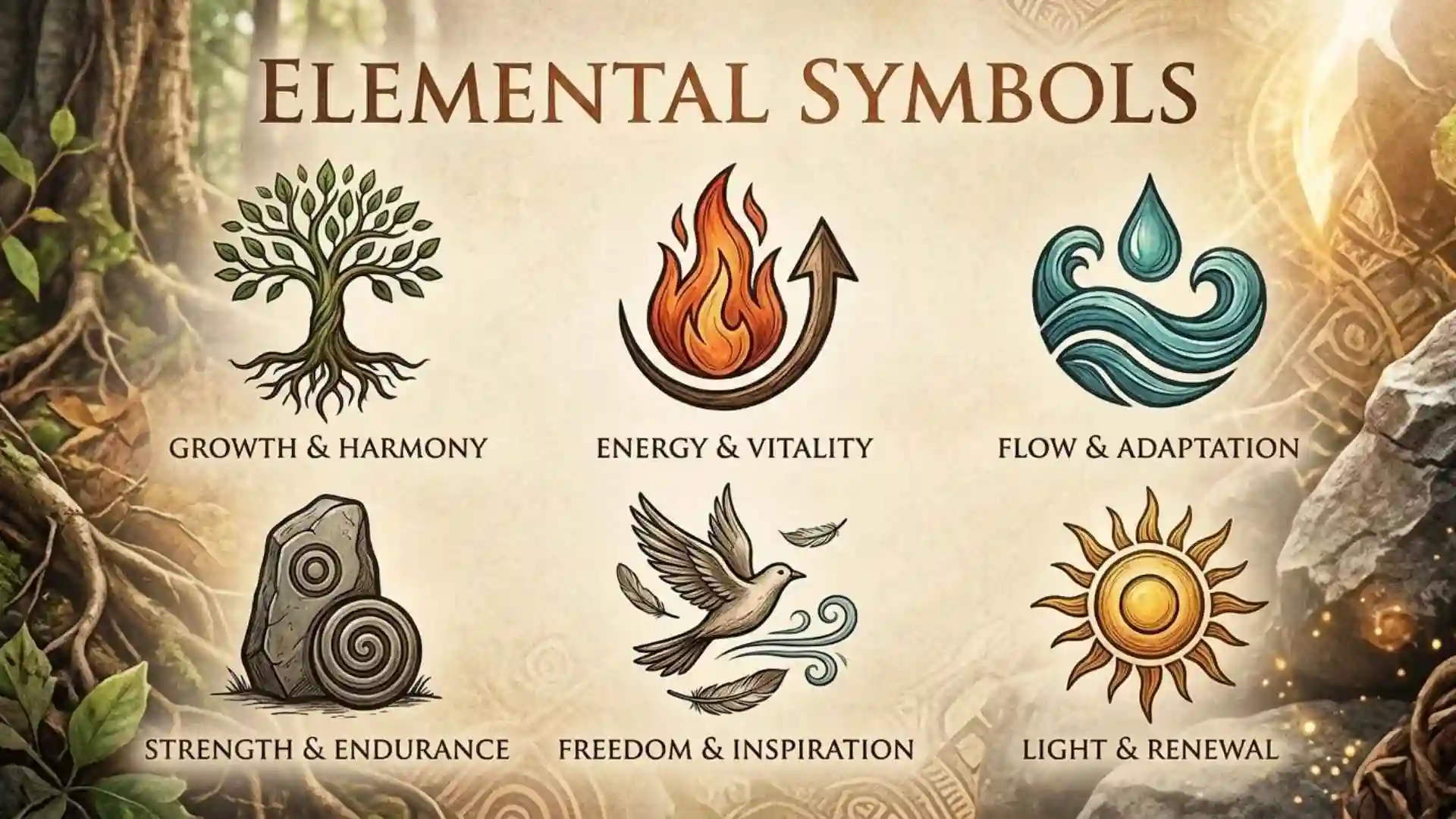
Elemental symbols have fascinated people for centuries because they represent the fundamental forces of nature and the mysteries of life. From the solid ground beneath your feet to the air you breathe, the flames that provide warmth, and the water that sustains every living thing, each element carries unique meanings. In many ancient cultures, spiritual traditions, philosophies, and belief systems, these elements symbolize different aspects of existence, human emotions, personal growth, and the connection between nature and the universe.
The five commonly discussed elements are Earth, Air, Fire, Water, and Spirit. Earth often represents stability, strength, and grounding, while Air symbolizes intellect, freedom, and communication. Fire is associated with passion, transformation, and energy, whereas Water reflects emotions, intuition, and healing. Spirit, sometimes called Ether or Aether, represents the invisible connection between all things. Their symbols vary across traditions, including ancient Greek philosophy, alchemy, Hinduism, Buddhism, and modern spiritual practices.
In this complete guide to elemental symbols, you will discover the meanings, origins, and spiritual significance of Earth, Air, Fire, Water, and Spirit. You will also explore their traditional shapes, associations with personality and emotions, uses in meditation and spiritual practices, and appearances in art, tattoos, and popular culture. Whether you are curious about ancient wisdom or simply want to understand the symbolism behind these powerful elements, this guide will help you explore their deeper meanings and lasting influence.
Quick Answer
Elemental symbols are visual signs representing the fundamental forces of nature, most commonly earth, air, fire, water, and spirit. They express physical qualities, emotional states, spiritual energies, and stages of transformation. Different cultures use elemental symbolism in religion, philosophy, medicine, astrology, alchemy, art, and modern spiritual practices.
Quick Facts About Elemental Symbols
| Aspect | Information |
| Origin | Ancient civilizations developed elemental systems independently to explain nature and existence |
| Historical Significance | Used in Greek philosophy, alchemy, medicine, astrology, religion, and ritual traditions |
| Main Meaning | The basic forces, qualities, or building blocks of life and the universe |
| Spiritual Meaning | Balance, transformation, consciousness, purification, grounding, and inner growth |
| Cultural Importance | Helped societies understand health, personality, seasons, gods, and natural events |
| Modern Usage | Tattoos, jewelry, fantasy stories, meditation, branding, fashion, games, and home decor |
What Are Elemental Symbols?
Elemental symbols are signs connected with the basic substances or forces believed to shape the natural world. The best-known Western system includes earth, air, fire, and water. A fifth element, often called spirit, ether, or quintessence, represents the invisible force linking the other four.
The idea that reality is built from a small number of essential elements appeared in several ancient civilizations. These cultures did not always use the same elements, but they shared a desire to understand why matter changes, why seasons shift, and why people have different temperaments.
In ancient Greece, the philosopher Empedocles described earth, air, fire, and water as four eternal “roots.” Plato later associated them with geometric forms, while Aristotle added a fifth heavenly substance called aether.
Elemental ideas also influenced ancient medicine. Greek and Roman physicians connected the four elements with bodily fluids called humors. Health was believed to depend on balance among these forces.
During the medieval and Renaissance periods, alchemists developed recognizable geometric elemental symbols. Upward and downward triangles, sometimes crossed by horizontal lines, represented the qualities of heat, coldness, dryness, and moisture.
Over time, elemental symbols moved beyond science and philosophy. They became powerful images in magic, religion, literature, psychology, art, and popular culture.
Deep Symbolic Meaning of Elemental Symbols
Spiritual Meaning
On a spiritual level, the elements represent stages of inner balance and transformation.
Earth symbolizes stability, the body, patience, and connection to physical life. Air represents thought, communication, inspiration, and freedom. Fire stands for passion, purification, courage, and change. Water symbolizes emotion, intuition, healing, and spiritual depth. Spirit represents unity, consciousness, and the sacred force believed to flow through all things.
Many spiritual traditions teach that no element is complete by itself. Fire without water may become destructive. Water without earth may lack direction. Air without grounding may turn into restless thought. Balance allows each force to express its highest quality.
Psychological Meaning
Psychologically, elemental symbols provide a simple language for complex emotions.
A person may describe anger as fire, sadness as rain, stability as solid ground, or creative thought as a breath of fresh air. These comparisons feel natural because the human mind often understands invisible experiences through visible patterns in nature.
Carl Jung’s work on archetypes helps explain this attraction. Jung believed that recurring symbols can emerge from shared patterns within the collective unconscious. While he did not create one fixed elemental system, fire, water, earth, and air frequently appear in Jungian interpretations of dreams, myths, and emotional development.
Water may represent the unconscious mind. Fire may suggest transformation or desire. Earth may reflect security and physical reality. Air may point toward intellect, ideas, or spiritual movement.
Cultural Meaning
Elemental symbols also carry social meaning. They help communities explain identity, morality, health, gender roles, sacred places, and seasonal change.
A farming culture may treat earth and rain as sacred sources of survival. A coastal society may view water as both provider and destroyer. Communities living near volcanoes may understand fire as a force of death, renewal, and divine power.
Because human societies depend on nature, elemental symbolism often reflects both respect and fear.
Types and Variations of Elemental Symbols
Earth Symbol
Visual description: A downward-pointing triangle crossed by a horizontal line.
Meaning: Stability, matter, fertility, structure, and endurance.
Symbolism: Earth is connected with the body, home, security, patience, and practical wisdom.
Cultural connection: It appears in agricultural religions, fertility traditions, alchemy, astrology, and nature-based spirituality.
Where it appears: Gardens, mountains, stones, caves, sacred landscapes, tattoos, jewelry, and meditation practices.
Air Symbol
Visual description: An upward-pointing triangle crossed by a horizontal line.
Meaning: Thought, breath, communication, movement, and intelligence.
Symbolism: Air represents ideas, language, freedom, imagination, and unseen influence.
Cultural connection: Breath is often linked with life or spirit. Words for breath and soul are closely related in several ancient languages.
Where it appears: Birds, clouds, wind imagery, feathers, incense smoke, literature, fantasy stories, and spiritual rituals.
Fire Symbol
Visual description: A simple upward-pointing triangle.
Meaning: Energy, passion, destruction, purification, and rebirth.
Symbolism: Fire can warm, protect, illuminate, consume, or transform. This makes it one of the most emotionally powerful elemental symbols.
Cultural connection: Sacred flames appear in Greek, Roman, Hindu, Zoroastrian, and ceremonial traditions.
Where it appears: Candles, hearths, temples, festivals, tattoos, logos, myths, and initiation rituals.
Water Symbol
Visual description: A simple downward-pointing triangle.
Meaning: Emotion, intuition, cleansing, fertility, and adaptability.
Symbolism: Water represents the unconscious, memory, birth, healing, and the flow of life.
Cultural connection: Rivers, wells, springs, oceans, and rain have been treated as sacred across the world.
Where it appears: Baptism, purification rituals, dream imagery, poetry, marine art, jewelry, and spiritual ceremonies.
Spirit or Ether Symbol
Visual description: Spirit may be shown as a circle, pentagram, wheel, central point, or combined elemental figure.
Meaning: Unity, consciousness, divine presence, and connection.
Symbolism: Spirit is often understood as the force that brings the physical elements into harmony.
Cultural connection: Similar ideas appear as aether in Greek thought, akasha in Indian traditions, and subtle life energy in later esoteric systems.
Where it appears: Ritual circles, sacred geometry, meditation art, occult diagrams, fantasy worlds, and contemporary spirituality.
Elemental Symbols Across Different Cultures
Ancient Egypt
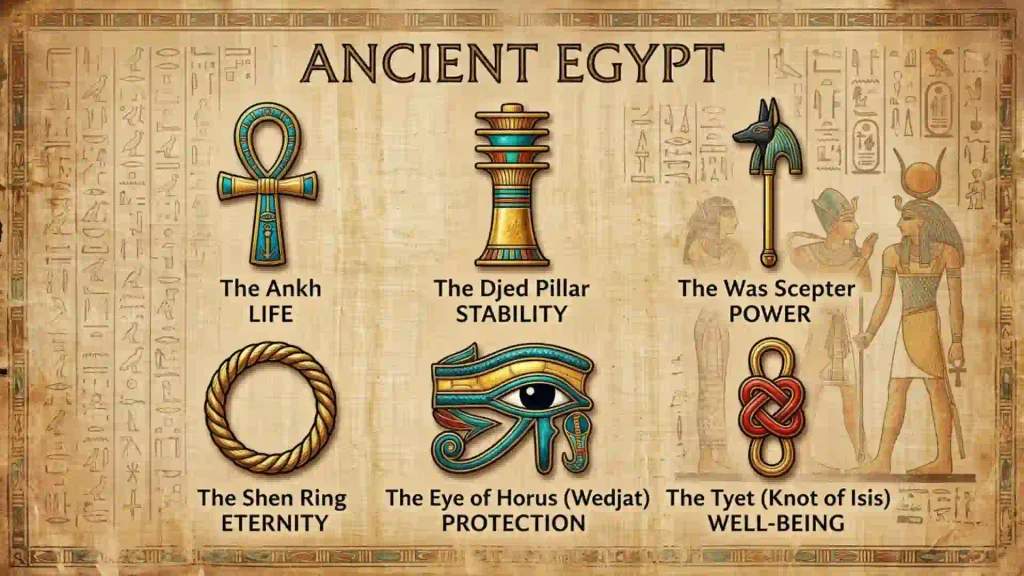
Ancient Egyptian religion did not follow the Greek four-element system, but natural forces were deeply sacred. The Nile represented fertility, renewal, and life. The sun symbolized divine order and power, while air, moisture, earth, and sky were personified through deities such as Shu, Tefnut, Geb, and Nut.
Ancient Greece
Greek philosophers used elements to explain matter and change. Empedocles identified four roots, while Plato connected each element with a geometric solid. Aristotle later linked the elements with qualities such as hot, cold, wet, and dry.
Roman Culture
Roman thinkers inherited many Greek elemental ideas. The elements influenced medicine, philosophy, architecture, agriculture, and astrology. Romans also worshipped divine figures connected with fire, sea, earth, winds, and household hearths.
Eastern Traditions
Chinese philosophy traditionally uses five phases called Wu Xing: wood, fire, earth, metal, and water. These are not simply physical materials. They describe cycles of growth, decline, interaction, seasons, organs, emotions, and social patterns.
Indian traditions often describe five great elements known as Pancha Mahabhuta: earth, water, fire, air, and ether. They are connected with the body, senses, yoga, Ayurveda, meditation, and spiritual development.
Japanese elemental thought includes earth, water, fire, wind, and void. The void can represent emptiness, spiritual potential, or realities beyond ordinary perception.
Indigenous Traditions
Indigenous traditions are diverse and should not be treated as one belief system. Many communities understand land, water, wind, animals, fire, and sky through relationships rather than abstract categories.
Natural forces may be regarded as relatives, teachers, ancestors, or living presences. Their symbolic meanings are often tied to specific landscapes, oral histories, ceremonies, and community responsibilities.
Modern Interpretations
Today, elemental symbols often represent personality types, emotional needs, spiritual paths, or creative identities. They appear in astrology, wellness culture, fantasy entertainment, environmental movements, and personal art.
Similar Symbols and Their Meanings
| Symbolic System | Main Components | Primary Focus | Key Difference |
| Classical elements | Earth, air, fire, water, spirit | Nature, matter, personality, transformation | Originates mainly in Western philosophy and esotericism |
| Chinese Wu Xing | Wood, fire, earth, metal, water | Cycles, relationships, health, change | Describes dynamic phases rather than fixed substances |
| Indian elements | Earth, water, fire, air, ether | Body, senses, consciousness, spiritual practice | Closely connected with yoga and Ayurveda |
| Zodiac elements | Fire, earth, air, water | Personality and astrological signs | Organizes the twelve zodiac signs into four groups |
| Four directions | North, east, south, west | Space, journey, ceremony, natural relationships | Meanings differ greatly among cultures and traditions |
A common misconception is that every culture used the same four-element model. In reality, elemental systems developed differently and should be understood within their own historical and cultural settings.
Elemental Symbols in Mythology and Folklore
Myths often turn the elements into gods, spirits, monsters, or magical beings.
Greek mythology includes Poseidon as ruler of the sea, Hephaestus as a god of fire and metalwork, and Gaia as the living Earth. Wind gods called the Anemoi represented different directions and weather patterns.
In European folklore, later writers and occult thinkers connected elemental spirits with nature. Gnomes were linked with earth, sylphs with air, salamanders with fire, and undines with water. These associations became especially influential through the writings attributed to the Renaissance physician and alchemist Paracelsus.
Dragons also gained elemental identities. Some breathe fire, while others control storms, oceans, ice, or the land. Such stories show how people give personality to forces that appear powerful and difficult to control.
Creation myths frequently begin with darkness, water, breath, clay, fire, or cosmic emptiness. These elemental images help explain how order emerged from chaos.
Elemental Symbols in Art, Literature, Movies, and Pop Culture
Artists use elemental imagery to express mood and conflict. Stormy water may suggest emotional danger. A dry landscape can represent loneliness. Fire may symbolize revolution, destruction, passion, or rebirth.
Literature is filled with elemental metaphors. Shakespeare used storms to reflect political and emotional disorder. Romantic poets saw wind, mountains, oceans, and fire as sources of beauty, fear, and spiritual insight.
Modern fantasy stories often turn elements into magical powers. Characters may control fire, water, earth, or air, with each power reflecting personality and moral struggle. Television series, video games, comics, and role-playing worlds use elemental systems because audiences understand them quickly.
In tattoos, the symbols may express identity, balance, resilience, or connection with nature. Fashion and jewelry often combine elemental triangles, zodiac signs, crystals, waves, flames, and celestial patterns.
Spiritual and Dream Meaning of Elemental Symbols
Dreams involving the elements are usually interpreted through emotion and context rather than fixed rules.
Dreaming of calm water may suggest emotional peace, while flooding may point to overwhelming feelings. Fire may represent motivation, anger, passion, cleansing, or a major life change.
Earth dreams can reflect stability, responsibility, family, or the need to feel grounded. Wind may suggest freedom, uncertainty, new ideas, or forces beyond personal control.
In meditation, people sometimes focus on an element to develop a quality they feel is missing. Earth may support calmness. Water may encourage emotional release. Fire may strengthen courage. Air may create mental clarity. Spirit may inspire unity and inner awareness.
These interpretations should be treated as reflective tools, not certain predictions.
Positive and Negative Meanings of Elemental Symbols
| Element | Positive Meaning | Negative Meaning |
| Earth | Stability, fertility, patience, safety | Rigidity, stagnation, materialism |
| Air | Intelligence, freedom, inspiration, communication | Confusion, detachment, restlessness |
| Fire | Courage, warmth, passion, purification | Anger, destruction, impulsiveness |
| Water | Healing, intuition, compassion, adaptability | Fear, emotional overwhelm, uncertainty |
| Spirit | Unity, awareness, sacred connection | Escapism, imbalance, loss of grounding |
The same element can represent light or shadow because nature itself has two sides. Fire cooks food but can burn a home. Water sustains life but can cause floods. Symbolic meaning depends on context, intensity, and personal experience.
Why Humans Are Attracted to Elemental Symbols
People are attracted to elemental symbols because they make complex experiences easier to understand.
You cannot physically hold courage, grief, desire, or intuition. However, you can imagine a flame, deep water, strong stone, or moving wind. Nature gives shape to invisible feelings.
Humans are also skilled at pattern recognition. We connect repeated natural events with memory and meaning. Rain may remind one person of comfort and another of loss. A mountain may represent adventure, isolation, strength, or home.
Elemental symbols also carry cultural memory. Their meanings have been repeated through myths, rituals, stories, artworks, and family traditions for generations.
Most importantly, the elements feel personal. People often recognize part of themselves in one force more than another.
Modern Uses of Elemental Symbols
Elemental symbols continue to appear in many areas of modern life:
- Tattoos: Represent personality, transformation, zodiac identity, or emotional balance.
- Jewelry: Elemental pendants and rings express spiritual beliefs or connection with nature.
- Fashion: Flames, waves, clouds, stones, and celestial designs create symbolic visual themes.
- Branding: Companies use fire for energy, water for purity, earth for sustainability, and air for freedom.
- Social media: Elemental icons appear in profile designs, digital art, personality quizzes, and spiritual content.
- Home decor: Natural textures, fountains, candles, plants, and open spaces create elemental balance.
- Contemporary spirituality: Practitioners may use elements in meditation, seasonal rituals, altar design, or mindfulness.
- Personal expression: Writers, artists, gamers, and musicians use elemental identities to explore character and emotion.
Interesting Facts About Elemental Symbols
- The alchemical symbols for fire and water are opposite triangles.
- The horizontal lines in the earth and air symbols help distinguish them from water and fire.
- Ancient Greek elements were linked with qualities such as hot, cold, wet, and dry.
- The word “quintessence” originally referred to the fifth essence beyond the four earthly elements.
- Chinese Wu Xing describes changing processes, not only physical substances.
- In Indian philosophy, ether is often connected with space and sound.
- Elemental triangles remain popular in minimalist tattoos and geometric jewelry.
- Renaissance alchemists used elemental symbols in diagrams, manuscripts, and laboratory notes.
- Modern fantasy systems often simplify cultural traditions to create understandable magical rules.
- Water and fire frequently appear together as symbols of opposing forces that can create balance.
Frequently Asked Questions
What are the four main elemental symbols?
The four classical elemental symbols represent earth, air, fire, and water. Earth and air use crossed triangles, while fire and water use plain upward or downward triangles.
What is the fifth elemental symbol?
The fifth element is commonly called spirit, ether, aether, or quintessence. It represents unity, consciousness, sacred energy, or the invisible force connecting the other elements.
What do elemental symbols mean spiritually?
Spiritually, elemental symbols represent grounding, emotion, transformation, thought, healing, balance, and connection with a greater whole.
Are elemental symbols religious?
They can appear in religious and spiritual traditions, but they are not limited to one religion. They also belong to philosophy, alchemy, art, medicine, psychology, and popular culture.
What element symbolizes strength?
Earth commonly symbolizes steady strength, endurance, and stability. Fire may symbolize courageous or active strength, depending on the context.
What element represents emotions?
Water is most often associated with emotions, intuition, memory, compassion, healing, and the unconscious mind.
Conclusion
Elemental symbols are more than ancient signs for earth, air, fire, water, and spirit.
They reveal how humans turn nature into a language for emotion, identity, transformation, and spiritual meaning.
Each element carries both creative and destructive possibilities, reminding us that balance matters more than power alone.
When you understand these symbols, you may also begin to see your own inner world reflected in the forces surrounding you.
 Sarah Thompson
 John Mercer