
Crochet symbols make it easier to understand patterns and turn a simple ball of yarn into something beautiful. From cozy blankets and stylish scarves to decorative flowers and handmade toys, every crochet project begins with a series of stitches that work together. Crochet symbols provide a visual language for these stitches, helping beginners and experienced crafters follow patterns without reading long written instructions. Once you understand the basic marks, you can recognize common stitches and start creating your favorite designs with greater confidence.
Each crochet symbol represents a specific stitch or technique. For example, a small oval often represents a chain stitch, an X or plus sign can indicate a single crochet, and a T-shaped symbol with one or more bars commonly represents a taller stitch, such as a double crochet. However, crochet symbols can vary between pattern standards and designers, so checking the pattern’s symbol key is essential. You may also encounter different conventions in US and UK crochet terminology, making it important to understand which system a pattern uses before you begin.
In this complete guide to crochet symbols, you will discover the meanings of common stitch symbols, learn how to read crochet charts, and explore the marks used in beginner and advanced patterns. You will also understand how increases, decreases, turning chains, repeats, and special stitches appear in diagrams. Whether you are learning your first chain stitch or tackling an intricate lace design, this guide will help you read crochet patterns more easily and bring your creative ideas to life.
Quick Answer
Crochet symbols are standardized visual marks used in stitch diagrams and pattern charts. Each symbol represents a crochet stitch, action, or placement. For example, an oval usually means a chain stitch, while a tall line with a slash commonly represents a double crochet in US terminology. Symbols help crocheters understand patterns without relying entirely on written language.
Quick Facts About Crochet Symbols
| Aspect | Information |
| Origin | Developed from written crochet instructions and later organized into visual chart systems |
| Historical Significance | Helped designers communicate increasingly complex lace, garment, and decorative patterns |
| Main Meaning | Each mark represents a stitch, stitch group, direction, or placement |
| Spiritual Meaning | Often associated with patience, connection, creativity, and transformation |
| Cultural Importance | Allows patterns to be shared between crocheters who speak different languages |
| Modern Usage | Used in books, magazines, digital patterns, social media tutorials, and design software |
What Are Crochet Symbols?
Crochet symbols are graphic representations of stitches. Instead of writing “work three double crochet stitches into the next chain space,” a designer can show the instruction through a small group of stitch-shaped marks.
The Craft Yarn Council publishes standardized crochet chart symbols commonly used by designers and yarn companies. Most symbols are drawn to resemble the structure of the completed stitch when viewed from the right side of the fabric. However, special designs may use additional signs, so readers should always check the chart key.
Crochet itself creates fabric by interlocking loops with a hook. Its name comes from a French word meaning “hook.” Although several earlier looped textile traditions influenced the craft, clear published instructions for modern crochet appeared in Europe during the early nineteenth century. The Dutch magazine Penélopé published crochet instructions in 1823, while many English and French pattern books followed during the 1840s.
Early instructions were mainly written. As crochet patterns became more detailed and international, visual charts offered a faster and more widely understandable method of communication.
Today, written abbreviations and symbol charts often appear together. A written pattern explains each row in words, while the chart shows the shape, placement, and relationship of the stitches.
How to Read the Most Common Crochet Symbols
The exact shape may vary slightly by publisher, but the following marks are widely recognized.
| Symbol Appearance | Common US Meaning | What You Do |
| Oval or small horizontal loop | Chain, ch | Yarn over and pull through the loop |
| Solid dot | Slip stitch, sl st | Pull yarn through the stitch and active loop |
| X or plus sign | Single crochet, sc | Insert hook, pull up a loop, yarn over, pull through both loops |
| T shape | Half double crochet, hdc | Yarn over, insert hook, pull up loop, yarn over, pull through all loops |
| Tall T with one slash | Double crochet, dc | Yarn over and complete the stitch in stages |
| Tall T with two slashes | Treble crochet, tr | Wrap yarn twice before inserting the hook |
| Several stitches joined at top | Cluster or decrease | Work stitches together so they share a final top |
| Several stitches from one base | Shell, fan, or increase | Work multiple stitches into one stitch or space |
| Curved arrow | Direction of work | Follow the indicated reading or turning direction |
| Bracket or curved line | Repeated group | Repeat the enclosed stitch sequence |
These marks form a visual grammar. The basic sign identifies the stitch, while its position tells you where that stitch belongs.
US and UK Crochet Terms
One of the most important facts for beginners is that crochet symbols may be international, but stitch names are not always the same.
For example:
| Symbol or Stitch Structure | US Term | UK Term |
| X or plus sign | Single crochet | Double crochet |
| T shape | Half double crochet | Half treble crochet |
| T with one slash | Double crochet | Treble crochet |
| T with two slashes | Treble crochet | Double treble crochet |
The physical stitch does not change. Only the name changes.
Before beginning a pattern, look for a note that says “US terms” or “UK terms.” If no note appears, inspect the publisher, pattern key, and abbreviation list. The Craft Yarn Council also maintains a standard list of common crochet abbreviations, including terms such as ch, sc, dc, tr, st, sp, tog, and yo.
Deep Symbolic Meaning of Crochet Symbols
Crochet symbols were created for practical communication, not as ancient sacred signs. Still, many crocheters experience deeper personal meaning while working with them.
Spiritual Meaning
A crochet chart begins as a collection of separate marks. Through focused action, those marks become a unified piece of fabric. This process can symbolize transformation.
The chain often represents beginnings and connection. A finished project depends on one loop passing through another, much like relationships, communities, and generations depend on shared support.
Circular patterns may suggest wholeness, cycles, protection, or continuity. Repeated rounds move outward from a central point, which can resemble personal growth or the gradual expansion of awareness.
These meanings are modern interpretations rather than fixed religious teachings. Their value comes from the meaning a maker gives to the process.
Psychological Meaning
Crochet combines repetition with visible progress. Each completed symbol becomes a stitch, and each stitch moves the project forward.
Psychologically, this creates a clear cycle:
- Read the symbol.
- Perform the action.
- Observe the result.
- Repeat the process.
That rhythm can create a feeling of order and control. A complex project becomes manageable because the mind only needs to solve one stitch or repeat at a time.
From a Jungian viewpoint, the circle can be compared with the mandala, an image of balance and psychological wholeness. However, an ordinary circular crochet chart is not automatically a Jungian or spiritual symbol. The connection exists through personal interpretation.
Cultural Meaning
Crochet patterns are often shared between family members, teachers, designers, and online communities. Symbols strengthen that exchange because they reduce language barriers.
A crocheter who cannot read a pattern’s written language may still understand its chart. In this way, crochet symbols function as a shared visual vocabulary.
They also preserve knowledge. A chart records the order of movements needed to recreate a design long after its original maker has finished the piece.
Types and Variations of Crochet Symbols
Basic Stitch Symbols
Basic symbols represent chains, slip stitches, single crochet, half double crochet, double crochet, and taller stitches.
Their visual structure often grows taller as the stitch grows taller. A chain is shown as a small oval, while a treble crochet appears as a longer vertical mark with additional slashes.
These symbols appear in nearly every type of crochet chart.
Increase Symbols
An increase is usually shown as two or more stitch symbols emerging from one point.
It means that several stitches must be worked into the same stitch or space. Increases widen the fabric and help create circles, sleeves, shawls, flowers, and shaped garments.
Symbolically, an increase may suggest growth, expansion, or abundance.
Decrease Symbols
A decrease is commonly shown as separate stitch symbols joining at the top.
This indicates that several stitches are worked together to create one completed stitch. Decreases narrow the fabric and produce shaping.
They may be interpreted as gathering, simplifying, or bringing separate elements into unity.
Shell and Fan Symbols
Shells and fans appear as groups of tall stitches spreading from one base or space.
They create decorative curves that resemble flowers, leaves, feathers, or open fans. These motifs often appear in lace, shawls, blankets, edging, and traditional household textiles.
Cluster, Puff, Bobble, and Popcorn Symbols
These textured stitches may be shown as grouped lines, enclosed stitch marks, or specialized shapes.
Although they can look similar, they are constructed differently. A cluster joins partly completed stitches at the top. Puff and bobble stitches create raised texture using loops or partly completed stitches. Popcorn stitches are usually made by completing several stitches and then joining the first and last.
Always follow the pattern legend because designers may draw these symbols differently.
Front Post and Back Post Symbols
Curved hooks or brackets around a stitch symbol may indicate front post or back post placement.
Rather than inserting the hook into the top loops, the crocheter works around the body of a previous stitch. This technique creates ribs, cables, baskets, and raised textures.
Crochet Symbols Across Different Cultures
Crochet symbols do not have documented origins in Ancient Egypt, Greece, or Rome. Connecting them directly to those civilizations would be historically misleading. However, crochet belongs to a much broader human tradition of coded textile knowledge.
Ancient Egypt
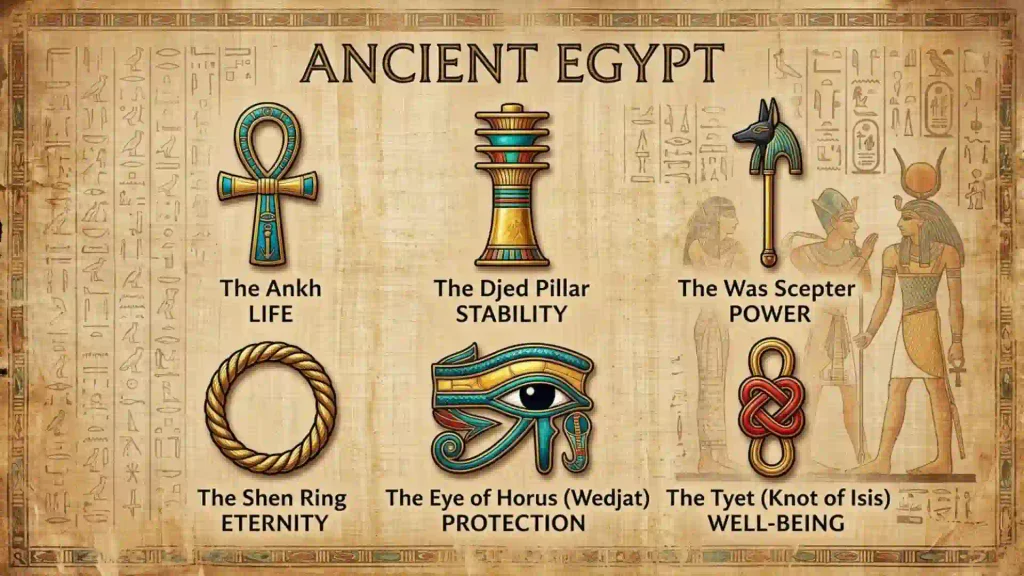
Ancient Egyptian textiles used weaving, knotting, decorative borders, and repeated geometric designs. These were not modern crochet charts, but they show how visual repetition could preserve artistic and cultural information.
Ancient Greece
Greek textiles and painted pottery often featured meanders, waves, floral forms, and repeating borders. Modern crocheters sometimes recreate similar motifs, although the crochet symbols used to make them are contemporary instructions.
Roman Culture
Roman mosaics and textiles relied heavily on structured repetition. Crochet charts share the same practical principle of building a large design from smaller repeated units, but there is no evidence that Romans used crochet stitch notation.
Eastern Traditions
Japanese crochet publications became especially influential in the modern global use of diagram-based patterns. Detailed charts allow designs to be followed even when the reader cannot understand the surrounding Japanese text.
Chinese, Korean, and other East Asian craft communities also use charted patterns widely in books and online tutorials.
Indigenous Traditions
Indigenous cultures around the world hold rich traditions of weaving, basketry, knotting, beadwork, and textile storytelling. These should not be treated as one single tradition or described as the origin of crochet symbols without evidence.
However, they demonstrate a universal principle: repeated visual systems can carry knowledge, identity, memory, and community values.
Irish Crochet Tradition
Irish crochet lace carries particular historical importance. During the nineteenth century, especially around the time of the Great Irish Famine, crochet lace production became a source of income for many families. Teachers and schools helped spread the technique, and Irish crochet later became internationally admired for its floral motifs and raised lacework.
Similar Symbols and Their Meanings
| Symbol System | Main Purpose | Similarity to Crochet Symbols | Key Difference |
| Knitting charts | Show knitted stitches | Uses visual marks and row direction | Represents stitches held across two needles |
| Cross-stitch charts | Show color and stitch placement | Converts a design into visual instructions | Usually uses a square grid |
| Sewing symbols | Guide cutting and construction | Communicates actions without long text | Focuses on fabric assembly |
| Embroidery diagrams | Show stitch type and direction | Represents thread movement visually | Stitches are placed on existing fabric |
| Musical notation | Records sound and timing | Turns symbols into ordered actions | Produces music rather than fabric |
Crochet charts are sometimes confused with written abbreviations. A symbol is a visual mark, while an abbreviation is a shortened word. Both may describe the same stitch.
Crochet Symbols in Mythology and Folklore
There are no established ancient myths specifically about modern crochet symbols. Still, thread, weaving, knots, and handmade cloth appear throughout world mythology.
In Greek tradition, the Moirai, or Fates, controlled the thread of life. Ariadne gave Theseus a thread to help him escape the Labyrinth. Penelope delayed remarriage by weaving and secretly undoing her work.
These stories concern thread and weaving rather than crochet, but they help explain why fiber crafts often carry symbolic associations with fate, memory, patience, and human connection.
Modern crocheters may view a chart as a map through a creative labyrinth. Each symbol guides the maker toward a finished form that cannot be seen clearly at the beginning.
Crochet Symbols in Art, Literature, Movies, and Pop Culture
Crochet has moved from household necessity into galleries, fashion collections, public installations, films, and digital communities.
In fiber art, enlarged stitches and repeated motifs may explore domestic labor, gender, memory, environment, or identity. In fashion, openwork charts create lace dresses, tops, bags, hats, and accessories.
Movies and television often use crocheted blankets or garments to suggest comfort, family history, nostalgia, or handmade care. Social media has introduced millions of people to granny squares, amigurumi, temperature blankets, and chart-based garment design.
Crochet symbols also appear in tattoos and jewelry. A chain symbol may honor a love of crafting, while a hook, yarn ball, or granny-square chart can represent patience, creativity, and connection.
Spiritual and Dream Meaning of Crochet Symbols
Dreaming about a crochet chart may reflect a need for order, patience, or step-by-step problem solving.
A clear chart can suggest that you feel guided or prepared. A confusing chart may represent uncertainty, pressure, or fear of making a mistake. Missing symbols might reflect a lack of information in waking life.
Crocheting successfully in a dream may symbolize confidence and creative progress. Unraveling work can suggest frustration, but it may also represent the freedom to correct a mistake and begin again.
Dream meanings are personal, not predictions. Consider your emotions, current challenges, and relationship with crafting before deciding what the dream means to you.
Positive and Negative Meanings of Crochet Symbols
| Positive Meaning | Negative or Cautionary Meaning |
| Creativity | Perfectionism |
| Patience | Frustration |
| Connection | Feeling tangled |
| Progress | Fear of mistakes |
| Transformation | Repeating unhealthy patterns |
| Cultural exchange | Misreading unfamiliar conventions |
| Mindful focus | Becoming overly fixated |
| Structure | Feeling controlled by rules |
The same chart can feel comforting to an experienced crocheter and overwhelming to a beginner. Meaning depends on knowledge, emotion, and context.
Why Humans Are Attracted to Crochet Symbols
Humans naturally search for patterns. We enjoy turning small units into larger, meaningful forms.
Crochet symbols satisfy this instinct beautifully. They offer structure without removing creativity. The chart shows what to do, but the maker still chooses the yarn, color, texture, tension, and final purpose.
There is also emotional satisfaction in translation. A flat printed mark becomes a physical stitch. A page becomes a blanket, garment, toy, or gift.
This process allows people to experience visible progress while connecting with family traditions, global craft communities, and their own creative identity.
Modern Uses of Crochet Symbols
Crochet symbols now appear in:
- Printed pattern books and magazines
- Downloadable PDF patterns
- Mobile crafting apps
- Online classes and video tutorials
- Social media pattern diagrams
- Garment design software
- Amigurumi instructions
- Lace and doily charts
- Granny-square diagrams
- Home decor patterns
- Fashion design
- International pattern exchanges
Charts are especially useful for lace, circular motifs, granny squares, and repeating designs because they show stitch placement more clearly than long paragraphs of written instructions.
Interesting Facts About Crochet Symbols
- Many stitch symbols are shaped to resemble the completed stitch.
- A symbol chart can often be followed without understanding the language of the written instructions.
- Crochet charts worked in rows are normally read back and forth, following the direction of the work.
- Charts worked in rounds are generally read from the center outward.
- Right-side rows are often read from right to left, while wrong-side rows may be read from left to right for right-handed work.
- Left-handed crocheters may find mirrored charts easier to follow.
- The same visual stitch can have different names under US and UK terminology.
- Designers sometimes create special symbols for unusual stitches, making the pattern legend essential.
- Brackets, arrows, colors, and numbers can show repeats, directions, stitch counts, or round changes.
- A chart can reveal the shape of a finished motif before the crocheter makes the first stitch.
Frequently Asked Questions
Are crochet symbols universal?
Many basic crochet symbols are internationally recognized, but small differences occur between publishers and designers. Always read the chart key before starting.
What does an oval mean in a crochet chart?
An oval usually represents a chain stitch. A series of connected ovals indicates a foundation chain or chain space.
What does an X mean in crochet symbols?
An X or plus sign usually represents a single crochet in US terminology, which is called a double crochet in UK terminology.
How do you read a crochet chart in the round?
Begin at the center or starting symbol and follow each round outward. Most charts use arrows or round numbers to show direction.
Are crochet symbols easier than written patterns?
Many people find charts easier for lace, motifs, and repeated designs because they show stitch placement visually. Beginners may benefit from using both written instructions and charts together.
Why should I check the crochet symbol key?
Not every publisher draws symbols in exactly the same way. The key explains special stitches, unusual marks, color changes, and pattern-specific instructions.
Conclusion
Crochet symbols turn a complicated design into a path of simple, understandable steps.
They connect makers across languages while preserving the structure of creative ideas.
Although they are practical instructions rather than ancient sacred signs, they can still represent patience, growth, memory, and human connection.
Once you learn their language, an intimidating chart becomes an invitation to create something beautiful, one loop at a time.
 Sarah Thompson
 Michael Rivera