
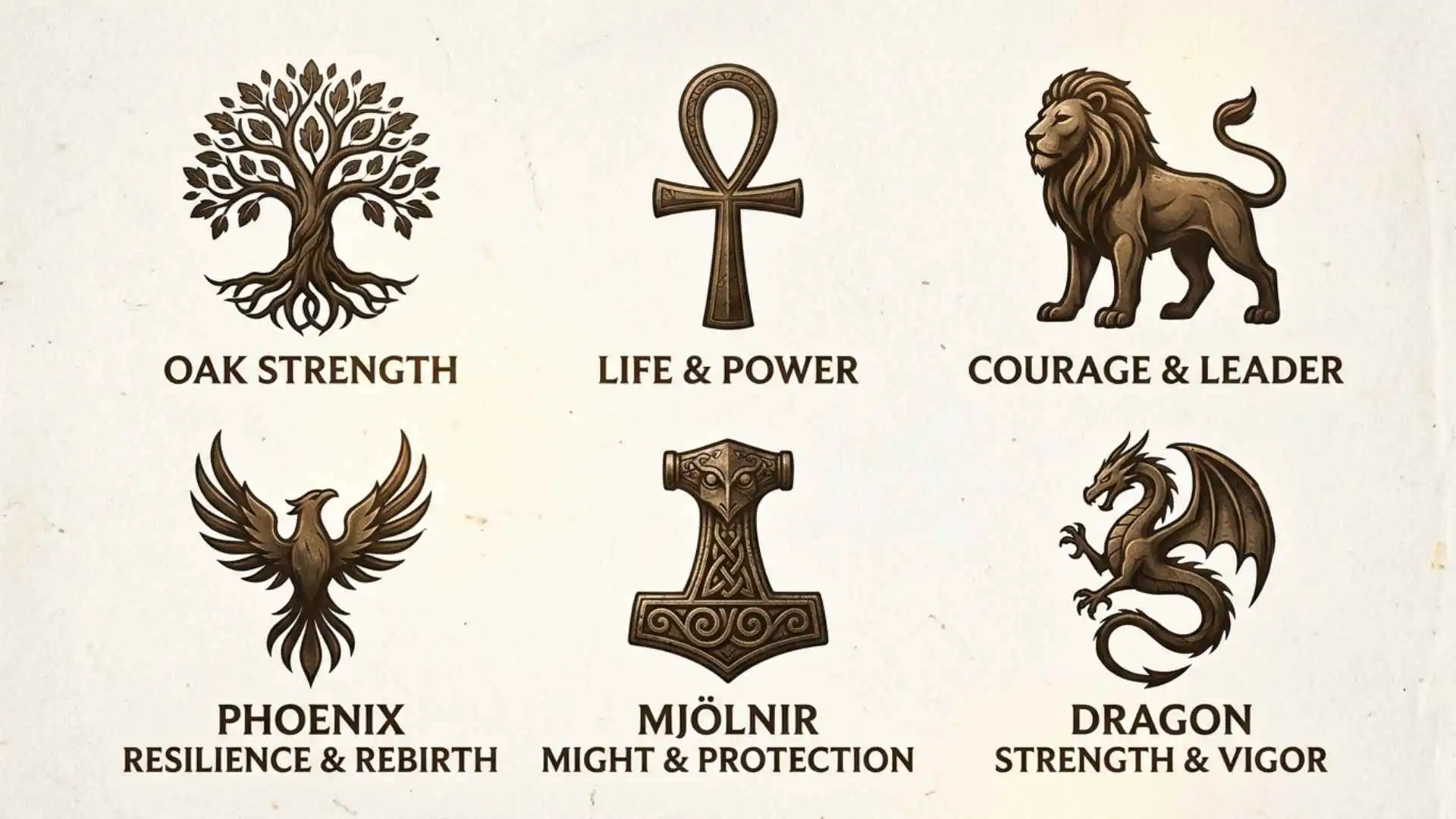
Strength is more than physical power. It represents the courage to face challenges, the resilience to overcome difficult times, and the inner determination to keep moving forward when life gets tough. Across cultures and throughout history, people have used meaningful symbols to express these qualities. From the mighty lion and ancient oak tree to the phoenix and Celtic knot, symbols for strength remind us of the power of perseverance, confidence, and personal growth.
Different strength symbols carry unique meanings rooted in mythology, religion, nature, and ancient traditions. The lion often represents courage and leadership, while the phoenix symbolizes rebirth after hardship. The oak tree stands for endurance and stability, and the Japanese daruma doll represents persistence and determination. Whether you are searching for a meaningful tattoo, a personal emblem, spiritual inspiration, or a daily reminder of your inner power, these symbols offer powerful ways to express what strength means to you.
In this guide, you will discover 15 powerful symbols for strength and explore their meanings, origins, and cultural significance. From ancient emblems of bravery to natural symbols of resilience, each sign offers a different perspective on overcoming obstacles and growing through adversity. You will also learn how to choose a strength symbol that reflects your personal journey, values, and goals.
Quick Answer
Symbols for strength are animals, plants, objects, shapes, and sacred signs associated with courage, resilience, protection, authority, or spiritual power. Popular examples include the lion, bear, eagle, oak tree, mountain, dragon, phoenix, Hercules’ club, Thor’s hammer, and the Buddhist vajra.
Quick Facts About Symbols for Strength
| Aspect | Information |
| Origin | Ancient religion, mythology, nature worship, warfare, royal imagery, and community traditions |
| Historical Significance | Used by rulers, warriors, religious groups, families, and civilizations to communicate power and protection |
| Main Meaning | Courage, endurance, authority, determination, resilience, and physical power |
| Spiritual Meaning | Inner transformation, faith, protection, life force, and victory over fear |
| Cultural Importance | Strengthens group identity, preserves traditional values, and connects people with ancestors |
| Modern Usage | Tattoos, jewelry, logos, clothing, home decor, artwork, memorials, and motivational designs |
What Are Symbols for Strength?
Symbols for strength are visual signs that communicate power without requiring a long explanation. They may represent physical force, but many also express emotional endurance, patience, wisdom, protection, or the courage to recover after loss.
Their origins reach back to the earliest human communities. People observed powerful animals, strong trees, violent storms, high mountains, and unbreakable materials. These natural forms became symbols because they displayed qualities humans admired.
Ancient rulers used lions, bulls, eagles, and weapons to show authority. Warriors decorated armor and shields with fierce animals to inspire confidence and intimidate enemies. Religious communities used sacred objects to represent divine protection and spiritual power.
Over time, the meaning of strength changed. Ancient societies often focused on military victory, kingship, and physical dominance. Modern interpretations also celebrate quiet courage, emotional healing, persistence, self-control, and the ability to begin again.
A symbol does not have one universal meaning. Its interpretation depends on culture, history, context, and personal experience.
Deep Symbolic Meaning of Symbols for Strength
Spiritual Meaning
On a spiritual level, strength often means remaining centered during hardship. It is not simply the power to defeat an enemy. It can be the ability to resist fear, protect others, forgive, or continue moving forward.
The phoenix represents spiritual rebirth because it rises from destruction. The lotus symbolizes strength through purity and growth because it emerges from muddy water. The vajra in Buddhist and Hindu traditions represents a force compared with both a thunderbolt and a diamond, expressing spiritual firmness and indestructibility.
These symbols suggest that real power may come from transformation rather than control.
Psychological Meaning
Psychologically, symbols for strength act as emotional anchors. A person may wear a lion pendant before a difficult event or choose a mountain tattoo after surviving a painful period.
Carl Jung described archetypes as recurring patterns and images that appear across myths, dreams, and cultures. The warrior, hero, protector, and reborn figure are common archetypes linked with strength.
A symbol can help the mind organize a complex emotional experience. Instead of repeatedly explaining a struggle, someone may use a broken chain to represent freedom or an oak tree to express survival.
Cultural Meaning
Cultures use strength symbols to teach values and preserve collective memory. A national eagle may represent sovereignty. A family crest may contain a lion to suggest courage. A community may honor a sacred animal connected with protection, ancestry, or survival.
However, cultural symbols should be approached respectfully. Indigenous animal imagery, clan signs, ceremonial objects, and sacred designs belong to living traditions, not merely decorative trends. The Smithsonian’s National Museum of the American Indian notes that animals can communicate values, spiritual beliefs, and family or clan histories within specific Native communities.
Types and Variations of Symbols for Strength
1. Lion
Visual description: A large lion, lion’s head, mane, paw, or roaring face.
Meaning: Courage, authority, royalty, protection, and leadership.
Cultural connection: Lions appeared in Egyptian royal imagery and were linked with kingship and divine power. Egyptian art also used the lion’s mane as a sign of power, regardless of gender.
Where it appears: Heraldry, statues, temples, national emblems, tattoos, sports logos, and literature.
2. Bear
Visual description: A standing bear, bear paw, claw, or powerful silhouette.
Meaning: Physical strength, protection, courage, healing, and independence.
Cultural connection: Bear symbolism varies widely among Indigenous nations, European traditions, and northern cultures. It should never be reduced to one universal “Native American” meaning.
Where it appears: Clan stories, folklore, cave art, jewelry, tattoos, flags, and outdoor branding.
3. Eagle
Visual description: An eagle with open wings, sharp talons, or a rising flight position.
Meaning: Vision, freedom, courage, authority, and victory.
Cultural connection: Eagles were associated with Zeus in Greek tradition and Jupiter in Roman culture. The Roman military used the aquila, or eagle standard, as an important symbol of legionary identity and imperial power.
Where it appears: National seals, military emblems, flags, coins, jewelry, and spiritual art.
4. Oak Tree
Visual description: A broad tree with a thick trunk, deep roots, and spreading branches.
Meaning: Endurance, stability, wisdom, protection, and long life.
Cultural connection: Oaks held sacred importance in several European traditions. Their deep roots and durable wood made them natural symbols of strength that develops slowly.
Where it appears: Family crests, poetry, parks, memorial art, logos, and tattoos.
5. Mountain
Visual description: A high peak, mountain range, or upward path.
Meaning: Determination, spiritual ascent, stability, ambition, and overcoming hardship.
Cultural connection: Mountains frequently appear as sacred meeting places between the human and divine worlds.
Where it appears: Religious stories, landscape paintings, motivational designs, tattoos, and outdoor brands.
6. Phoenix
Visual description: A fiery bird rising from flames or ashes.
Meaning: Rebirth, recovery, transformation, and resilience.
Cultural connection: The phoenix developed through ancient Mediterranean traditions and later became a widespread symbol of renewal.
Where it appears: Poetry, fantasy literature, films, tattoos, memorial art, and recovery-related designs.
7. Dragon
Visual description: A serpent-like or winged creature with claws, scales, horns, or fire.
Meaning: Power, protection, wisdom, vitality, or destructive force.
Cultural connection: Chinese dragons often represent auspicious power, rain, authority, and cosmic balance. Many European dragons are portrayed as dangerous guardians or enemies defeated by heroes.
Where it appears: Temples, festivals, mythology, flags, films, games, fashion, and tattoos.
8. Hercules’ Club
Visual description: A heavy wooden club, sometimes shown with a lion skin.
Meaning: Heroic strength, endurance, protection, and victory over impossible challenges.
Cultural connection: Heracles, called Hercules by the Romans, became the archetypal strong hero. His Twelve Labors included defeating the Nemean Lion, whose skin he later wore as protection.
Where it appears: Greek and Roman sculpture, coins, mosaics, paintings, literature, and films.
9. Mjölnir, Thor’s Hammer
Visual description: A short-handled hammer, often worn as a pendant.
Meaning: Protection, divine force, courage, blessing, and defense against chaos.
Cultural connection: In Norse mythology, Mjölnir belonged to Thor, the thunder god and defender of gods and humans.
Where it appears: Norse artifacts, modern jewelry, historical reenactment, popular entertainment, and tattoos.
10. Celtic Knot
Visual description: Interwoven lines without an obvious beginning or end.
Meaning: Continuity, endurance, connection, and eternal life.
Cultural connection: Modern people often call many interlaced designs “Celtic strength knots,” although historical meanings are not always documented. The endless pattern is commonly interpreted as lasting connection and resilience.
Where it appears: Manuscript-inspired art, jewelry, tattoos, wedding designs, and memorials.
11. Lotus Flower
Visual description: A layered flower rising above water.
Meaning: Spiritual strength, purity, awakening, and growth through difficulty.
Cultural connection: The lotus is important in Hindu, Buddhist, and Egyptian traditions, although its meaning differs across them.
Where it appears: Temples, sacred art, meditation spaces, jewelry, yoga designs, and tattoos.
12. Vajra
Visual description: A symmetrical ritual object with pronged ends and a central grip.
Meaning: Indestructible truth, spiritual power, clarity, and disciplined strength.
Cultural connection: The Sanskrit word vajra can refer to both a thunderbolt and a diamond. In Buddhist traditions, it represents powerful and unbreakable spiritual insight.
Where it appears: Buddhist ritual practice, statues, paintings, temple art, and meditation symbolism.
13. Bull
Visual description: A muscular bull, horns, or charging figure.
Meaning: Fertility, determination, physical power, virility, and stubborn endurance.
Cultural connection: Bulls appeared in Minoan, Mesopotamian, Egyptian, Greek, and Roman religious imagery.
Where it appears: Ancient reliefs, mythology, financial branding, sports logos, statues, and tattoos.
14. Shield
Visual description: A round, oval, or pointed defensive object.
Meaning: Protection, boundaries, duty, courage, and readiness.
Cultural connection: Shields protected the body in battle, but decorated shields also communicated family, city, military, and religious identity.
Where it appears: Heraldry, military insignia, superhero stories, security logos, jewelry, and tattoos.
15. Broken Chain
Visual description: A metal chain separated at one or more links.
Meaning: Liberation, survival, resistance, independence, and victory over oppression.
Cultural connection: The broken chain became a powerful political and social image connected with emancipation, protest, and freedom.
Where it appears: Monuments, activist art, tattoos, posters, jewelry, and memorial designs.
Symbols for Strength Across Different Cultures
Ancient Egypt
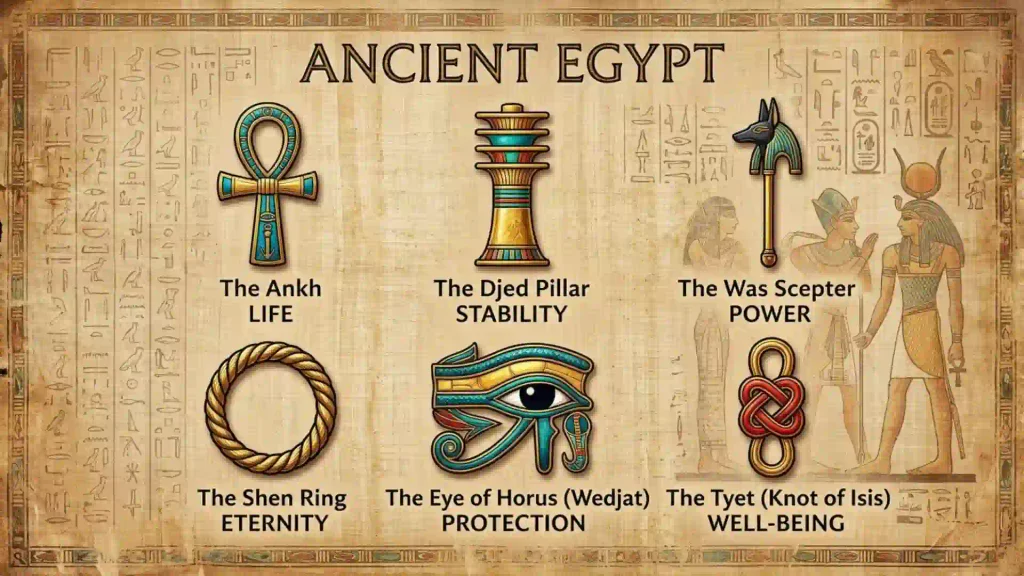
Ancient Egyptian strength symbols included lions, bulls, falcons, cobras, and royal staffs. The lioness goddess Sekhmet expressed fierce protective power, while the sphinx joined human intelligence with a lion’s body.
Strength in Egypt was closely connected with kingship, divine order, protection, and the ruler’s duty to resist chaos.
Ancient Greece
Greek culture placed strength within heroic stories. Heracles embodied physical force, suffering, courage, and perseverance. Athena represented disciplined strength guided by wisdom, while Nike personified victory.
Greek myths repeatedly warned that strength without judgment could become pride or destruction.
Roman Culture
Roman symbols included the eagle, fasces, armor, laurel wreath, and images of Hercules. The eagle represented military command and imperial authority. The laurel wreath represented victory, honor, and earned status.
Roman strength focused heavily on discipline, duty, public authority, and military organization.
Eastern Traditions
In Chinese culture, dragons can symbolize vitality, authority, good fortune, and control over water. Tigers often represent courage and protection.
In Hindu and Buddhist traditions, the lotus, vajra, lion, elephant, and sacred deities may represent spiritual power, wisdom, protection, or victory over ignorance.
Indigenous Traditions
Indigenous cultures are diverse, so no animal or design has one shared meaning across all nations. Bears, eagles, buffalo, wolves, thunderbirds, and other beings may appear in specific creation stories, clan systems, ceremonies, or family histories.
These symbols must be understood within the community that created them. Treating sacred imagery as a generic “strength symbol” can erase its deeper meaning.
Modern Interpretations
Today, people often combine ancient symbols with personal stories. A phoenix may represent recovery from illness. A mountain may mark the completion of a difficult journey. A lion may express confidence, while a lotus may represent emotional growth.
Modern strength is increasingly understood as resilience, healing, vulnerability, and self-respect.
Similar Symbols and Their Meanings
| Symbol | Main Form of Strength | Key Difference |
| Lion | Leadership and courage | Focuses on command and confidence |
| Bear | Protection and endurance | Often expresses grounded, defensive power |
| Eagle | Vision and freedom | Connects strength with perspective and independence |
| Bull | Physical force and determination | Can also suggest stubbornness or aggression |
| Oak Tree | Stability and longevity | Represents gradual, rooted strength |
| Phoenix | Recovery and rebirth | Strength develops through destruction and renewal |
| Mountain | Persistence and spiritual ascent | Represents a challenge or journey |
| Shield | Protection and boundaries | Defensive rather than aggressive power |
| Dragon | Cosmic or supernatural power | Meaning varies sharply between cultures |
| Lotus | Spiritual resilience | Emphasizes growth through difficult conditions |
These symbols overlap, but they are not interchangeable. A lion communicates a different kind of strength from a lotus. One may suggest visible authority, while the other expresses quiet transformation.
Symbols for Strength in Mythology and Folklore
Myths often turn strength into a story. Heracles proves himself through exhausting labors. Thor protects the ordered world from giants and destructive forces. Dragons may guard treasure, bring rain, represent imperial authority, or challenge heroes.
The phoenix teaches that destruction does not always mean an ending. The oak survives storms through deep roots. The mountain tests whether a traveler has enough discipline to keep climbing.
These stories shaped modern ideas of strength because they make power understandable. They show strength being tested, lost, misused, and rebuilt.
Symbols for Strength in Art, Literature, Movies, and Pop Culture
Artists use strong animals, heroic bodies, storms, weapons, mountains, and trees to communicate power. Literature often uses the lion for courage, chains for oppression, and fire for both destruction and renewal.
Movies and television frequently present heroes wearing shields, animal emblems, or symbolic armor. Fantasy stories use dragons and phoenixes to explore danger, transformation, and destiny.
In tattoos, symbols become personal records. In fashion, they may communicate confidence or rebellion. In branding, lions, bulls, eagles, and shields are used to suggest reliability, dominance, speed, or protection.
The context determines whether the symbol feels inspiring, threatening, sacred, or commercial.
Spiritual and Dream Meaning of Symbols for Strength
Dreaming of a strength symbol may reflect a need for courage, protection, confidence, or emotional stability. However, dream meanings are personal rather than fixed predictions.
A lion may reflect leadership or fear of authority. A bear may suggest protection, isolation, or strong boundaries. A mountain may represent a major goal. A broken chain may reflect liberation from a limiting situation.
A phoenix can appear during a period of recovery or identity change. A shield may suggest healthy boundaries, but it may also reveal emotional defensiveness.
The most useful question is not “What does this symbol always mean?” It is “What does this image make me feel, and what is happening in my life right now?”
Positive and Negative Meanings of Symbols for Strength
| Positive Meaning | Negative Meaning |
| Courage | Aggression |
| Protection | Control |
| Confidence | Arrogance |
| Persistence | Stubbornness |
| Leadership | Domination |
| Emotional resilience | Emotional suppression |
| Independence | Isolation |
| Spiritual discipline | Rigidity |
| Authority | Abuse of power |
| Survival | Constant defensiveness |
Strength has both light and shadow. Courage protects, but aggression harms. Strong boundaries preserve well-being, but walls can prevent intimacy. Leadership can serve a community, while domination serves only the person in control.
Why Humans Are Attracted to Symbols for Strength
Humans naturally look for patterns and stories that make difficult experiences easier to understand. A visual symbol turns an invisible quality into something we can see, touch, wear, or remember.
A tree makes endurance visible. A shield gives shape to emotional boundaries. A phoenix transforms recovery into a dramatic story of rebirth.
Symbols also connect personal experiences with cultural memory. When someone chooses an ancient image, they may feel part of a story much larger than their own.
Most importantly, strength symbols remind people of who they want to become. They do not create courage by themselves, but they can awaken a quality that already exists.
Modern Uses of Symbols for Strength
Today, symbols for strength appear in:
- Tattoos that mark survival, recovery, or personal transformation
- Jewelry worn as a reminder of courage or protection
- Fashion featuring lions, dragons, shields, and powerful words
- Branding designed to communicate security, authority, or endurance
- Social media posts about healing, confidence, and motivation
- Home decor featuring mountains, trees, sacred geometry, or affirmations
- Meditation spaces containing lotus, vajra, or meaningful natural imagery
- Memorial art honoring someone’s bravery or perseverance
- Sports logos that use fierce animals to create team identity
When choosing a symbol, research its cultural background and avoid using sacred imagery without understanding its meaning.
Interesting Facts About Symbols for Strength
- Heracles’ lion skin represented both victory and protection after he defeated the Nemean Lion.
- The Egyptian lion was closely connected with royalty, guardianship, and solar power.
- The vajra combines two ideas that seem different: the unstoppable force of lightning and the durability of a diamond.
- Broken chains can represent both personal freedom and collective liberation.
- Oak trees became strength symbols partly because of their size, long life, and durable wood.
- Dragon symbolism is not universally negative. In many East Asian traditions, dragons are connected with beneficial power and good fortune.
- A shield usually symbolizes defensive strength, while a sword often represents active power, justice, or conflict.
- The phoenix is not a direct equivalent of every sacred firebird. Different cultures have distinct bird traditions with their own histories.
- Modern “Celtic strength knots” are often contemporary interpretations rather than symbols with one proven ancient meaning.
- The same animal may carry different meanings in separate communities, making cultural context essential.
Frequently Asked Questions
What is the most powerful symbol of strength?
The lion is one of the most widely recognized symbols of strength because it represents courage, leadership, royal power, and protection. However, the best symbol depends on the type of strength you want to express.
What symbol represents inner strength?
The lotus, oak tree, mountain, phoenix, and vajra commonly represent inner strength. They emphasize spiritual growth, stability, persistence, transformation, and emotional resilience.
What animal symbolizes strength and courage?
Lions, bears, eagles, bulls, elephants, tigers, and wolves can symbolize strength and courage. Their exact meanings depend on cultural tradition and context.
What symbol represents strength after hardship?
The phoenix is a popular symbol of strength after hardship because it represents rebirth after destruction. The lotus and broken chain also express recovery, freedom, and transformation.
What symbol represents female strength?
Lionesses, Sekhmet, Athena, Durga, bears, moons, and lotus flowers are often associated with feminine strength. They can represent protection, wisdom, independence, creation, and fierce compassion.
How do I choose a personal strength symbol?
Choose a symbol that reflects your own experience and values. Consider whether your strength feels like courage, patience, protection, recovery, freedom, wisdom, or persistence. Then research the symbol’s cultural history before using it.
Conclusion
Symbols for strength reveal that power has many forms, from the roar of a lion to the quiet growth of a lotus.
Some represent courage in battle, while others honor healing, patience, protection, or the ability to begin again.
Their deepest value comes from the stories, cultures, and personal experiences connected with them.
The right symbol does not simply show that you are strong. It reminds you why you chose to keep going.
 Sarah Thompson
 John Mercer