
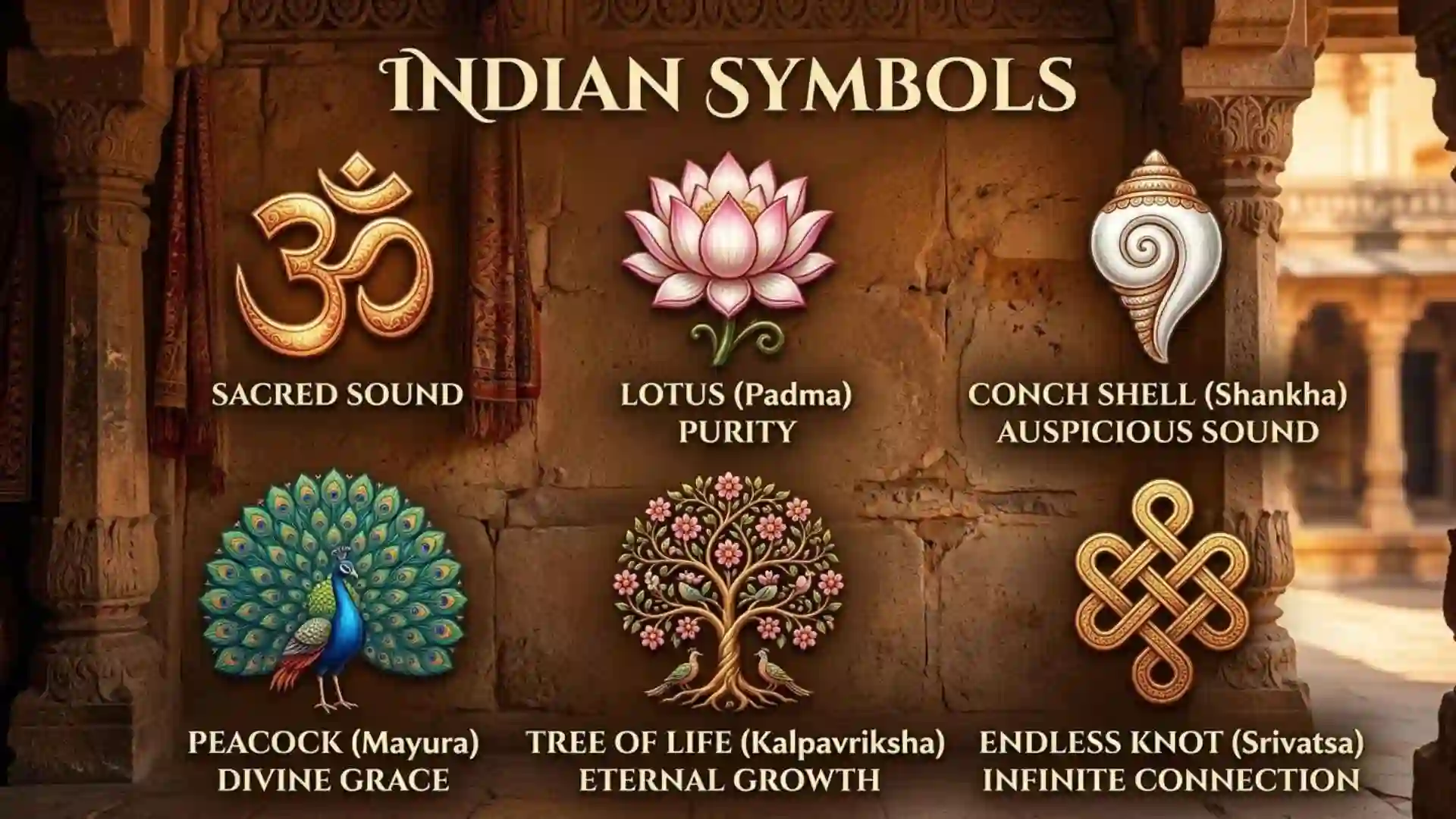
Indian symbols carry stories that stretch across thousands of years, from ancient temples and sacred texts to modern national identity.
They express ideas that words cannot always capture, including purity, courage, protection, wisdom, balance, and spiritual freedom.
A lotus, wheel, hand gesture, or simple sound may connect daily life with mythology, philosophy, and human emotion.
By exploring their hidden meanings, you can better understand how India’s diverse communities view life, nature, consciousness, and the universe.
Quick Answer
Indian symbols are visual signs, sacred sounds, animals, plants, objects, and gestures that represent India’s religious beliefs, cultural values, history, and national identity. Common examples include Om, the lotus, Ashoka Chakra, swastika, trishula, diya, peacock, tiger, banyan tree, and various mudras used in worship, meditation, art, and ceremonies.
Quick Facts About Indian Symbols
| Aspect | Information |
| Origin | Many developed in the Indus Valley, Vedic culture, Buddhism, Jainism, Hindu traditions, and later Indian kingdoms |
| Historical Significance | Used in temples, coins, seals, manuscripts, royal emblems, architecture, and freedom movements |
| Main Meaning | Unity, strength, purity, cosmic order, wisdom, prosperity, and spiritual growth |
| Spiritual Meaning | Connection between the individual soul, nature, divine reality, and universal consciousness |
| Cultural Importance | Preserve beliefs, regional traditions, community identity, and shared historical memory |
| Modern Usage | Flags, government emblems, festivals, tattoos, jewelry, yoga spaces, fashion, films, and branding |
What Are Indian Symbols?
Indian symbols are images, sounds, gestures, animals, plants, and geometric designs that communicate important cultural or spiritual ideas. Some represent the Republic of India, while others belong to Hinduism, Buddhism, Jainism, Sikhism, tribal traditions, regional customs, or folk art.
Their roots reach back to some of South Asia’s earliest civilizations. Archaeological seals from the Indus Valley contain animals, human figures, trees, and geometric forms whose full meanings remain uncertain. Later Vedic literature, Buddhist monuments, Jain manuscripts, Hindu temples, royal dynasties, and regional art expanded India’s symbolic vocabulary.
Indian symbols evolved because the subcontinent was never culturally uniform. Different communities often shared a symbol while interpreting it in distinct ways. The lotus, for example, appears in Hindu, Buddhist, Jain, artistic, political, and architectural traditions.
Symbols also made complex teachings easier to remember. A wheel could represent law, moral movement, time, or the cycle of life. A lamp could communicate knowledge defeating ignorance. Through repeated use in rituals and stories, these objects became part of India’s cultural memory.
Deep Symbolic Meaning of Indian Symbols
Spiritual Level
Many Indian symbols describe a journey from confusion to awareness. The lotus rises from muddy water yet opens clean and bright, making it a symbol of spiritual purity and inner awakening.
Om represents the sacred vibration associated with existence and consciousness. In meditation, chanting Om may help practitioners focus their breathing, quiet mental distractions, and feel connected to something larger than the individual self.
The diya, or oil lamp, represents knowledge, hope, and divine presence. Lighting a lamp during prayer or Diwali expresses the victory of light over darkness and wisdom over ignorance.
Yoga also reflects the Indian ideal of uniting body, mind, and spirit. UNESCO describes yoga as an ancient Indian practice involving postures, controlled breathing, meditation, chanting, and techniques aimed at self-realization and well-being.
Psychological Level
From a psychological viewpoint, symbols turn invisible feelings into visible forms. A lion may awaken courage, while a protective hand may create emotional safety.
Carl Jung’s idea of archetypes helps explain why circles, trees, animals, mothers, heroes, and journeys appear across human cultures. Indian mandalas and chakras often organize complicated inner experiences into balanced visual patterns.
The banyan tree can represent psychological stability because its roots descend from wide branches and create new trunks. It feels permanent, sheltering, and connected. The lotus offers another emotional lesson: difficult surroundings do not have to define personal character.
Cultural Level
Indian symbols build belonging. Rangoli patterns at an entrance may welcome guests, invite prosperity, and mark a festival. Turbans, sacred threads, tilaks, jewelry, flags, and regional motifs can express family background, faith, community, or place.
However, India contains many religions and cultural traditions. No single symbol represents every Indian in exactly the same way. Respectful interpretation requires attention to regional, historical, and religious context.
Types and Variations of Indian Symbols
Om
Visual description: A flowing Sanskrit-based sacred character.
Meaning and symbolism: Om represents primordial sound, consciousness, and the unity of existence.
Cultural connection: It is important in Hinduism and also appears in Buddhist, Jain, and yogic traditions.
Where it appears: Temples, manuscripts, meditation rooms, jewelry, artwork, and tattoos.
Lotus
Visual description: A many-petaled flower rising above water.
Meaning and symbolism: Purity, beauty, rebirth, detachment, and enlightenment.
Cultural connection: Hindu deities such as Lakshmi and Brahma are commonly shown with lotuses. The flower is also central to Buddhist imagery.
Where it appears: Sculpture, paintings, yoga philosophy, architecture, mandalas, and political design.
Ashoka Chakra
Visual description: A navy-blue wheel with 24 spokes.
Meaning and symbolism: Dharma, law, movement, responsibility, and moral progress.
Cultural connection: It is based on the wheel associated with Emperor Ashoka and appears at the center of India’s national flag.
Where it appears: The Tiranga, government imagery, monuments, educational material, and civic ceremonies.
Lion Capital of Ashoka
Visual description: Four lions standing back to back above a circular base, although only three are visible from most angles.
Meaning and symbolism: Courage, authority, confidence, and the spread of ethical law.
Cultural connection: The original sculpture stands at Sarnath, where Buddhist tradition connects the Buddha with his first sermon. India adopted the Lion Capital as its State Emblem on January 26, 1950.
Where it appears: Currency, passports, official documents, courts, and government buildings.
Swastika
Visual description: A cross with arms bent at right angles.
Meaning and symbolism: Well-being, good fortune, auspiciousness, prosperity, and cosmic order.
Cultural connection: It has ancient sacred importance in Hindu, Buddhist, and Jain traditions.
Where it appears: Homes, temples, wedding rituals, business openings, manuscripts, and festival decorations.
The traditional Indian swastika should not be confused with the Nazi emblem. The Indian symbol existed for centuries before Nazism and carries very different religious and cultural meanings.
Trishula
Visual description: A three-pronged spear or trident.
Meaning and symbolism: Divine power, protection, and mastery over opposing forces.
Cultural connection: It is strongly associated with Shiva. Its three points may represent creation, preservation, and destruction, or past, present, and future.
Where it appears: Temples, statues, devotional art, festival processions, and sacred objects.
Mudras
Visual description: Carefully arranged hand and finger positions.
Meaning and symbolism: Teaching, protection, meditation, compassion, fearlessness, or divine blessing.
Cultural connection: Mudras appear in Hindu worship, Buddhist art, classical Indian dance, yoga, and meditation.
Where it appears: Temple sculptures, paintings, dance performances, rituals, and spiritual practice.
Peacock
Visual description: A bright blue and green bird with an eye-patterned feather train.
Meaning and symbolism: Beauty, royalty, pride, renewal, protection, and grace.
Cultural connection: The peacock is associated with Krishna, Saraswati, and Kartikeya. The Indian peafowl is also India’s national bird.
Where it appears: Miniature paintings, textiles, jewelry, architecture, dance costumes, and national imagery.
Indian Symbols Across Different Cultures
Ancient Egypt
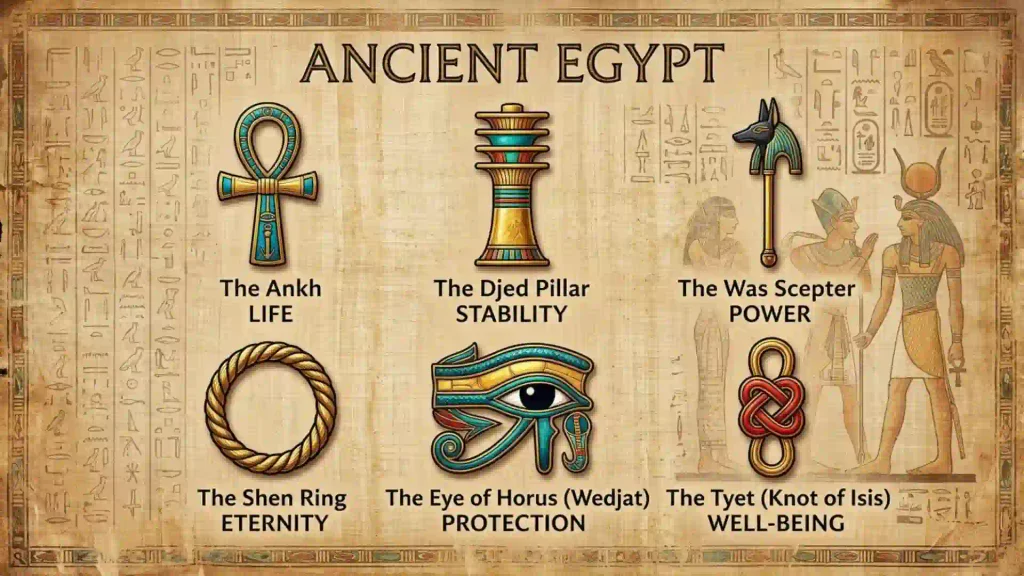
Egyptian and Indian cultures both used lotus imagery. In Egypt, the flower was connected with the sun, creation, and rebirth. In Indian traditions, it more often expresses spiritual purity, divine beauty, and enlightenment.
Ancient Greece
Greek mythology used thunderbolts, owls, olive branches, and sacred animals to identify gods and human qualities. Indian mythology works similarly, using objects such as Shiva’s trishula, Vishnu’s chakra, and Saraswati’s veena to express divine powers.
Roman Culture
Roman standards and imperial eagles represented state power and military unity. India’s modern flag, Ashoka Chakra, and State Emblem also create national unity, although their central themes emphasize moral law, historical continuity, and sovereignty.
Eastern Traditions
Indian Buddhism carried symbols such as the lotus, dharma wheel, mudras, stupas, and mandalas into Tibet, China, Korea, Japan, and Southeast Asia. Local cultures adapted their appearance while preserving many of their spiritual meanings.
Indigenous Traditions
India’s Adivasi communities use distinctive animal figures, trees, human forms, dots, and geometric patterns. Warli, Gond, Bhil, and other visual traditions often express relationships among people, ancestors, land, farming, animals, and seasonal cycles.
Modern Interpretations
Today, Indian symbols may represent spirituality, cultural pride, national identity, fashion, wellness, or personal growth. Their meaning depends on whether they appear in a temple, political setting, yoga studio, artwork, tattoo, or commercial product.
Similar Symbols and Their Meanings
| Indian Symbol | Similar Symbol | Shared Meaning | Key Difference |
| Lotus | Egyptian water lily | Rebirth and renewal | Indian traditions emphasize purity and enlightenment |
| Ashoka Chakra | Buddhist dharma wheel | Moral teaching and movement | The Ashoka Chakra also represents the Indian nation |
| Banyan tree | Tree of Life | Connection, wisdom, and continuity | The banyan has specific roots in Indian village and sacred life |
| Diya | Candle or sacred flame | Hope and illumination | The diya has strong ritual importance in Indian festivals |
| Mandala | Sacred circle | Wholeness and cosmic balance | Indian mandalas follow particular religious and meditative systems |
| Trishula | Trident | Authority and power | The trishula is closely connected with Shiva and Indian cosmology |
A common misconception is that similar-looking symbols always have identical meanings. Their shapes may be related, but cultural context determines how communities understand them.
Indian Symbols in Mythology and Folklore
Indian mythology uses symbols as a form of visual storytelling. Vishnu’s discus, the Sudarshana Chakra, represents divine order and the destruction of harmful forces. Shiva’s third eye symbolizes higher perception but also the power to burn away illusion.
Ganesha’s elephant head represents intelligence, memory, and the ability to overcome obstacles. His large ears suggest careful listening, while his small eyes encourage concentration.
Lakshmi’s lotus expresses prosperity joined with spiritual purity. Saraswati’s veena represents learning, harmony, music, and disciplined creativity. Hanuman’s mace symbolizes strength guided by loyalty and service.
Folklore also gives symbolic meaning to snakes, rivers, mountains, trees, cows, monkeys, and birds. These stories taught moral values while preserving respect for nature and community memory.
Indian Symbols in Art, Literature, Movies, and Pop Culture
Indian art has used symbolic imagery for centuries. Temple carvings communicate divine stories through posture, clothing, animals, weapons, flowers, and hand gestures. Miniature paintings use color and setting to express love, devotion, power, or separation.
Indian poetry often treats rivers as mothers, the nation as sacred land, and the monsoon as a symbol of longing and renewal. During the independence movement, images such as Bharat Mata, the spinning wheel, and the tricolor became powerful signs of unity and resistance.
Modern films use diyas, wedding colors, temple bells, rain, bindis, and national flags to create emotional meaning. Fashion designers frequently reinterpret paisley, lotus, peacock, mandala, and block-print motifs.
Tattoos may feature Om, Sanskrit words, chakras, elephants, or lotuses. Because many of these images are sacred, thoughtful use and accurate understanding are important.
Spiritual and Dream Meaning of Indian Symbols
Dreaming of a lotus may suggest emotional growth, recovery, or calm emerging from hardship. A diya may represent hope, guidance, or a truth becoming clearer.
An elephant can symbolize wisdom, family loyalty, patience, or the strength to remove obstacles. A snake may represent fear, hidden energy, healing, transformation, or spiritual awakening depending on the dream’s emotional tone.
Dream symbols are not fixed predictions. Personal experiences, religious background, and feelings within the dream matter more than a universal dictionary meaning.
During meditation, geometric forms, colors, sounds, or sacred images may help focus attention. Such experiences should be approached with curiosity rather than treated as guaranteed supernatural messages.
Positive and Negative Meanings of Indian Symbols
| Positive Meaning | Negative or Cautionary Meaning |
| Lotus: purity and awakening | Detachment taken to emotional isolation |
| Tiger: courage and strength | Aggression or uncontrolled power |
| Snake: renewal and wisdom | Fear, deception, or danger |
| Fire: knowledge and purification | Destruction or anger |
| Peacock: beauty and confidence | Pride or vanity |
| Wheel: progress and moral action | Endless repetition or feeling trapped |
| Third eye: insight and awareness | Harsh judgment or destructive revelation |
A symbol can contain both light and shadow because human life contains both. Fire warms a home but can also destroy it. Power may protect or dominate. Context gives the symbol its final emotional meaning.
Why Humans Are Attracted to Indian Symbols
People naturally search for patterns that make life feel meaningful. Symbols simplify complicated ideas into forms the mind can remember.
A lotus may become a personal reminder to survive hardship. A tree may represent family roots. A wheel can encourage movement when life feels stuck.
Indian symbols are especially attractive because they combine beauty with layered meaning. Their forms are often symmetrical, colorful, and connected with memorable myths.
They also carry cultural memory. Seeing a diya during Diwali or a rangoli outside a home may awaken feelings of family, celebration, safety, and belonging even before a person consciously explains why.
Modern Uses of Indian Symbols
Indian symbols now appear in tattoos, jewelry, clothing, yoga studios, home decor, digital art, and social media posts. Brands use elephants, lotuses, peacocks, paisley, and mandalas to suggest wisdom, luxury, wellness, or cultural richness.
The rupee sign, adopted in 2010, combines the Devanagari letter “र” with elements resembling the Roman “R.” It gives Indian currency a clear visual identity in global communication.
Traditional symbolism also remains alive through festivals, rituals, crafts, classical dance, wedding customs, temple architecture, and community art. Rather than belonging only to the past, these symbols continue to change as each generation gives them new meaning.
Interesting Facts About Indian Symbols
- The Ashoka Chakra contains 24 spokes and appears in the center of India’s national flag.
- The Lion Capital used as India’s State Emblem comes from an Ashokan pillar at Sarnath.
- Mudras can communicate complete ideas without spoken language.
- Rangoli designs are often temporary, reminding viewers that beauty does not need to be permanent.
- The banyan can grow additional trunks when aerial roots reach the soil.
- The peacock appears in religion, royal art, textiles, dance, and national identity.
- Om is treated as both a written symbol and a sacred sound.
- Yoga was added to UNESCO’s Representative List of the Intangible Cultural Heritage of Humanity in 2016.
- The sacred Indian swastika has an ancient meaning of well-being and should not be interpreted through Nazi symbolism.
- Indian symbols frequently cross religious boundaries while receiving different interpretations in Hindu, Buddhist, Jain, Sikh, and folk traditions.
Frequently Asked Questions
What are the most famous Indian symbols?
The best-known Indian symbols include Om, the lotus, Ashoka Chakra, Lion Capital, swastika, diya, trishula, peacock, tiger, elephant, banyan tree, and sacred mudras.
What is the main symbol of India?
India has several major national symbols. The Ashoka Chakra appears on the national flag, while the Lion Capital of Ashoka serves as the State Emblem.
What does the lotus symbolize in Indian culture?
The lotus commonly represents purity, spiritual awakening, beauty, resilience, divine creation, and the ability to rise above difficult conditions.
Is Om only a Hindu symbol?
Om is especially important in Hindu traditions, but it also appears in Buddhism, Jainism, yoga, meditation, and several wider South Asian spiritual practices.
Why is the swastika sacred in India?
In Indian religions, the swastika is an ancient sign of well-being, prosperity, harmony, and auspicious beginnings. Its sacred history predates its misuse by Nazi Germany.
What Indian symbol represents protection?
Several symbols represent protection, including the trishula, protective mudras, Hanuman’s mace, sacred yantras, and certain images of deities such as Durga and Ganesha.
Conclusion
Indian symbols reveal how history, faith, nature, and human emotion can meet within a single image.
From the lotus and diya to the Ashoka Chakra, each form carries layers of memory and meaning.
They remind us that symbols are not merely decorations but living expressions of identity, hope, courage, and transformation.
When understood with respect, they open a doorway into India’s extraordinary cultural and spiritual imagination.
 Michael Rivera
 John Mercer