
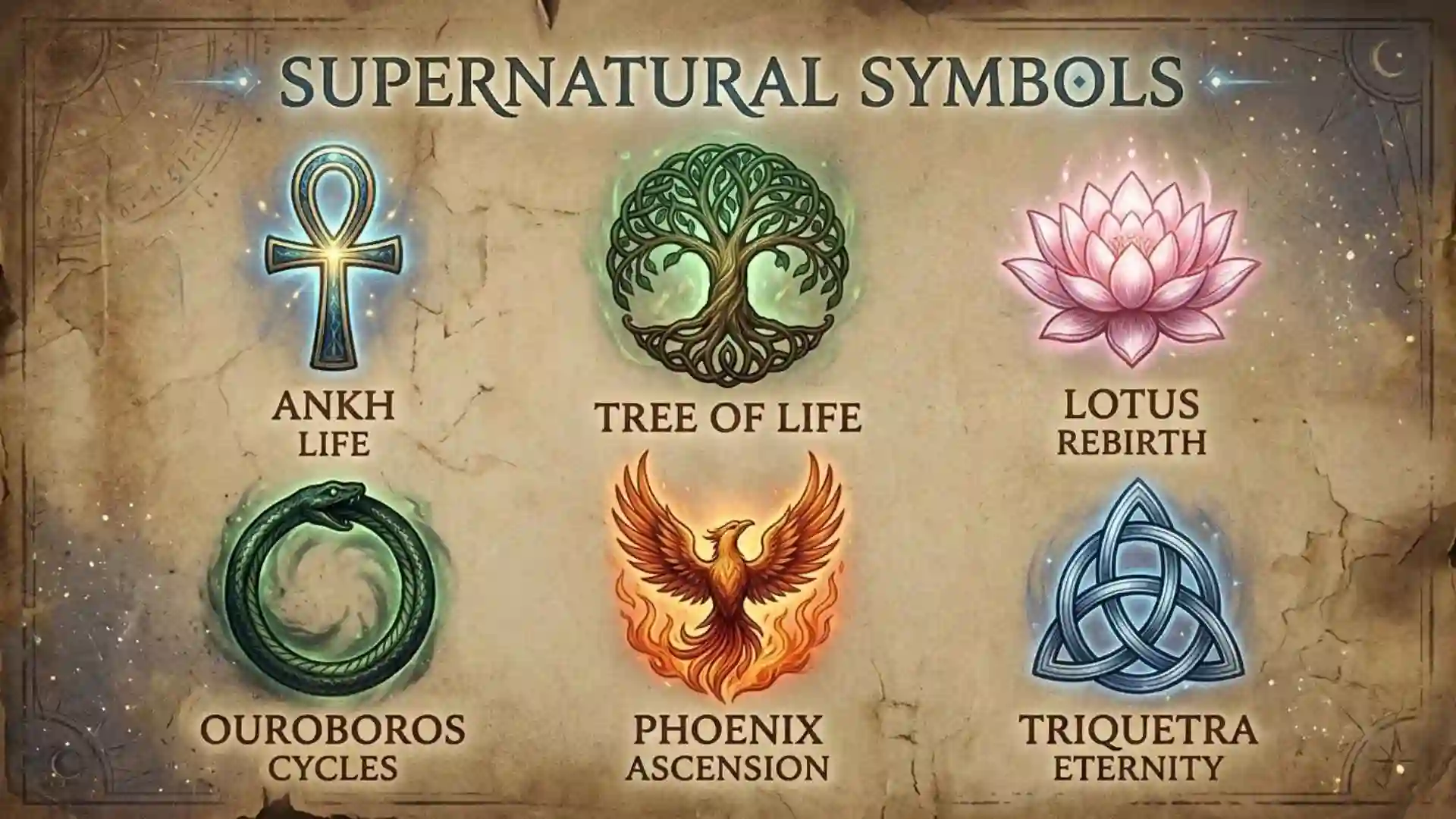
Supernatural symbols have fascinated people for centuries, appearing in ancient myths, religious traditions, folklore, spiritual practices, and mysterious stories. From protective talismans and mystical sigils to pentagrams, runes, and symbols associated with spirits, these designs often represent forces beyond ordinary human understanding. Some are believed to offer protection, attract positive energy, or connect people with the spiritual world, while others represent transformation, hidden knowledge, mystery, or the unknown.
Different cultures have developed supernatural symbols to express their beliefs about magic, life, death, spirits, and the universe. Ancient civilizations used sacred markings, amulets, and ritual objects to represent divine power or ward off misfortune. Symbols such as the Eye of Horus, the pentagram, the Ankh, and various runes have acquired rich histories and multiple interpretations over time. The meaning of a supernatural symbol often depends on its cultural origin, historical context, and the beliefs of the people who use it.
In this complete guide to supernatural symbols, you will explore their hidden meanings, ancient origins, spiritual associations, and modern interpretations. You will discover symbols connected with protection, magic, paranormal beliefs, mysterious creatures, and supernatural forces. Whether you are interested in mythology, folklore, spiritual symbolism, fantasy stories, or the mysterious side of human culture, this guide will help you understand how these intriguing symbols have shaped beliefs and inspired imaginations across generations.
Quick Answer
Supernatural symbols are visual signs associated with spiritual forces, magic, protection, divination, mythical beings, or realities beyond normal human experience. Common examples include pentagrams, sigils, protective circles, the Eye of Horus, the ankh, runes, the ouroboros, and symbols featured in supernatural fiction and television.
Quick Facts About Supernatural Symbols
| Aspect | Information |
| Origin | Ancient religion, mythology, folk magic, astronomy, and ritual traditions |
| Historical Significance | Used to communicate sacred ideas, seek protection, mark identity, and explain unknown forces |
| Main Meaning | Connection with magic, spirits, hidden knowledge, fate, or the unseen world |
| Spiritual Meaning | Protection, transformation, balance, divine power, or communication with higher realms |
| Cultural Importance | Reflects the beliefs, fears, values, and spiritual systems of different communities |
| Modern Usage | Tattoos, jewelry, television, movies, fashion, gaming, branding, and personal spirituality |
What Are Supernatural Symbols?
Supernatural symbols are shapes, images, letters, objects, or patterns linked to forces believed to exist beyond the natural world. They may represent gods, spirits, demons, ancestors, cosmic powers, magical protection, or hidden knowledge.
Some symbols began as sacred religious signs. Others developed through mythology, alchemy, astrology, folklore, or ceremonial magic. Over time, their meanings changed as cultures met, religions evolved, and artists reused old images in new settings.
For example, the pentagram has appeared in several religious and magical traditions. Its meaning has included harmony, protection, humanity, the five elements, and, in some modern contexts, Satanism. The direction, surrounding design, and cultural setting greatly affect its interpretation.
A sigil is another common supernatural sign. It is usually a designed mark associated with a specific intention, spiritual being, magical purpose, or fictional power. Renaissance magical texts included sigils connected with angels and demons, while modern practitioners may create personal sigils to represent goals or ideas.
Supernatural symbols became important because they gave visible form to invisible ideas. A person cannot easily draw fear, destiny, protection, or spiritual energy, but a circle, eye, star, serpent, or knot can carry those meanings.
Deep Symbolic Meaning of Supernatural Symbols
Spiritual Level
Spiritually, supernatural symbols often act as bridges between the physical and invisible worlds. They may represent prayer, protection, divine presence, sacred order, or transformation.
A closed circle can symbolize wholeness and a protected spiritual boundary. An eye may represent divine awareness or watchfulness. A serpent can suggest healing, danger, knowledge, death, or renewal because snakes shed their skin.
These symbols do not have one universal meaning. Their spiritual significance depends on the belief system in which they appear.
Psychological Level
Psychologically, supernatural imagery gives shape to emotions that are difficult to explain. Carl Jung described archetypes as recurring patterns found in myths, dreams, stories, and the human imagination.
The shadow, wise elder, divine child, serpent, dark forest, and protective circle can all function as archetypal images. They may reflect inner conflict, hidden fears, personal growth, or the need for safety.
Someone attracted to a protective symbol may be responding to a deep desire for control during an uncertain time. A symbol of rebirth may appeal to a person recovering from loss or beginning a new chapter.
Cultural Level
Culturally, supernatural symbols preserve shared stories. They tell us what a community feared, honored, protected, or considered sacred.
A carved sign over a doorway may reveal a historical fear of evil spirits. A burial symbol may express beliefs about the afterlife. A family amulet can become a sign of identity passed from one generation to another.
However, historical interpretations require care. Some marks called “witch marks” may have served protective purposes, while others could have been decorative patterns or geometric practice by craftspeople. Context and archaeological evidence matter more than sensational claims.
Types and Variations of Supernatural Symbols
Pentagram and Pentacle
A pentagram is a five-pointed star. When surrounded by a circle, it is often called a pentacle.
It has represented balance, protection, human life, sacred geometry, and the five elements. In Christian history, it was sometimes connected with the five wounds of Christ. In modern Pagan traditions, it may represent earth, air, fire, water, and spirit.
Its inverted form has gained darker associations in modern occultism and popular culture, but not every pentagram is a demonic sign.
Protective Circle
A protective circle is drawn as a complete boundary, sometimes filled with names, letters, stars, or religious signs.
In folklore and ceremonial traditions, circles can separate sacred space from ordinary space. In modern fantasy and horror stories, they may trap spirits, block demons, or protect a person performing a ritual.
The circle itself represents completeness, unity, and containment.
Sigils
Sigils are designed marks created to express a name, being, intention, or magical purpose.
Historical grimoires included sigils connected with spiritual entities. Modern occult practices may use personally designed sigils during meditation or ritual. Fictional stories often use them as magical locks, summoning signs, or protective seals.
The Eye of Horus
The Eye of Horus comes from ancient Egyptian religion. It is commonly connected with protection, healing, royal power, and restoration.
Its meaning grew from myths involving Horus and his damaged eye. Because the eye was restored, it became a powerful sign of recovery and wholeness.
Ankh
The ankh is an ancient Egyptian cross-like symbol with a loop at the top. It represents life and is often interpreted as eternal life.
Egyptian art frequently shows deities holding the ankh, sometimes presenting it toward a ruler. In modern culture, it appears in jewelry, Gothic fashion, tattoos, and spiritual design.
Ouroboros
The ouroboros shows a serpent or dragon eating its own tail.
It represents endless cycles, unity, destruction, renewal, eternity, and the idea that endings create new beginnings. It appears in ancient Egyptian imagery, later Greek thought, alchemy, philosophy, and modern fantasy.
Runes
Runes were letters used in early Germanic writing systems, especially in northern Europe.
Although they served practical writing purposes, some runes also gained religious, magical, or divinatory meanings. Modern media often presents them as mysterious supernatural signs, sometimes without respecting their historical language-based origins.
Triquetra
The triquetra consists of three connected loops or pointed sections.
It can symbolize threefold unity, eternity, interconnectedness, or spiritual balance. It has appeared in Celtic-style artwork, Christian decoration, modern Pagan imagery, jewelry, fantasy television, and tattoo design.
Supernatural Symbols Across Different Cultures
Ancient Egypt
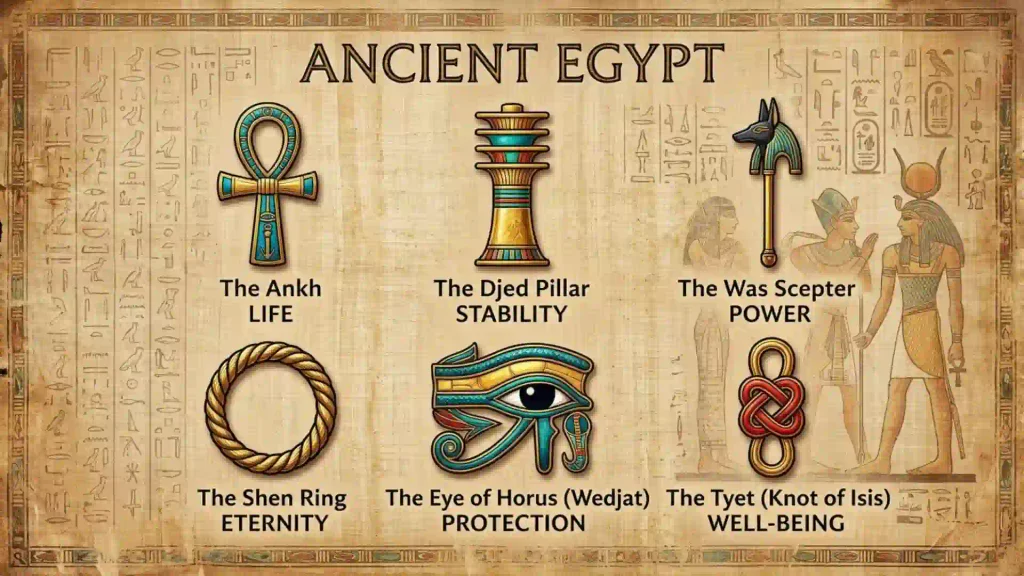
Ancient Egyptian culture used symbols such as the ankh, scarab, Eye of Horus, and djed pillar. These images represented life, protection, resurrection, stability, healing, and divine authority.
They appeared in temples, tombs, amulets, coffins, and royal art because Egyptians believed symbols could support the soul in both life and death.
Ancient Greece
Greek mythology used symbolic objects linked to gods and heroes. Zeus carried the thunderbolt, Poseidon held the trident, Athena was connected with the owl, and Hermes carried the caduceus.
These signs communicated divine identity and power. Later Greek magical texts also included mysterious letters, names, stars, and protective designs.
Roman Culture
Romans adopted many Greek symbols but connected them with Roman religion, household spirits, imperial authority, and daily protection.
Homes sometimes contained religious images honoring protective household deities. Amulets and charms were also used against misfortune, envy, and harmful spiritual influence.
Eastern Traditions
Chinese culture includes the bagua, yin-yang symbol, talismanic writing, dragons, and protective door figures. The bagua consists of eight trigrams and is connected with the I Ching, cosmology, balance, direction, and patterns of change.
In Hindu and Buddhist traditions, mandalas may represent the structure of the cosmos, spiritual order, meditation, and the journey toward deeper awareness.
Indigenous Traditions
Indigenous traditions are diverse and should never be treated as one belief system. Different communities use sacred animals, geometric patterns, masks, colors, carvings, and ceremonial objects with meanings tied to their own histories.
Some symbols may represent ancestors, land, dreams, healing, protection, or spiritual relationships. Sacred designs should be understood through the community that created them rather than copied without context.
Modern Interpretations
Today, supernatural imagery blends religion, folklore, horror, fantasy, gaming, and personal spirituality.
People may wear a symbol because of its traditional meaning, its appearance in a favorite story, or the emotional memory attached to it. Modern interpretations are often personal, but historical meanings should still be respected.
Similar Symbols and Their Meanings
| Symbol | Main Meaning | Common Misconception |
| Pentagram | Protection, balance, five elements | Always represents evil |
| Hexagram | Unity of opposites, sacred authority | Has only one religious meaning |
| Protective circle | Safety, boundaries, containment | Automatically summons spirits |
| Sigil | Spiritual name, intention, or purpose | Every sigil is demonic |
| Ouroboros | Cycles, eternity, rebirth | Represents only destruction |
| Eye symbol | Awareness, protection, divine sight | Every eye symbol has the same origin |
| Rune | Letter, sound, cultural sign | All runes were originally magical spells |
Similar symbols can look alike while carrying very different meanings. A six-pointed star may be a religious emblem, magical seal, decorative shape, or fictional device depending on its setting.
The safest way to interpret a symbol is to examine its date, location, surrounding text, creators, and cultural tradition.
Supernatural Symbols in Mythology and Folklore
Myths often turn ordinary objects into supernatural signs. A sword may prove rightful kingship. A doorway may mark the border between worlds. A mirror may reveal truth, trap a spirit, or act as a passage.
In European folklore, iron was sometimes believed to repel fairies or harmful beings. Salt became associated with purity and protection. Knots could symbolize binding, fate, love, or magical restraint.
Serpents appear across many traditions. They can represent evil and temptation, but they can also symbolize medicine, wisdom, fertility, protection, and renewal.
These stories shaped modern fantasy. When viewers see a glowing rune, broken circle, black feather, or blood-red moon, they already expect hidden danger or spiritual power because centuries of storytelling have trained us to read those signs emotionally.
Supernatural Symbols in Art, Literature, Movies, and Pop Culture
Artists use supernatural symbols to create mystery without explaining everything directly. A raven may suggest death or prophecy. A candle can represent hope, ritual, memory, or the soul. A doorway may suggest entry into another reality.
Gothic literature often uses ruined churches, moonlight, mirrors, family crests, and ancient manuscripts to create a supernatural atmosphere. Horror films use inverted religious imagery, circles, dolls, numbers, and strange writing to signal danger.
The television series Supernatural gave several fictionalized occult signs a major place in modern fandom. Its best-known design is the anti-possession symbol worn by Sam and Dean Winchester. It combines a pentagram-like endless knot with a circular sun form and functions within the story as protection against demonic possession.
The series also uses Devil’s Traps, sigil-based circles designed to hold demons. Once a demon is trapped inside, it cannot escape unless the boundary is broken, according to the show’s fictional rules.
These designs now appear on fan tattoos, jewelry, clothing, posters, and home decor. Many fans use them not as literal magical objects, but as signs of courage, loyalty, survival, and connection with the Winchester brothers’ story.
Spiritual and Dream Meaning of Supernatural Symbols
Seeing a supernatural symbol in a dream does not prove that a spirit is contacting you. Dreams often combine memory, emotion, fear, imagination, and recent experiences.
A circle may reflect a need for safety or completion. An eye may suggest self-awareness, judgment, or the feeling of being watched. A locked door may represent a hidden memory or blocked opportunity.
A pentagram could reflect protection, fear of the occult, spiritual curiosity, or media recently watched. A serpent may suggest transformation, danger, healing, or distrust depending on the dreamer’s emotions.
The most useful question is not simply, “What does this symbol mean?” Instead, ask:
What did I feel when I saw it?
Where did it appear?
Did it protect, threaten, guide, or confuse me?
Personal emotion often reveals more than a fixed dream dictionary.
Positive and Negative Meanings of Supernatural Symbols
| Positive Meaning | Negative Meaning |
| Protection | Fear |
| Spiritual awakening | Obsession |
| Transformation | Destruction |
| Hidden wisdom | Deception |
| Personal strength | Control |
| Sacred mystery | Confusion |
| Rebirth | Death |
| Connection | Possession |
| Balance | Chaos |
| Courage | Danger |
A single symbol can contain both light and shadow. Fire warms a home but can also destroy it. A serpent can represent healing or danger. An eye can suggest protection or unwanted surveillance.
Context turns the image into a message.
Why Humans Are Attracted to Supernatural Symbols
Humans naturally search for patterns. We look at stars and imagine animals, heroes, and gods. We notice repeated numbers and wonder whether they carry a message.
Symbols help the brain compress large ideas into simple images. A single mark can communicate danger, hope, faith, identity, or belonging faster than a paragraph.
They also offer emotional control. During uncertain times, wearing a protective charm or drawing a meaningful sign may help a person feel grounded. The object may not control outside events, but it can influence attention, confidence, and emotional focus.
Supernatural symbols also connect us with cultural memory. Even when we do not know a symbol’s complete history, its shape may feel ancient because we have seen similar forms in stories, religious buildings, art, games, and films.
Modern Uses of Supernatural Symbols
Today, supernatural symbols appear in:
- Tattoos: Used to express protection, transformation, fandom, grief, or identity.
- Jewelry: Worn as amulets, decorative pieces, religious signs, or personal reminders.
- Fashion: Common in Gothic, alternative, fantasy, occult-inspired, and streetwear design.
- Branding: Used to suggest mystery, rebellion, ancient knowledge, or hidden power.
- Social media: Shared in spiritual posts, fandom artwork, usernames, and visual storytelling.
- Contemporary spirituality: Included in meditation, altar design, rituals, and intention-setting.
- Home decor: Printed on wall art, candles, blankets, carvings, and collectible objects.
- Entertainment: Used in television, movies, books, comics, games, and music imagery.
Before wearing or reproducing a sacred symbol, learn where it comes from. This prevents cultural disrespect and helps you choose a design whose meaning truly matches your intention.
Interesting Facts About Supernatural Symbols
- The pentagram has been used for protection in several historical settings and was not always viewed as an evil sign.
- Sigils can represent spiritual beings, magical intentions, organizations, fictional groups, or personal goals.
- The ouroboros appears in multiple traditions and expresses the idea that creation and destruction form one continuous cycle.
- Runes began as letters, even though modern entertainment often presents them mainly as magical signs.
- Protective markings were sometimes placed near doors, windows, fireplaces, and other openings believed to be spiritually vulnerable.
- Many symbols change meaning when inverted, enclosed in a circle, combined with letters, or placed in a different cultural setting.
- The anti-possession tattoo from Supernatural became one of the show’s most recognizable fan designs.
- A symbol’s modern popular meaning can be very different from its earliest historical use.
- Not every mysterious carving found in an old building was created for magic or protection.
- Personal experience can influence symbolic interpretation as strongly as traditional history.
Frequently Asked Questions
What is the most common supernatural symbol?
The pentagram is one of the most widely recognized supernatural symbols, although its meaning ranges from balance and protection to modern occult or Satanic associations.
What does the supernatural anti-possession symbol mean?
In the television series Supernatural, it protects the wearer from demonic possession. Its design combines a pentagram-like knot with a circular form.
Are supernatural symbols evil?
No. Many represent protection, healing, life, balance, wisdom, or spiritual transformation. Meaning depends on history, orientation, culture, and context.
What symbols protect against evil spirits?
Protective symbols vary by tradition and may include eyes, circles, crosses, pentacles, sacred names, amulets, knots, or culturally specific talismans.
What does it mean to dream about supernatural symbols?
Such dreams may reflect fear, curiosity, transformation, spiritual questions, recent media, or a desire for protection. The dream’s emotional context is essential.
Can a symbol have more than one meaning?
Yes. Most ancient symbols have developed multiple religious, cultural, psychological, and modern meanings over time.
Conclusion
Supernatural symbols reveal humanity’s lasting desire to understand what cannot be easily seen or explained.
They carry stories of protection, fear, transformation, faith, death, and renewal across cultures and generations.
Whether found in an ancient temple, a dream, a tattoo, or a television series, their meaning depends on context and personal connection.
The deeper we study these signs, the more we learn about history and the hidden landscape of the human mind.
Sometimes the greatest mystery within a supernatural symbol is the part of ourselves that responds to it.
 Sarah Thompson
 John Mercer