
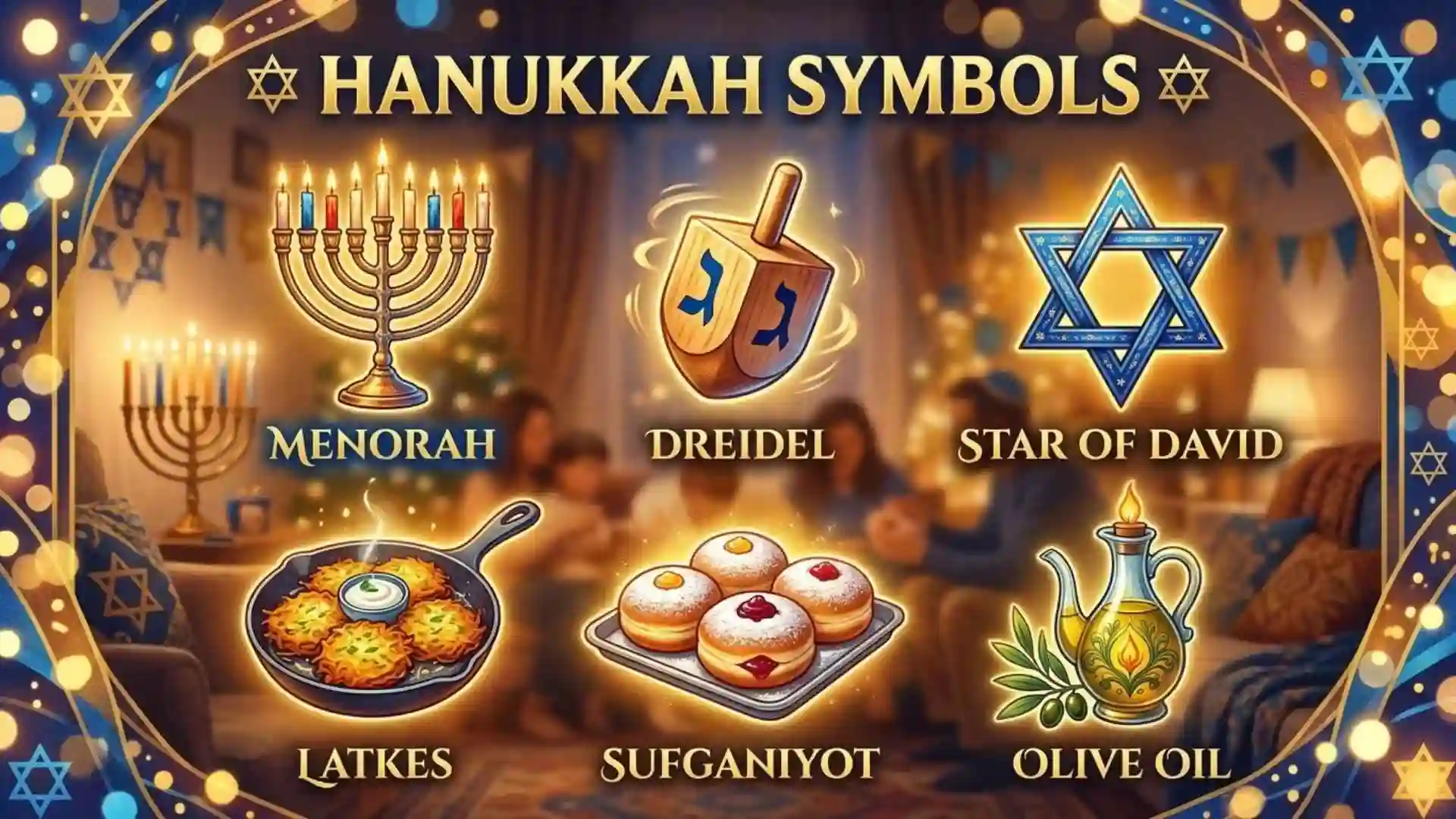
Hanukkah symbols carry deep meanings connected to light, faith, courage, hope, and Jewish identity. Celebrated for eight nights, Hanukkah, also known as the Festival of Lights, commemorates the rededication of the Second Temple in Jerusalem and the traditional story of a small amount of sacred oil burning for eight days. From the glowing Hanukkah menorah to spinning dreidels, golden gelt, and delicious oil-fried foods, each symbol helps preserve the holiday’s history, religious traditions, and joyful spirit.
Many Hanukkah symbols represent more than festive decorations or family customs. The hanukkiah, the nine-branched Hanukkah lamp, symbolizes the miracle of the oil and serves as the centerpiece of nightly celebrations. The dreidel connects to Jewish tradition and cultural memory, while candles illuminate homes with messages of hope and perseverance. Foods such as latkes and sufganiyot recall the oil at the heart of the Hanukkah story. Together, these symbols express resilience, religious freedom, gratitude, and the importance of keeping traditions alive across generations.
In this guide to Hanukkah symbols and their hidden meanings, you will discover the history, spiritual significance, and cultural importance behind the holiday’s most recognizable objects and customs. You will learn what the menorah, dreidel, Star of David, traditional foods, gifts, and other symbols represent, along with how Jewish families celebrate Hanukkah around the world. Whether you are exploring Jewish history, learning about religious symbolism, or preparing to celebrate with loved ones, this guide will help you understand the deeper meaning behind the Festival of Lights.
Quick Answer
Hanukkah symbols are objects, foods, colors, games, and rituals connected with the Jewish Festival of Lights. The most important symbols include the nine-branched hanukkiah, candles or oil, the dreidel, Hanukkah gelt, fried foods, and the Maccabees. Together, they represent religious freedom, divine help, Jewish identity, courage, remembrance, and hope.
Quick Facts About Hanukkah Symbols
| Aspect | Information |
| Origin | Ancient Judea during the second century BCE |
| Historical Significance | Commemorate the Maccabean revolt and the rededication of the Second Temple in Jerusalem |
| Main Meaning | Light, courage, dedication, religious freedom, and Jewish continuity |
| Spiritual Meaning | Faith can grow even during fear, oppression, or uncertainty |
| Cultural Importance | Connects Jewish families with history, tradition, community, and identity |
| Modern Usage | Candle lighting, public displays, games, food, art, jewelry, decorations, and education |
What Are Hanukkah Symbols?
Hanukkah symbols are visual objects and traditional practices associated with the eight-day Jewish holiday of Hanukkah, also spelled Chanukah. The Hebrew word Hanukkah means “dedication,” referring to the rededication of the Temple in Jerusalem after the Maccabees regained control of it more than 2,000 years ago.
The holiday begins on the twenty-fifth day of Kislev in the Hebrew calendar. Its historical background comes from events in the second century BCE, when the Seleucid ruler Antiochus IV attempted to suppress Jewish religious practices. A Jewish resistance movement led by the priestly Hasmonean family, commonly called the Maccabees, fought against this control.
After entering Jerusalem, the Jewish fighters purified and rededicated the Temple. Later rabbinic tradition focused on a small amount of ritually pure oil that was said to have burned for eight days, long enough for new oil to be prepared.
Over time, the symbols of Hanukkah developed around these connected themes:
- The military and spiritual courage of the Maccabees
- The rededication of the Temple
- The miracle associated with oil
- The right to maintain Jewish worship and identity
- The responsibility to bring light into dark places
Hanukkah symbols became important because they make these themes visible. A child may first learn the story through candles, coins, songs, food, and a spinning top. As that child grows, the same symbols can reveal deeper lessons about memory, resilience, responsibility, and faith.
Deep Symbolic Meaning of Hanukkah Symbols
Spiritual Meaning
At the spiritual level, Hanukkah symbols teach that holiness can begin with something small.
One lamp does not remove every shadow at once. However, the Hanukkah lights increase night by night. A single flame becomes two, then three, until the full hanukkiah shines. This gradual growth suggests that spiritual transformation often happens through repeated choices rather than one dramatic moment.
Oil also carries strong spiritual meaning. It fuels the light while remaining mostly unseen. In Jewish interpretation, this can represent inner faith, wisdom, and sacred potential. A person may feel that their courage is limited, yet even a small reserve can carry them farther than expected.
The shamash, or helper light, offers another spiritual lesson. It serves the other lights without losing its own flame. Symbolically, kindness works in the same way. Sharing knowledge, comfort, or hope does not reduce what a person possesses. It often increases light for everyone.
Psychological Meaning
Psychologically, light is one of humanity’s strongest symbols of safety, awareness, and hope. Darkness can represent fear, confusion, isolation, or uncertainty. A flame gives the mind a visible point of focus and creates a sense of warmth and control.
From a Jungian perspective, Hanukkah imagery can be understood through universal archetypes such as light versus darkness, the courageous rebel, the threatened community, and the return to a sacred center. These patterns appear in many stories, but Hanukkah places them within a specific Jewish historical and religious experience.
The Maccabees represent resistance to forced conformity. Their story speaks to a basic emotional need: the desire to remain true to one’s values when outside pressure demands surrender.
The yearly repetition of Hanukkah rituals also strengthens cultural memory. Lighting candles, singing familiar songs, and preparing traditional foods can provide emotional stability. These actions tell participants, “You belong to a story that began before you and can continue after you.”
Cultural Meaning
Culturally, Hanukkah symbols strengthen family and community bonds. They connect Jews living in different countries through recognizable practices while also allowing regional traditions to flourish.
An Ashkenazi family may prepare potato latkes, while Sephardic and Mizrahi communities may enjoy foods such as bimuelos, sfenj, or other oil-fried pastries. Israeli celebrations often feature sufganiyot, or filled doughnuts. These foods differ, but the oil connects them to the same central memory.
Hanukkah symbols therefore express unity without demanding sameness. They show how a shared tradition can remain recognizable while adapting to different languages, places, ingredients, and family customs.
Types and Variations of Hanukkah Symbols
The Hanukkiah
Visual description: A lamp or candelabrum with eight lights in a row and a separate ninth light called the shamash.
Meaning: The eight lights recall the eight days associated with the oil miracle.
Symbolism: Faith, increasing holiness, public remembrance, spiritual courage, and the spread of light.
Cultural connection: The hanukkiah is the central ritual object of Hanukkah. One additional light is kindled on each night until all eight are burning.
Where it appears: Homes, synagogues, community centers, public squares, paintings, greeting cards, jewelry, and holiday decorations.
The nine-branched hanukkiah is often casually called a menorah. Technically, however, the ancient Temple menorah had seven branches, while the Hanukkah lamp has eight ceremonial lights plus the shamash.
Candles and Flames
Visual description: Small flames lit from right to left in placement and traditionally kindled beginning with the newest light.
Meaning: The lights recall both the Temple’s rededication and the miracle tradition.
Symbolism: Hope, truth, divine presence, memory, knowledge, and moral courage.
Cultural connection: Families often place the hanukkiah near a window or doorway so its light can be seen. This reflects the principle of publicizing the miracle.
Where it appears: Religious observance, photography, poetry, memorial art, public ceremonies, and family gatherings.
Olive Oil
Visual description: Oil placed in small cups with floating or fixed wicks, or represented through oil-fried foods.
Meaning: It recalls the purified oil associated with the Temple.
Symbolism: Purity, endurance, hidden strength, sacred service, and transformation.
Cultural connection: Oil lamps are considered a traditional way to light the hanukkiah, although candles are widely used.
Where it appears: Hanukkah lamps, historical storytelling, religious teaching, food traditions, and spiritual commentary.
The Shamash
Visual description: A ninth light positioned above, below, or apart from the other eight.
Meaning: Its name means “attendant” or “helper.” It is used to light the Hanukkah lights.
Symbolism: Service, leadership, generosity, responsibility, and shared wisdom.
Cultural connection: The ceremonial lights are treated as sacred and are not traditionally used for ordinary illumination. The shamash provides practical light.
Where it appears: Every traditional hanukkiah, whether made from silver, brass, glass, ceramic, wood, or modern materials.
The Dreidel
Visual description: A four-sided spinning top marked with Hebrew letters.
Meaning: Outside Israel, the letters nun, gimel, hei, and shin commonly stand for Nes gadol hayah sham, meaning “A great miracle happened there.” In Israel, the final letter is often peh, creating the phrase “A great miracle happened here.”
Symbolism: Memory, chance, survival, play, education, and the turning of fortune.
Cultural connection: Dreidel games are often played with coins, nuts, candy, or chocolate gelt.
Where it appears: Family games, classrooms, children’s books, songs, cartoons, ornaments, and graphic design.
A popular legend says Jewish children used spinning tops to hide Torah study from hostile authorities. Historians also connect the dreidel to European spinning-top games. This means its modern symbolism blends documented cultural development with meaningful folk tradition.
Hanukkah Gelt
Visual description: Real coins, money gifts, or chocolate coins wrapped in gold or silver foil.
Meaning: “Gelt” is the Yiddish word for money.
Symbolism: Generosity, learning, charity, reward, gratitude, and responsible use of wealth.
Cultural connection: Families historically gave small amounts of money to children, teachers, or those in need. Chocolate coins later became a popular version.
Where it appears: Dreidel games, gift bags, table decorations, classrooms, and family celebrations.
Latkes, Sufganiyot, and Fried Foods
Visual description: Potato pancakes, jelly-filled doughnuts, fritters, and regional foods cooked in oil.
Meaning: The oil used in cooking recalls the miracle of the Temple oil.
Symbolism: Memory through taste, abundance, celebration, warmth, and family connection.
Cultural connection: Latkes are especially associated with Ashkenazi communities, while sufganiyot are highly popular in Israel. Sephardic traditions include foods such as bimuelos and sfenj.
Where it appears: Homes, bakeries, synagogues, festivals, cookbooks, and holiday markets.
The Maccabees
Visual description: Often shown as determined Jewish fighters carrying shields, swords, or banners.
Meaning: They represent the Jewish revolt against Seleucid religious oppression.
Symbolism: Courage, resistance, religious freedom, identity, and dedication.
Cultural connection: The historical books of 1 and 2 Maccabees preserve major accounts of the revolt, although they are not part of the Jewish biblical canon.
Where it appears: Historical art, children’s books, songs, literature, education, and modern discussions of Jewish strength.
Blue, White, Silver, and Gold
These colors are common in modern Hanukkah decorations, especially in North America.
Blue and white often reflect broader Jewish identity and the colors associated with the flag of Israel. Silver and gold suggest candlelight, valuable oil, coins, and celebration.
However, no single color combination is required by Jewish law for Hanukkah. The strong use of blue and white is largely a modern design tradition rather than an ancient ritual rule.
The Star of David
The Star of David is frequently included in Hanukkah cards and decorations because it is a widely recognized symbol of Judaism and Jewish identity.
However, it is not specifically a Hanukkah symbol in origin. Its connection to the holiday is cultural rather than part of the central Hanukkah ritual. The hanukkiah, oil, lights, and rededication story are more directly tied to Hanukkah.
Hanukkah Symbols Across Different Cultures
Hanukkah belongs specifically to Jewish history and religion. It should not be treated as a mixture of Egyptian, Greek, Roman, Eastern, or Indigenous traditions. Still, comparing its imagery with other cultures helps explain why light carries such broad emotional power.
Ancient Jewish Culture
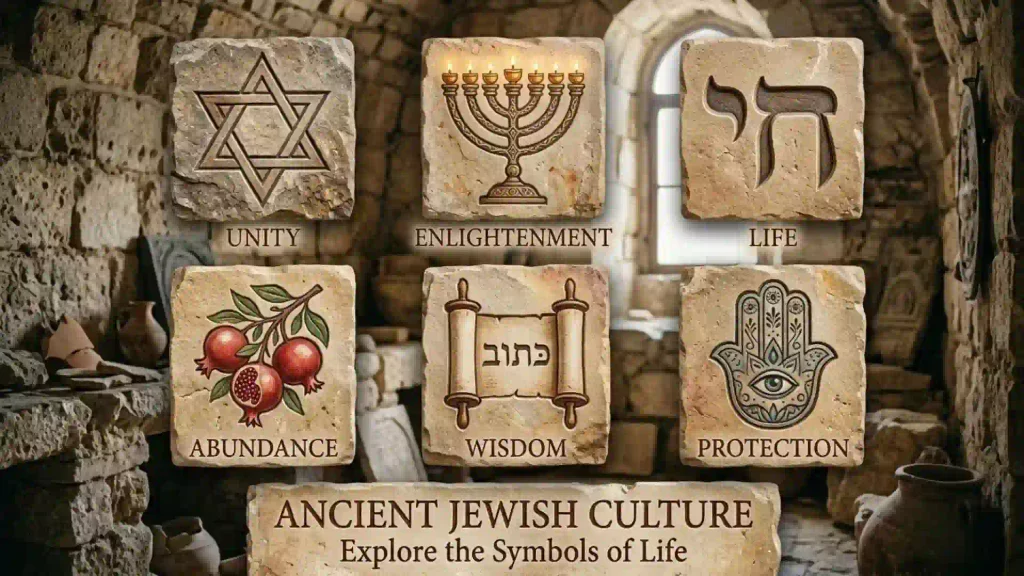
In ancient Judea, lamps, oil, the Jerusalem Temple, and religious dedication had direct sacred importance. Hanukkah symbols emerged from Jewish experiences under Seleucid rule and from the recovery and rededication of the Temple.
Hellenistic Greek Culture
Greek influence forms part of Hanukkah’s historical setting. The conflict was not simply “Jews versus Greeks,” since many Jews adopted elements of Hellenistic culture while others resisted religious assimilation.
Fire and lamps were important in Greek religion, but Greek sacred flames are not sources of Hanukkah practice. The relationship is historical contrast rather than shared ritual origin.
Roman Culture
Roman lamps often symbolized domestic life, public ceremony, and divine honor. After Rome later controlled Judea and destroyed the Second Temple in 70 CE, the memory of Jewish worship in Jerusalem became even more emotionally significant.
Roman culture did not create Hanukkah symbols, but the later Roman destruction of the Temple deepened the importance of preserving Jewish memory through home rituals.
Ancient Egypt
Egyptian religion associated sunlight with deities such as Ra and used lamps in sacred settings. Yet these beliefs are unrelated to the Jewish meaning of the Hanukkah lights.
The similarity lies only in the universal human use of light as a symbol of life, order, and protection.
Eastern Traditions
Hindu, Buddhist, Chinese, and other Asian traditions also use lamps to represent wisdom, awakening, remembrance, or the removal of ignorance.
These parallels can help explain the psychology of light symbolism, but they should not erase major religious differences. The Hanukkah lights recall a particular Jewish historical and spiritual narrative.
Indigenous Traditions
Many Indigenous communities treat fire as a source of gathering, teaching, survival, ceremony, and connection with ancestors. Such traditions are highly diverse and should not be reduced to a single interpretation.
The respectful comparison is that both fire-centered traditions can preserve community memory. Hanukkah itself, however, remains rooted in Jewish history.
Modern Global Interpretations
Today, Hanukkah symbols appear in Jewish communities across North America, Europe, Israel, Latin America, Africa, Asia, and Australia.
Public hanukkiah lightings often communicate visibility and belonging. For minority communities, placing a Jewish symbol in public can express both celebration and the right to live openly as Jews.
Similar Symbols and Their Meanings
| Symbol | Main Meaning | Similarity to Hanukkah Symbols | Important Difference |
| Seven-branched menorah | Ancient Temple worship and Jewish identity | Uses sacred light and oil imagery | It has seven branches, not nine |
| Shabbat candles | Peace, holiness, and welcoming Shabbat | Uses candlelight in Jewish home ritual | Lit weekly for Shabbat, not for Hanukkah |
| Eternal light | Divine presence and continuity | Represents enduring sacred light | Usually remains continually lit in a synagogue |
| Star of David | Jewish identity and community | Often appears in Hanukkah decor | Not specifically created for Hanukkah |
| Oil lamp | Illumination and sacred service | Closely connected with Temple oil | Not every oil lamp is a Hanukkah object |
| Torch | Knowledge, liberty, or victory | Shares the image of light overcoming darkness | Usually civic or secular rather than a Hanukkah ritual |
A common misconception is that every nine-branched decorative lamp is automatically suitable for Hanukkah. A ritual hanukkiah should provide eight lights arranged at the same level, with the shamash clearly separated.
Hanukkah Symbols in Mythology and Folklore
Hanukkah is based on Jewish history and religious tradition rather than classical mythology. Still, folklore has shaped how people tell and remember its story.
The most famous example is the oil miracle. The Books of Maccabees emphasize the military victory and Temple rededication, while the later Talmud gives special attention to the small container of oil that burned for eight days.
The dreidel also carries a beloved folk story. According to tradition, Jewish children studying Torah under persecution kept spinning tops nearby. When officials approached, they pretended to be playing instead of learning.
Whether every detail can be historically verified is less important than understanding the story’s cultural role. It teaches that identity can survive through intelligence, courage, secrecy, and play.
Another important tradition concerns Judith, a Jewish heroine who defeated an enemy general after feeding him salty cheese and wine. Her story is not part of the central historical account of Hanukkah, yet some Jewish communities connect cheese foods with the holiday in her honor.
Hanukkah Symbols in Art, Literature, Movies, and Pop Culture
Artists often paint the hanukkiah as a warm point of light against a dark window. This contrast can represent family intimacy, public identity, resistance, or hope.
In literature and poetry, Hanukkah lights frequently symbolize memory. A candle may connect a modern family with ancestors who celebrated under very different conditions.
Hanukkah appears in children’s books through dreidels, talking latkes, family gatherings, Maccabee stories, and humorous holiday conflicts. Television and movies often present it as part of Jewish family life, although some portrayals wrongly treat Hanukkah as simply a Jewish version of Christmas.
The holiday has also appeared in powerful stories of survival. The United States Holocaust Memorial Museum recounts how teenager Gerda Weissmann created a menorah from potatoes while imprisoned in a forced-labor camp. Although she had no candles, the act became a form of hope and spiritual resistance.
Modern Hanukkah imagery appears on clothing, greeting cards, phone wallpapers, social media posts, jewelry, household decorations, and public art. Tattoos may include flames, Hebrew words, Maccabee imagery, or menorahs, though permanent body art is viewed differently across Jewish communities.
Spiritual and Dream Meaning of Hanukkah Symbols
Dreams involving Hanukkah symbols do not have one fixed religious meaning. Dream interpretation is personal and should not be confused with formal Jewish teaching.
Still, certain themes may be helpful for reflection.
Dreaming of a Bright Hanukkiah
A brightly burning hanukkiah may represent hope, family connection, recovered confidence, or a desire for spiritual direction.
Dreaming of an Unlit Menorah
An unlit lamp may suggest emotional exhaustion, disconnection from tradition, grief, or potential that has not yet been expressed.
Dreaming of One Small Flame
A single flame may symbolize a fragile but meaningful beginning. It can suggest that even limited courage is enough to start moving forward.
Dreaming of a Spinning Dreidel
A dreidel may represent uncertainty, changing fortune, playfulness, or feeling that an important outcome is outside your control.
Dreaming of Spilled Oil
Spilled oil could reflect wasted energy, overlooked blessings, or anxiety about not having enough emotional strength.
In meditation, Hanukkah lights may inspire reflection on where a person needs courage, what values deserve protection, and how private faith can become public kindness.
Positive and Negative Meanings of Hanukkah Symbols
| Positive Meaning | Negative or Cautionary Meaning |
| Hope during darkness | Fear of losing hope |
| Religious freedom | Memory of persecution |
| Courage and resistance | Conflict or violence |
| Cultural continuity | Anxiety about assimilation |
| Family and belonging | Loneliness or exclusion |
| Faith and miracles | Waiting passively for change |
| Generosity | Commercialization |
| Public identity | Fear of antisemitism |
| Light and wisdom | Pride without compassion |
| Dedication | Rigidity or intolerance |
Hanukkah symbols contain both light and shadow because the holiday remembers joy and danger at the same time. The flames celebrate survival, but they also recall a period when Jewish practice was threatened.
The Maccabean story can inspire courage, yet it also raises difficult questions about power, internal division, and religious conflict. Mature interpretation does not remove these tensions. It allows celebration and thoughtful reflection to exist together.
Why Humans Are Attracted to Hanukkah Symbols
People are naturally drawn to light during the darkest part of the year. A small flame creates warmth, movement, and a sense of life. It gathers attention without demanding it.
The eight-night pattern is also psychologically powerful. Instead of beginning with full brightness, Hanukkah grows slowly. This mirrors how people build trust, recover from loss, develop courage, or strengthen faith.
Humans also rely on objects to carry memory. A grandparent’s hanukkiah may become more than metal or glass. It can hold stories of migration, survival, celebration, and family members who are no longer present.
Food creates another emotional connection. The smell of frying latkes or sweet doughnuts can instantly awaken childhood memories. Psychologists often connect scent and taste with strong autobiographical recall because they are closely linked with emotional processing.
Finally, Hanukkah symbols allow people to participate. The story is not only read. It is enacted through lighting, singing, eating, giving, spinning, and gathering.
Modern Uses of Hanukkah Symbols
Today, Hanukkah symbols appear in both sacred and everyday spaces.
Families light traditional silver hanukkiot as well as modern designs shaped like trees, buildings, animals, musical instruments, or abstract sculptures. Public menorahs appear outside government buildings, universities, hospitals, shopping centers, and community spaces.
Jewelry may feature tiny dreidels, flames, Hebrew letters, Stars of David, or hanukkiah pendants. Fashion brands use blue, white, silver, gold, and playful food designs during the season.
On social media, families share candle-lighting photos, recipes, educational videos, songs, and reflections on Jewish identity. These posts can increase cultural understanding, although reducing the holiday to decorations or shopping can hide its deeper meaning.
Hanukkah symbols also appear in classrooms and interfaith events. When used respectfully, they help explain Jewish history and religious diversity. Educators should avoid presenting Hanukkah as the “Jewish Christmas,” since the holidays have different origins, beliefs, rituals, and theological meanings.
Interesting Facts About Hanukkah Symbols
- A Hanukkah lamp is more precisely called a hanukkiah. The word menorah can describe a lamp generally, but the ancient Temple menorah had seven branches.
- The number eight suggests going beyond an ordinary cycle. Seven often represents a complete natural pattern, while eight can symbolize renewal or spiritual transcendence.
- The shamash is not counted among the eight ceremonial lights. It serves as the helper used to kindle them.
- Traditional Hanukkah lights may use candles or olive oil. Oil directly recalls the Temple story.
- Dreidel letters differ in Israel. The letter peh replaces shin so the phrase means “A great miracle happened here.”
- Chocolate gelt is newer than the custom of giving real money. Gelt historically helped teach generosity, Torah study, and charitable responsibility.
- Latkes were not always made from potatoes. Earlier Jewish pancakes could be prepared from cheese, grain, or other local ingredients.
- Sufganiyot became especially popular in modern Israel. Their production also supported professional bakers and seasonal workers.
- Hanukkah is a relatively minor Jewish festival in religious law. Its visibility became much greater in countries where it falls near Christmas.
- Public light is part of the symbolism. The hanukkiah is traditionally displayed where others can see it, turning private memory into visible testimony.
Frequently Asked Questions
What is the most important symbol of Hanukkah?
The hanukkiah is the central Hanukkah symbol. Its eight ceremonial lights commemorate the holiday’s eight nights, while the shamash is used to light them.
What do the eight candles of Hanukkah symbolize?
They recall the eight days during which the small supply of Temple oil is traditionally said to have burned.
Why does a Hanukkah menorah have nine branches?
Eight branches hold the ceremonial Hanukkah lights. The ninth holds the shamash, or helper light, used to kindle the others.
Is the Star of David a Hanukkah symbol?
The Star of David is a general symbol of Judaism and Jewish identity. It often appears in Hanukkah decorations, but it is not one of the holiday’s original ritual symbols.
What does the dreidel symbolize?
The dreidel represents the Hanukkah miracle, cultural memory, changing fortune, childhood learning, and Jewish survival. Its Hebrew letters form a phrase about a great miracle.
Why are oil-fried foods eaten during Hanukkah?
Foods such as latkes, sufganiyot, bimuelos, and sfenj are fried in oil to recall the oil connected with the rededication of the Jerusalem Temple.
Conclusion
Hanukkah symbols transform an ancient struggle into living experiences of light, taste, memory, courage, and belonging.
The hanukkiah, oil, dreidel, gelt, traditional foods, and Maccabee story each reveal a different part of the holiday’s meaning.
Together, they remind people that identity can survive pressure and that hope often begins with one small flame.
Hanukkah’s lasting message is that light becomes most meaningful when it is protected, shared, and allowed to grow.
 Michael Rivera
 John Mercer