
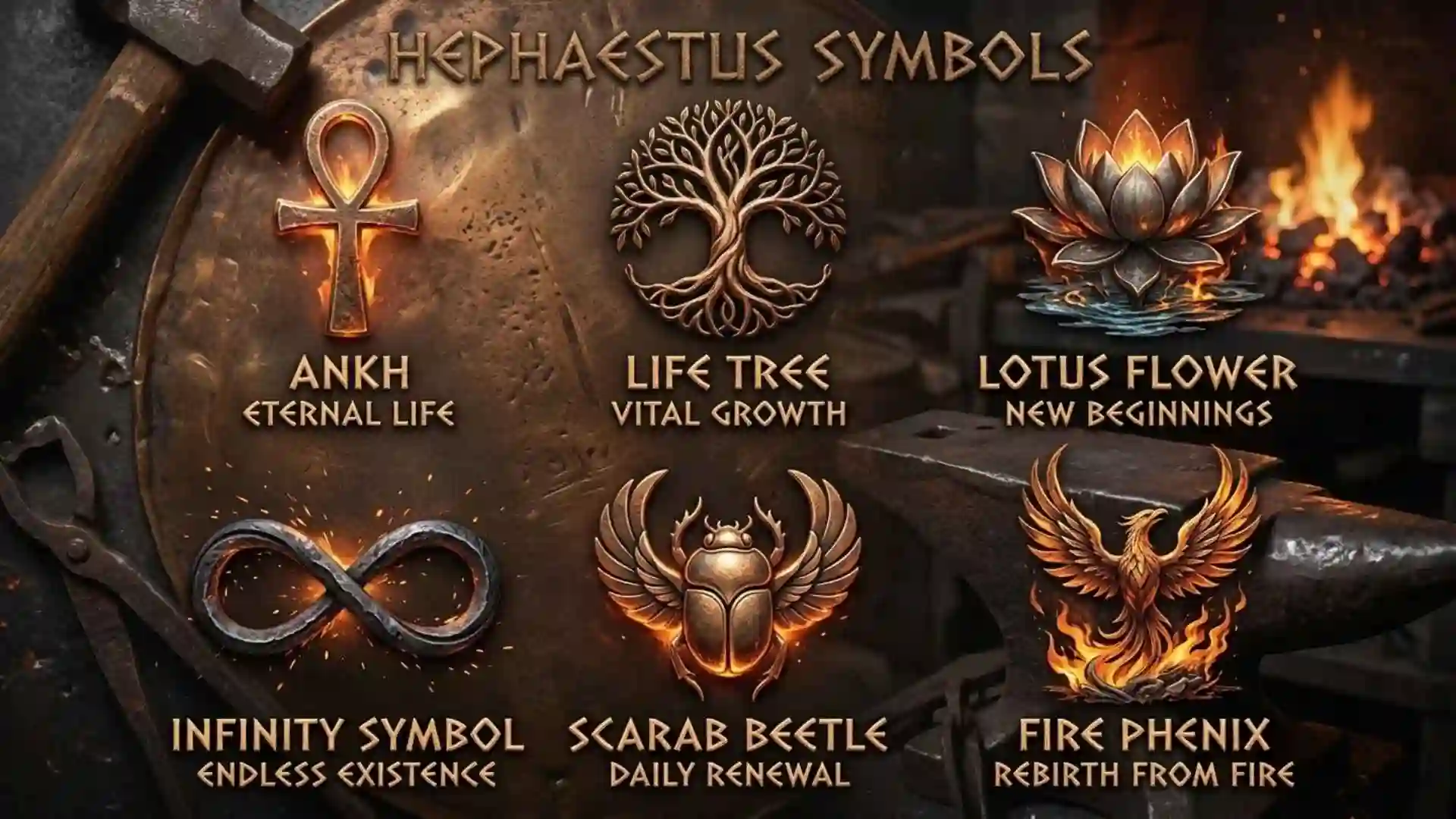
Hephaestus symbols represent the powerful connection between fire, craftsmanship, creativity, strength, and transformation in ancient Greek mythology. As the Greek god of fire, metalworking, blacksmiths, and skilled artisans, Hephaestus was known for creating extraordinary weapons, armor, jewelry, and magical objects for gods and heroes. His symbols reflect more than his skill with tools. They also tell a deeper story about hard work, resilience, innovation, and the ability to turn raw materials into something extraordinary.
Several symbols are closely associated with Hephaestus, including the hammer, anvil, tongs, forge, fire, and volcano. Each represents an important part of his divine identity and craftsmanship. The hammer and anvil symbolize creation and skilled labor, while fire represents both destruction and renewal. His connection with volcanoes highlights the intense power of nature and the transformative energy behind metalworking. Together, these symbols reveal why Hephaestus became an important figure in Greek mythology.
In this guide to Hephaestus symbols, you will discover their meanings, mythological origins, spiritual associations, and cultural significance. You will also explore how his symbols connect with creativity, determination, physical strength, perseverance, and personal transformation. Whether you are interested in Greek mythology, ancient gods, symbolic meanings, or the deeper lessons behind Hephaestus’s story, understanding these symbols will help you appreciate the lasting influence of this remarkable Olympian god.
Quick Answer
Hephaestus symbols include the hammer, anvil, blacksmith’s tongs, forge, fire, bellows, volcano, donkey, and craftsman’s cap. Together, they represent skilled labor, creativity, endurance, controlled power, invention, and the transformation of hardship into something useful, strong, or beautiful.
Quick Facts About Hephaestus Symbols
| Aspect | Information |
| Origin | Ancient Greek religion and mythology |
| Historical Significance | Connected with blacksmiths, metalworkers, sculptors, builders, and skilled artisans |
| Main Meaning | Craftsmanship, invention, hard work, resilience, and transformation |
| Spiritual Meaning | Purification through struggle and the shaping of the inner self |
| Cultural Importance | Honored the social value of skilled labor and technological knowledge |
| Modern Usage | Tattoos, jewelry, logos, fantasy stories, games, art, and personal symbols of perseverance |
What Are Hephaestus Symbols?
Hephaestus symbols are objects, tools, animals, and natural forces associated with Hephaestus, the Greek god of fire, metalworking, blacksmiths, sculpture, and craftsmanship. His best-known attributes are the hammer, anvil, and tongs.
In ancient art, Hephaestus was often shown as a bearded craftsman holding a hammer or tongs. He might appear beside an anvil, working inside a forge, wearing a craftsman’s cap, or riding a donkey. These visual clues helped viewers recognize him immediately.
Hephaestus was one of the Twelve Olympians, yet his story was very different from those of physically perfect gods such as Apollo or athletic warriors such as Ares. Greek myths describe him as having a mobility impairment. According to different traditions, Hera rejected him at birth, or Zeus threw him from Olympus after he defended his mother.
Despite rejection, Hephaestus became the divine smith of Olympus. He created weapons, armor, jewelry, thrones, mechanical servants, and extraordinary objects for gods and heroes. His symbols therefore evolved beyond simple blacksmithing tools. They became signs of intelligence, patience, technological mastery, and the power to rebuild a life through purposeful work.
Deep Symbolic Meaning of Hephaestus Symbols
Spiritual Meaning
On a spiritual level, the forge represents transformation through heat and pressure. Metal enters the fire in one condition and leaves in another. In the same way, painful experiences can reshape a person’s character.
The hammer symbolizes disciplined action. The anvil represents the stable inner foundation on which change takes place. Fire stands for purification, energy, and awakening, while the tongs suggest emotional control. They allow the smith to handle something dangerous without being destroyed by it.
Together, these Hephaestus symbols tell a spiritual story: suffering does not automatically create wisdom, but conscious effort can turn suffering into strength.
Psychological Meaning
Psychologically, Hephaestus can be understood as the wounded creator archetype. He is excluded from the idealized world of Olympus, yet he develops abilities no other god can match.
In a Jungian interpretation, his forge resembles the hidden workshop of the unconscious. Difficult emotions descend into this inner space, where they can be examined, heated, broken apart, and reshaped. Anger may become determination. Loneliness may become imagination. Shame may become empathy.
People are often drawn to Hephaestus because he represents competence earned through experience rather than privilege. His story reassures anyone who has felt overlooked, different, or underestimated.
Cultural Meaning
Ancient societies depended on metalworkers for farming tools, weapons, household objects, religious offerings, and building materials. Yet smiths were also mysterious figures because they seemed to transform ordinary stone and ore into powerful objects.
Hephaestus gave sacred meaning to this skilled labor. His mythology reminded Greek communities that civilization was supported not only by kings and warriors, but also by builders, inventors, artists, and craftspeople.
Types and Variations of Hephaestus Symbols
The Hammer
The hammer is the most recognizable symbol of Hephaestus. It is usually shown as a heavy blacksmithing tool raised above an anvil.
It represents strength guided by purpose. A hammer can destroy, but in the hands of a skilled craftsperson, it shapes and improves. In Greek vase paintings, sculptures, modern tattoos, and fantasy art, it identifies Hephaestus as a worker rather than a passive ruler.
The Anvil
The anvil is a solid metal surface on which heated metal is shaped. Symbolically, it represents endurance, stability, and the ability to withstand repeated pressure.
While the hammer expresses action, the anvil represents resilience. It does not escape the blow. It receives force without losing its essential strength.
Blacksmith’s Tongs
Tongs allow a smith to grip heated metal safely. In art, Hephaestus may hold them beside a hammer or furnace.
They symbolize control, precision, patience, and respect for dangerous power. Spiritually, they can represent emotional boundaries and the wisdom required to handle intense feelings.
The Forge and Sacred Fire
The forge is the workshop where raw material becomes a finished creation. Fire is therefore both a practical tool and a symbol of transformation.
Hephaestus was associated with the controlled fire of craftsmanship, although fire could also become destructive. This double meaning links him with creativity, danger, purification, passion, and technological progress.
Bellows
Bellows push air into a fire, increasing its heat. They appear less often than the hammer or anvil, but they belong naturally to Hephaestus imagery.
Bellows represent breath, life force, persistence, and the hidden energy that keeps creativity alive. They suggest that talent must be continually fed through practice.
Volcanoes
Volcanoes became natural symbols of the divine forge because they combine underground fire, molten material, smoke, and violent creative power.
Later traditions placed the forge of Hephaestus or Vulcan beneath volcanic regions, including Mount Etna and the island of Vulcano. The rumbling earth could be imagined as the sound of a supernatural smith at work.
The Donkey
Ancient vase paintings sometimes show Hephaestus returning to Olympus while riding a donkey, often accompanied by Dionysus and his followers.
The donkey symbolizes humility, endurance, and an unconventional return to honor. Unlike the eagle of Zeus or the horses of Poseidon, it is a working animal. Its association with Hephaestus reinforces his connection with ordinary labor and practical strength.
Craftsman’s Cap
Hephaestus is sometimes shown wearing a rounded cap known as a pilos. Similar caps were connected with workers and craftsmen.
It represents professional identity, knowledge gained through practice, and pride in skilled work. Unlike a royal crown, it honors ability rather than status.
Hephaestus Symbols Across Different Cultures
Ancient Greece
In Greece, the hammer, anvil, tongs, and forge directly identified Hephaestus as the divine patron of smiths and artisans. His worship was especially important in manufacturing centers such as Athens and on Lemnos, an island strongly connected with his mythology.
Ancient Egypt
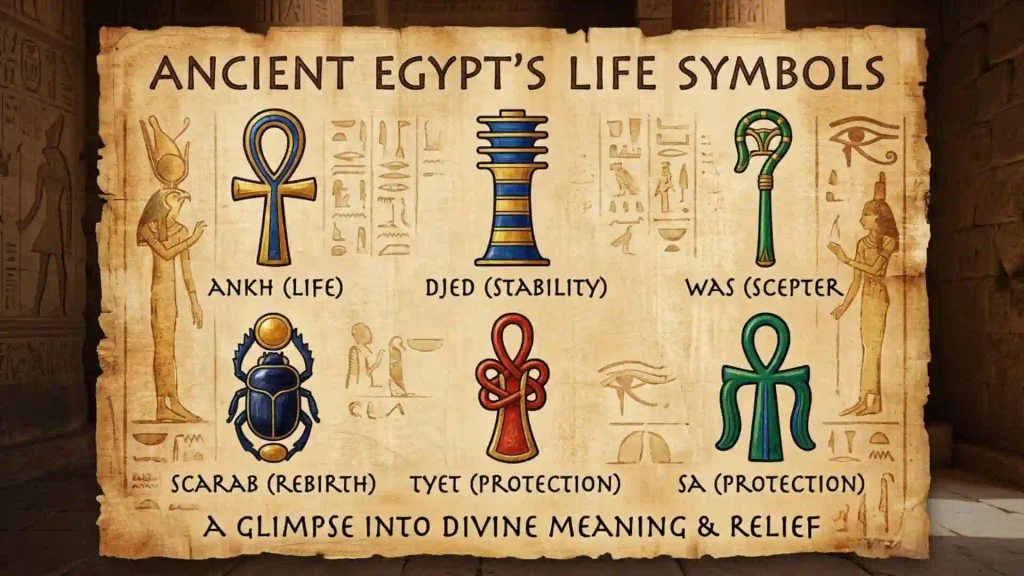
Egyptians did not worship Hephaestus, but Greek writers sometimes compared foreign creator gods with familiar Greek deities. Ptah, the craftsman and creator god of Memphis, offers a useful symbolic parallel because he was linked with artisans, design, and the making of ordered forms.
The comparison should not erase their differences. Ptah belonged to a distinct Egyptian religious system, while Hephaestus developed within Greek mythology.
Roman Culture
The Romans identified Hephaestus with Vulcan. Both gods were associated with fire and metalworking, but Roman worship placed stronger emphasis on fire’s destructive danger.
The Vulcanalia festival was held on August 23, during the hot season when crops and buildings faced a greater risk of fire. Vulcan’s hammer therefore symbolized both productive craftsmanship and the need to control destructive flames.
Eastern Traditions
Many Eastern traditions contain sacred fire figures, divine artisans, or legendary smiths, although none should be treated as an exact version of Hephaestus.
In Hindu tradition, Agni represents sacred fire, sacrifice, and communication between humans and the divine. Vishvakarma is more closely connected with divine architecture, craftsmanship, and construction. These figures share themes of creation and sacred skill while remaining culturally distinct.
Indigenous Traditions
There is no single Indigenous interpretation of the forge because Indigenous cultures are highly diverse. Some communities developed advanced metalworking traditions, while others gave greater symbolic importance to stone, wood, clay, fire, or bone craftsmanship.
A respectful comparison focuses on the broader idea of the maker: a person who receives knowledge from ancestors, nature, or spiritual forces and transforms natural material into culturally meaningful objects.
Modern Interpretations
Today, Hephaestus symbols often represent engineering, skilled trades, disability resilience, innovation, and creative independence. The forge has become a metaphor for personal development, while the hammer and anvil appear in logos, tattoos, workshops, games, and fantasy entertainment.
Similar Symbols and Their Meanings
| Symbol or Figure | Similarity to Hephaestus | Important Difference |
| Vulcan | Fire, forge, hammer, and metalworking | Roman tradition emphasized protection from destructive fire |
| Prometheus | Fire, technology, and human advancement | Prometheus gives fire to humanity, while Hephaestus masters it through craft |
| Athena | Intelligence, invention, and skilled work | Athena represents strategy and weaving more than forge work |
| Thor’s Hammer | Strength, protection, and sacred power | Mjölnir is mainly a weapon and protective emblem |
| Ptah | Creation, craftsmen, and ordered design | Belongs to Egyptian religion and has a different theology |
| Vishvakarma | Divine construction and craftsmanship | Connected with Hindu cosmology and celestial architecture |
A common misconception is that every hammer symbol represents Hephaestus. Hammers may also represent Thor, labor movements, construction, justice, industry, or general strength. Context determines the meaning.
Hephaestus Symbols in Mythology and Folklore
Hephaestus created many remarkable objects in Greek mythology. Homer’s Iliad describes him making new armor for Achilles after Thetis asks for his help. The shield of Achilles was not merely protective equipment. It displayed an entire vision of human society, including cities, fields, celebrations, conflict, and cosmic order.
He was also credited with making divine thrones, jewelry, weapons, and mechanical creations. Ancient stories describe golden attendants that could move and assist him, an early mythological image of intelligent machines.
Another famous tale tells how Hephaestus trapped Hera in a magical throne. Dionysus eventually persuaded him to return to Olympus, where he released her. This story explains images of Hephaestus riding a donkey in a joyful procession.
Such myths shaped his symbols into signs of cleverness as well as physical labor. His finest power was not brute force. It was the ability to design what others could not imagine.
Hephaestus Symbols in Art, Literature, Movies, and Pop Culture
Ancient Greek pottery often shows Hephaestus at work, returning to Olympus, or presenting armor to Thetis. Sculptures and later European paintings use hammers, anvils, glowing furnaces, and muscular workshop scenes to identify him.
In literature, he represents the gifted outsider, inventive mind, or wounded artist. Modern novels and poetry often use the forge as a metaphor for character formation.
Movies, television series, comics, and video games portray him as an engineer, weapon maker, inventor, or master builder. These versions may change the original myths, but they preserve his basic identity as the creator of extraordinary technology.
In tattoo art, the hammer and anvil can express perseverance, trade pride, recovery, or the belief that identity is built through effort. Fashion and industrial design use forge imagery to communicate toughness, authenticity, and handmade quality.
Spiritual and Dream Meaning of Hephaestus Symbols
Dreaming of a forge may suggest that a difficult period is reshaping your identity. It can appear when you are developing a skill, recovering from failure, or preparing to make an important change.
A hammer may symbolize decisive action. An anvil may represent pressure, endurance, or the need for a stronger foundation. Tongs can suggest emotional distance, careful handling, or healthier boundaries.
A glowing fire may indicate inspiration and renewed energy. However, an uncontrolled blaze can warn of anger, exhaustion, or ambition that has become destructive.
These meanings are symbolic interpretations, not fixed predictions. Personal emotions, cultural background, and the events within the dream matter more than any universal dream dictionary.
Positive and Negative Meanings of Hephaestus Symbols
| Positive Meaning | Negative Meaning |
| Creativity and invention | Obsession with work |
| Resilience under pressure | Emotional isolation |
| Skilled craftsmanship | Perfectionism |
| Transformation and healing | Destructive anger |
| Practical intelligence | Manipulation through cleverness |
| Controlled strength | Power without compassion |
| Independence | Withdrawal from relationships |
The same forge that creates a protective shield can also produce a weapon. Hephaestus symbolism therefore contains both light and shadow. Skill becomes positive when guided by wisdom, responsibility, and care.
Why Humans Are Attracted to Hephaestus Symbols
People recognize themselves in the image of raw metal placed into a fire. Life applies pressure, and everyone must decide whether that pressure will break them or reshape them.
The symbols also satisfy our natural attraction to transformation. Humans love stories in which discarded material becomes valuable, an outsider becomes essential, or pain produces unexpected beauty.
On a deeper level, Hephaestus preserves cultural memory of the first craftsmen who mastered fire and metal. Their knowledge changed farming, warfare, architecture, transportation, trade, and daily life.
His imagery reminds us that creation is rarely effortless. Meaningful work usually requires heat, repetition, mistakes, and patience.
Modern Uses of Hephaestus Symbols
Hephaestus symbols appear in tattoos celebrating resilience, creativity, disability pride, engineering, or family traditions in skilled trades.
Jewelry designs may feature miniature hammers, anvils, flames, or forge tools. Workshops and metalworking businesses use them in branding to suggest strength, durability, and handmade quality.
In home decor, anvil sculptures and industrial-style objects create a sense of history and solid workmanship. On social media, forge imagery often accompanies motivational messages about discipline and self-improvement.
Contemporary spiritual practitioners may use the forge as a meditation symbol. They imagine fear, anger, or grief being heated, examined, and consciously reshaped into courage, purpose, or compassion.
Interesting Facts About Hephaestus Symbols
- Hephaestus was usually recognized by working tools rather than royal objects such as a scepter or crown.
- Ancient artists sometimes showed him riding a donkey during his return to Olympus.
- His hammer symbolizes creative force, but the anvil is equally important because it represents endurance.
- The Romans identified him with Vulcan, whose name helped inspire the modern word “volcano.”
- Hephaestus was credited with creating moving golden attendants, which are sometimes compared with mythological robots.
- His workshop contained self-operating bellows in ancient poetic descriptions.
- The shield of Achilles is one of the most detailed examples of divine craftsmanship in classical literature.
- Hephaestus represents one of mythology’s strongest links between physical difference, rejection, talent, and social value.
- His symbols continue to appear in engineering groups, metalworking brands, fantasy games, and maker communities.
Frequently Asked Questions
What is the main symbol of Hephaestus?
The hammer is his most recognizable symbol, although the anvil and blacksmith’s tongs are also central attributes.
What does the anvil of Hephaestus symbolize?
The anvil represents stability, endurance, discipline, and the ability to withstand pressure while being transformed.
Why is fire associated with Hephaestus?
Fire was essential to metalworking. It symbolizes his control over the forge, as well as creation, purification, danger, and transformation.
What animal represents Hephaestus?
The donkey is strongly associated with him, especially in ancient scenes showing his return to Olympus.
What do Hephaestus symbols mean in tattoos?
They commonly represent craftsmanship, perseverance, creative power, resilience, engineering, or rebuilding oneself after hardship.
Are Hephaestus and Vulcan the same god?
Vulcan is the Roman deity identified with Hephaestus. They share many features, but Vulcan had a stronger Roman connection with destructive fire and protection against burning.
Conclusion
Hephaestus symbols show that true strength is not always loud, beautiful, or effortless.
The hammer, anvil, fire, and forge represent the patient work of turning wounds into wisdom and ideas into reality.
His story honors craftspeople, outsiders, inventors, and anyone who has rebuilt life after rejection.
Like metal in a skilled smith’s hands, human character can be shaped by pressure without losing its deepest value.
 Sarah Thompson
 Michael Rivera