
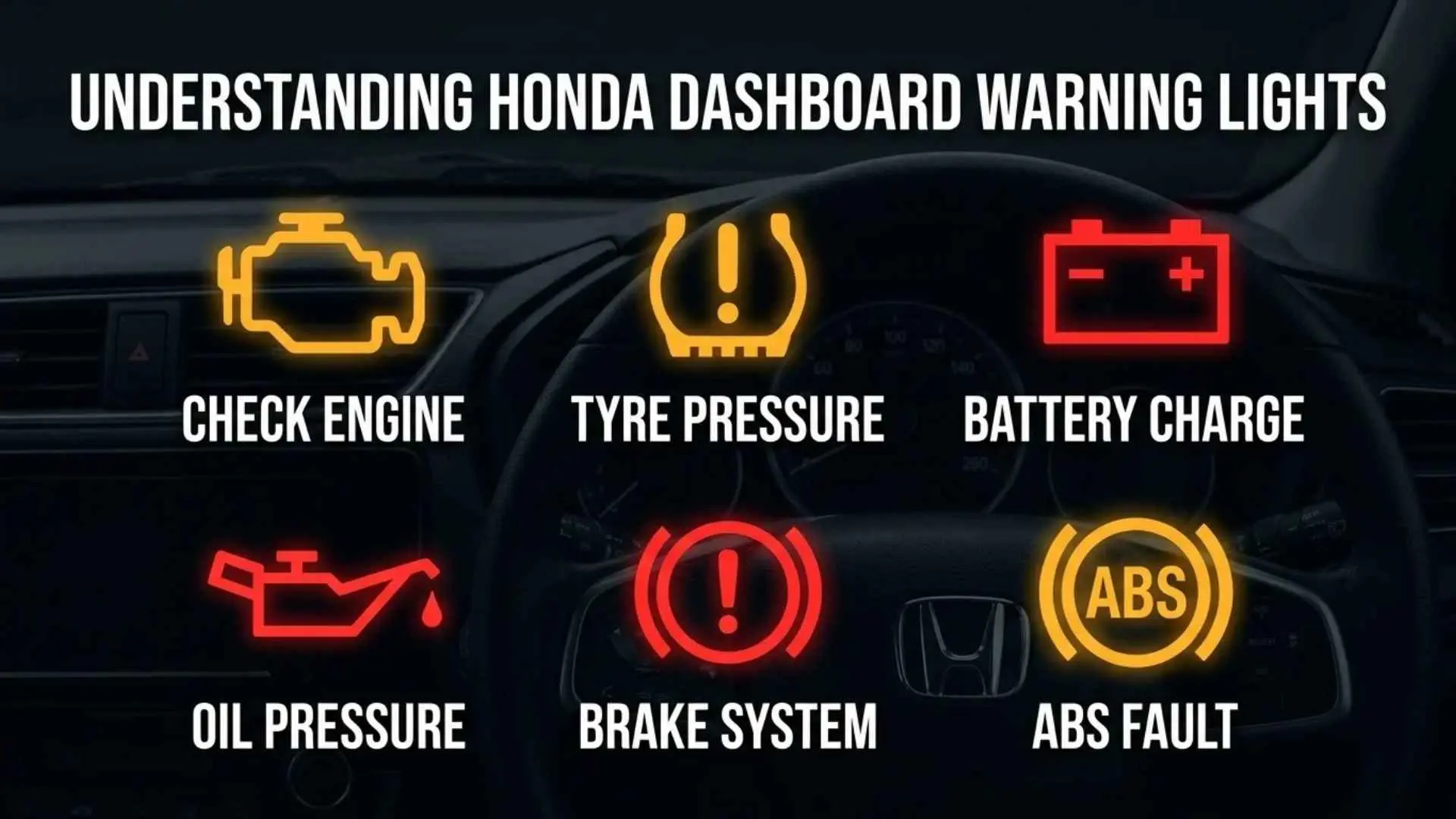
Honda dashboard warning lights and symbols help drivers understand their vehicle’s condition and identify potential problems before they become serious. Whether you drive a Honda Civic, Accord, CR-V, HR-V, Pilot, or another Honda model, these dashboard indicators provide important information about your engine, brakes, battery, tires, airbags, and other vehicle systems. Some lights simply remind you about routine maintenance, while others warn you about problems that need immediate attention.
Understanding Honda dashboard warning light colors is just as important as recognizing their symbols. Red warning lights generally indicate serious problems that may require you to stop driving safely and address the issue immediately. Yellow or amber lights usually signal a malfunction or maintenance concern that needs attention soon. Green and blue indicators typically show that a particular feature or vehicle system is operating. Knowing these color differences can help you make safer decisions and avoid unnecessary repairs.
In this complete guide to Honda dashboard warning lights and symbols, you will learn what common indicators mean, why they appear, and what steps to take when they illuminate. From the check engine light and oil pressure warning to the tire pressure monitoring system (TPMS), battery light, ABS warning, and maintenance minder, we will explain each symbol in simple terms. You will also discover how warning lights differ across Honda models and when you should stop driving, check your owner’s manual, or visit a qualified mechanic.
Quick Answer
Honda dashboard warning lights symbols communicate the condition of your engine, brakes, tires, battery, safety systems, and driver-assistance features. Red lights usually signal an urgent safety or mechanical problem, amber lights require inspection soon, and green or blue lights normally confirm that a feature is operating. Exact meanings can vary by model and year.
Quick Facts About Honda Dashboard Warning Lights Symbols
| Aspect | Information |
| Origin | Developed from standardized automotive instrument-panel icons and Honda-specific vehicle systems |
| Historical significance | Replaced many text-based alerts as vehicles became more advanced and internationally sold |
| Main meaning | Warn, inform, or confirm the operating status of a vehicle system |
| Safety meaning | Helps drivers recognize mechanical, electrical, braking, and driver-assistance problems |
| Cultural importance | Uses widely recognized shapes and colors that can be understood across languages |
| Modern usage | Appears on digital instrument clusters, multi-information displays, and head-up displays |
| Most urgent colors | Red and amber |
| Informational colors | Green, blue, and sometimes white |
What Are Honda Dashboard Warning Lights Symbols?
Honda dashboard warning lights symbols are illuminated icons shown on the instrument panel. They monitor major systems such as the engine, brakes, charging system, airbags, transmission, tires, steering, and vehicle stability control.
Most symbols briefly illuminate when you start the vehicle. This is called a bulb or system check. The lights should usually disappear after the engine starts. A symbol that remains illuminated, begins flashing, or appears while driving may indicate a problem.
Honda groups dashboard indicators into several broad categories:
- Malfunction indicators
- Condition indicators
- System status indicators
- Driver-assistance indicators
- Lighting and signal indicators
Modern Honda vehicles may also display a written message beside the icon. For example, a warning symbol may appear with instructions such as “Brake System Problem,” “Low Tire Pressure,” or “Engine Oil Pressure Low.”
Dashboard layouts differ among the Honda Civic, Accord, CR-V, HR-V, Pilot, Passport, Ridgeline, and Odyssey. Hybrid and electric models may also show battery, regenerative braking, and high-voltage system indicators. Always compare the symbol with the owner’s manual for your exact model year. Honda provides model-specific manuals through its official owner resources.
Understanding Honda Warning Light Colors
The color of a Honda dashboard light often tells you how quickly you need to react.
Red Warning Lights
Red generally means stop safely or take immediate action. It may indicate a problem involving:
- Engine oil pressure
- Braking
- Charging system
- Engine temperature
- Seat belts
- Supplemental restraint system
- Electric power steering
A red light does not always mean the engine is already damaged, but continuing to drive could increase the risk.
Amber or Yellow Warning Lights
Amber lights usually mean that a system requires attention soon. You may still be able to drive carefully, but the cause should not be ignored.
Common amber warnings involve:
- Check engine system
- Anti-lock brakes
- Tire pressure
- Vehicle Stability Assist
- Emissions equipment
- Forward collision systems
- Lane assistance
- Electric parking brake
Honda owner guides describe red and amber indicators as the most critical, while blue and green indicators are generally informational.
Green, Blue, or White Indicators
These colors usually confirm that a feature is active.
Examples include:
- Turn signals
- Exterior lights
- Cruise control
- ECON mode
- High beams
- Auto high-beam
- Adaptive Cruise Control
- Lane Keeping Assist System
A blue high-beam symbol is normally not a fault. It simply tells you that the high beams are switched on.
Most Important Honda Dashboard Warning Lights Symbols
Oil Pressure Warning Light
Visual description: A red oil can, often with a drop coming from its spout.
Meaning: The engine may not have enough oil pressure to lubricate its moving parts.
What to do: Pull over safely, turn off the engine, and check the oil level after allowing the vehicle to rest. Do not continue driving if the light remains on after adding the correct oil.
This warning is about oil pressure, not simply the time for an oil change. Driving with low oil pressure can quickly cause severe engine damage.
Charging System Warning Light
Visual description: A red battery-shaped box with plus and minus signs.
Meaning: The battery is not receiving the proper charge. Possible causes include a failing alternator, damaged drive belt, wiring fault, weak battery, or charging-system problem.
What to do: Turn off unnecessary electrical equipment and stop in a safe place. The vehicle may continue running briefly, but it can shut down once stored battery power is exhausted.
For hybrid vehicles, this symbol may relate to the 12-volt electrical system rather than the large hybrid battery.
Brake System Warning Light
Visual description: A red circle containing an exclamation mark or the word “BRAKE.”
Meaning: The parking brake may be engaged, the brake fluid may be low, or the braking system may have developed a fault.
What to do: Make sure the parking brake is fully released. If the light stays on, press the brake pedal gently and evaluate its feel. A soft, unusually low, or weak pedal requires immediate attention.
Honda advises drivers to check brake-pedal pressure, inspect the brake-fluid level when safely stopped, and arrange immediate repair if braking feels abnormal.
Some newer Hondas have separate red and amber brake-system indicators. An amber warning may point to an electronic brake-control or parking-brake malfunction.
Engine Coolant Temperature Warning
Visual description: A thermometer above wavy lines.
Meaning: A red temperature symbol means the engine may be overheating. Some Honda models also show a blue symbol when the engine is still cold.
What to do: Turn off the air conditioner, pull over safely, and shut down the engine if the red warning remains on or steam appears. Never remove a hot radiator cap because pressurized coolant can cause serious burns.
A blue coolant light usually turns off as the engine warms. It is informational rather than an emergency warning.
Malfunction Indicator Lamp or Check Engine Light
Visual description: An amber engine-shaped icon.
Meaning: The engine-management or emissions-control system has detected a fault.
A steady light may be caused by an emissions sensor, ignition issue, fuel-system problem, loose fuel cap on some models, or another engine-control fault.
A flashing check engine light is more serious. Honda documentation notes that flashing can indicate engine misfiring, which may damage the catalytic converter.
What to do: Reduce speed and avoid hard acceleration. If the light flashes, the engine shakes, or power drops sharply, stop driving and obtain professional assistance.
Anti-Lock Brake System Light
Visual description: The letters “ABS” inside a circle.
Meaning: The anti-lock braking system has detected a fault.
The regular brakes may still work, but the wheels may lock during hard braking. Electronic brake-force distribution and stability functions may also be affected.
What to do: Drive carefully, allow more stopping distance, and have the vehicle inspected. If the ABS light appears with a red brake warning, stop as soon as it is safe.
Tire Pressure Monitoring System Light
Visual description: An amber horseshoe-shaped tire with an exclamation mark.
Meaning: One or more tires may be underinflated, or the Tire Pressure Monitoring System may have a fault.
A steady light usually means low tire pressure. A light that flashes before staying on may indicate a TPMS malfunction.
What to do: Check all tires when cold and inflate them to the pressure listed on the driver-side doorjamb label, not the maximum pressure molded into the tire.
Temperature changes can reduce tire pressure, especially during cold weather. A puncture, leaking valve, wheel damage, or recent tire replacement may also trigger the warning. Honda manuals state that a flashing light that remains illuminated should be inspected.
Vehicle Stability Assist Warning
Visual description: A car with curved skid marks behind it.
Meaning: The Vehicle Stability Assist system is actively correcting wheel slip, or a fault has disabled part of the system.
If the icon flashes briefly on a slippery road, the system is working. If it stays on, VSA, brake assist, hill-start assist, or another related function may have a problem.
What to do: Slow down when the light flashes. If it remains on, check whether VSA was manually switched off. Arrange an inspection if the warning does not disappear.
Supplemental Restraint System Warning
Visual description: A seated person with a circular airbag in front.
Meaning: There may be a fault involving the airbags, seat-belt tensioners, impact sensors, or restraint-system electronics.
What to do: Have the vehicle checked promptly. The airbags or tensioners may not operate correctly during a crash.
Do not confuse this warning with the passenger-airbag-off indicator, which can appear when the system detects a light passenger, child restraint, or empty front seat.
Electric Power Steering Warning
Visual description: A steering wheel, sometimes with an exclamation mark.
Meaning: The electric power steering system may not be providing normal assistance.
What to do: Grip the wheel firmly, reduce speed, and pull over safely. Steering may become much heavier, especially at low speeds.
Turning the vehicle off and restarting it may clear a temporary electronic fault, but a warning that returns requires diagnosis.
Transmission System Warning
Visual description: A gear symbol, transmission message, blinking gear position, or amber warning.
Meaning: The transmission, shift controls, fluid temperature, or electronic management system may have a fault.
What to do: Avoid aggressive acceleration and towing. Stop if the vehicle shifts harshly, will not select a gear, smells burnt, or displays a message telling you to park.
On some Honda vehicles, a blinking “D” indicator can signal a transmission-control problem.
Low Fuel Indicator
Visual description: An amber fuel pump.
Meaning: The fuel level is low.
What to do: Refuel soon. Repeatedly driving with very little fuel can leave you stranded and may expose the fuel pump to additional heat.
The arrow beside the fuel-pump icon often shows which side of the vehicle contains the fuel door.
Honda Sensing Warning Symbols
Many newer Honda vehicles include Honda Sensing driver-assistance technology. Depending on the model, the dashboard may show indicators for:
- Collision Mitigation Braking System
- Road Departure Mitigation
- Lane Departure Warning
- Lane Keeping Assist System
- Adaptive Cruise Control
- Traffic Sign Recognition
- Blind Spot Information
- Auto High-Beam
An amber warning often means a system is unavailable, obstructed, switched off, or malfunctioning. Dirt, snow, heavy rain, fog, bright sunlight, damaged glass, or a blocked camera and radar sensor can temporarily disable these features.
Clean the windshield and sensor areas carefully. Driver-assistance systems are support tools, not replacements for attention, steering, or braking.
Similar Honda Symbols and Their Differences
| Symbol | Normal or Warning? | Key Difference |
| Red brake light | Serious warning | May indicate low fluid or a braking fault |
| Amber brake light | Service warning | Often relates to electronic braking or parking-brake controls |
| ABS light | Warning | Regular braking may remain, but anti-lock function may be unavailable |
| Skidding-car light flashing | Normal intervention | Stability control is actively reducing wheel slip |
| Skidding-car light staying on | Possible fault | Stability-related systems may be disabled |
| TPMS light steady | Low pressure likely | Check tire inflation |
| TPMS light flashing, then steady | System fault likely | Sensor or monitoring system needs inspection |
| Check engine light steady | Fault detected | Diagnosis is needed soon |
| Check engine light flashing | Urgent fault | Misfire may damage the catalytic converter |
| Blue temperature light | Informational | Engine is cold |
| Red temperature light | Urgent warning | Engine may be overheating |
Why Dashboard Symbols Use Shapes and Colors
Dashboard icons are designed for fast recognition. A driver may have only a few seconds to notice a warning, understand its urgency, and react safely.
Red attracts attention because people commonly associate it with danger, stopping, heat, and blood. Amber signals caution, much like traffic lights and roadwork signs. Green communicates normal operation, while blue is often used for lighting features.
The shapes also reduce language barriers. An oil can represents lubrication, a battery represents electrical charging, and a thermometer represents temperature. Even when drivers speak different languages, the visual message remains similar.
There is no recognized spiritual or mystical meaning behind Honda warning lights. Their symbolism is practical and psychological. They transform complex electronic data into simple visual instructions that drivers can understand under pressure.
What to Do When Multiple Honda Warning Lights Appear
Several warning lights appearing at the same time can indicate one shared problem rather than many separate failures.
For example, low system voltage can trigger warnings for steering, braking, stability control, and driver-assistance systems. A weak 12-volt battery, charging fault, damaged wheel-speed sensor, or communication error may affect several electronic modules.
Follow these steps:
- Reduce speed and remain calm.
- Note whether any red lights are present.
- Pay attention to changes in braking, steering, engine sound, temperature, or power.
- Stop immediately if the vehicle feels unsafe.
- Photograph the instrument panel before turning the vehicle off.
- Read the displayed message and consult the correct owner’s manual.
- Arrange professional diagnosis instead of replacing parts based only on the icon.
Interesting Facts About Honda Dashboard Warning Lights Symbols
- Many indicators briefly illuminate at startup to confirm that their bulbs and circuits are functioning.
- A warning symbol can mean different things when it is steady, flashing, red, or amber.
- Green and blue symbols are usually status indicators rather than fault warnings.
- A loose or missing fuel cap can trigger an emissions warning on certain Honda models.
- Cold weather can cause tire-pressure warnings without a puncture because air pressure falls as temperature drops.
- A blocked windshield camera can temporarily disable several Honda Sensing functions.
- A single weak battery can create numerous electronic warnings at once.
- Hybrid models use additional symbols for regenerative braking, high-voltage batteries, and electric-drive systems.
- Older Honda vehicles may use fewer icons and more simple indicator lamps than modern digital clusters.
- The exact response recommended for a symbol can vary by vehicle, engine, trim, and model year.
Frequently Asked Questions
What is the most serious warning light on a Honda?
Red oil-pressure, brake-system, charging-system, and high-temperature warnings are among the most serious. Stop safely and investigate immediately, especially if the vehicle behaves abnormally.
Can I drive my Honda with the check engine light on?
You may be able to drive carefully with a steady check engine light if the vehicle runs normally. A flashing light, severe shaking, overheating, or major power loss requires immediate attention.
Why are all my Honda dashboard lights on suddenly?
Possible causes include a weak 12-volt battery, alternator problem, damaged sensor, wiring fault, or electronic communication error. A professional scan can identify the stored diagnostic codes.
What does the triangle with an exclamation mark mean in a Honda?
It is commonly a system-message or master-warning indicator. Check the multi-information display for a specific explanation, since the triangle can accompany several different conditions.
How do I reset Honda dashboard warning lights?
Fix the underlying cause first. Some indicators turn off automatically after repair or normal driving. Others require recalibration, a maintenance reset, or diagnostic equipment. Do not disconnect the battery simply to hide a warning.
Where can I find symbols for my exact Honda model?
Use the owner’s manual supplied with the vehicle or access Honda’s official online manual resources. Select the correct model, trim, and year because warning systems vary.
Conclusion
Honda dashboard warning lights symbols are not decorations or mysterious codes. They are direct messages from systems that protect your engine, passengers, tires, brakes, and electrical equipment.
Learning the difference between red, amber, green, and blue indicators helps you make safer decisions under pressure.
Never ignore a flashing or persistent warning simply because the vehicle still seems to drive normally.
When the dashboard speaks, a calm and informed response can prevent a small fault from becoming a dangerous or expensive problem.
 Michael Rivera
 John Mercer