
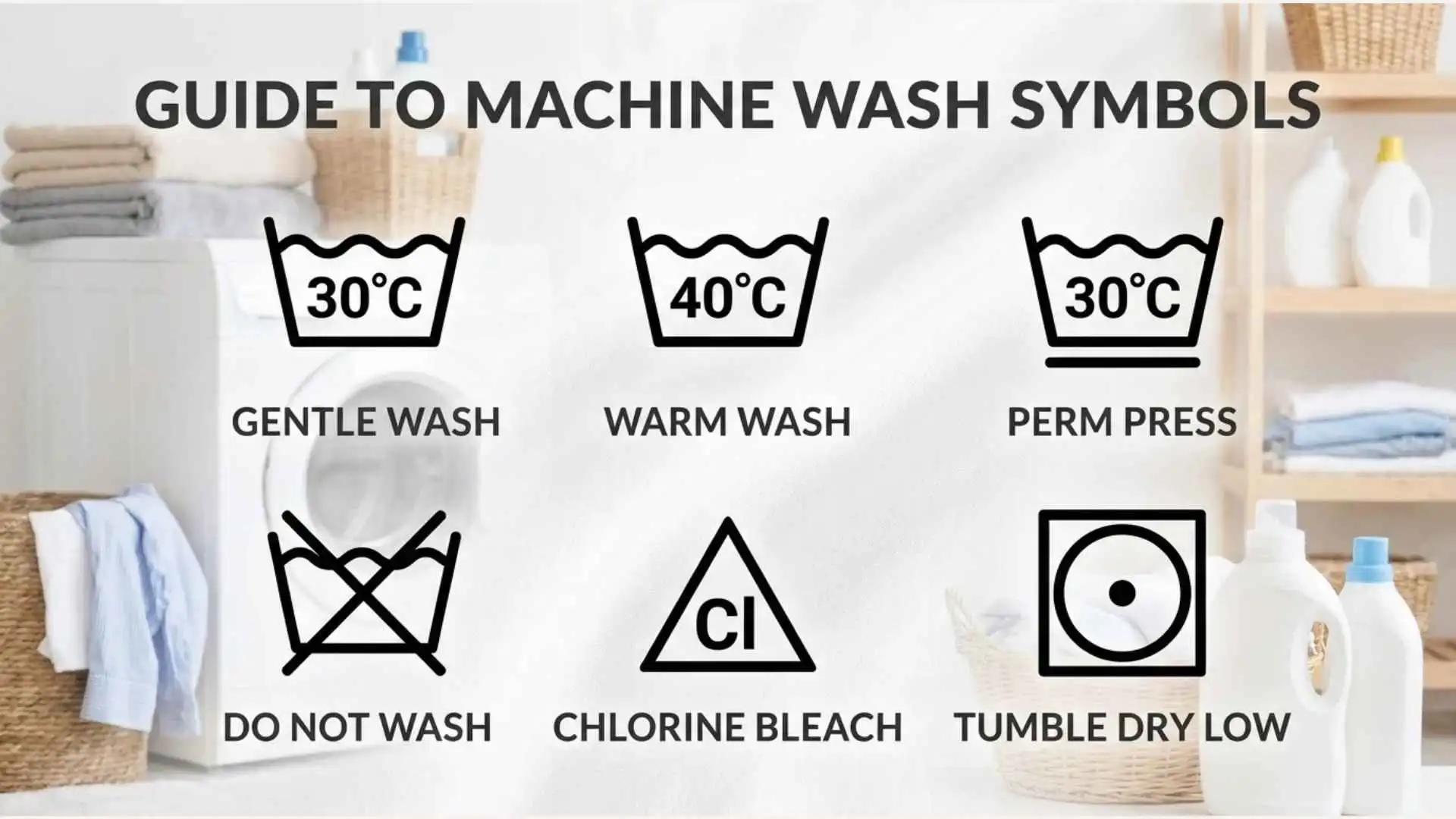
Machine wash symbols are small instructions on clothing care labels that help you wash your clothes safely and correctly. These symbols tell you important details about water temperature, washing cycles, spin speed, and special care requirements. Whether you are washing everyday T-shirts, delicate fabrics, towels, or expensive garments, understanding laundry symbols can help prevent shrinking, fading, stretching, and fabric damage.
Although many washing machine symbols look similar, each one has a specific meaning. A tub filled with water represents machine washing, while dots inside the tub indicate the recommended water temperature. Lines underneath the tub suggest a gentler washing cycle, and a crossed-out symbol means the garment should not be machine washed. Learning these common machine wash symbols and their meanings makes laundry easier and helps you choose the right settings for different fabrics.
In this complete guide, you will discover the meanings of common machine wash symbols, including normal wash, permanent press, delicate cycles, cold water washing, and hand-wash instructions. You will also learn how to recognize washing temperature symbols, understand special care labels, and avoid common laundry mistakes. By the end, you will feel more confident reading clothing care labels and choosing the right washing machine settings to keep your clothes clean, fresh, and in good condition.
Quick Answer
Machine wash symbols are care-label pictograms that explain whether a garment can be washed in a washing machine, which water temperature to use, and how gentle the wash cycle should be. A washtub represents washing, numbers or dots indicate temperature, lines beneath it show cycle strength, and a crossed-out tub means do not wash.
Quick Facts About Machine Wash Symbols
| Aspect | Information |
| Origin | Developed through twentieth-century textile care-labeling systems |
| Historical Significance | Created to communicate fabric-care instructions across different languages |
| Main Meaning | Shows the safest washing temperature, cycle, and method for a textile |
| Spiritual Meaning | No traditional spiritual meaning, although symbolically they may represent care, responsibility, and preservation |
| Cultural Importance | Helps consumers understand clothing-care instructions worldwide |
| Modern Usage | Printed or woven into labels on clothing, bedding, towels, curtains, and other textiles |
What Are Machine Wash Symbols?
Machine wash symbols are visual instructions placed on textile care labels. The main washing symbol looks like a small tub filled with water. Details inside or beneath that tub explain how the item should be cleaned.
The washtub is one of five major categories used in international textile care labeling. The others relate to bleaching, drying, ironing, and professional cleaning. In the internationally recognized sequence, these categories normally appear in that order.
These pictograms are designed to tell you the maximum treatment a garment can safely withstand. This means a label showing 40°C does not require you to wash at exactly 40°C. It means you should not exceed that temperature unless the manufacturer provides other instructions.
Origin and Historical Background
Before standardized care labels, laundry instructions were often written in words. This created problems when clothing crossed national borders or was sold to people who spoke different languages.
GINETEX, the International Association for Textile Care Labelling, was established in France in 1963 and helped develop a unified visual system. Its symbols later influenced international textile-care standards, including ISO 3758. The current GINETEX overview is based on ISO 3758:2023.
In the United States, the Federal Trade Commission’s Care Labeling Rule requires manufacturers and importers of covered textile apparel to provide regular care instructions. A label must generally give at least one safe washing or dry-cleaning method and include warnings when an ordinary care process could damage the product.
Machine wash symbols became important because they reduced confusion. A person could recognize a crossed-out washtub or a gentle-cycle line without needing to translate a sentence.
How to Read Machine Wash Symbols
The easiest way to understand washing symbols is to read them in layers:
- Look at the main shape. A washtub refers to washing.
- Check for a number or dots. These indicate the maximum water temperature.
- Look underneath the tub. Lines show how gentle the cycle should be.
- Check for a hand or cross. These change the washing method completely.
Basic Machine Wash Symbol
A plain washtub means the item can normally be washed in a household washing machine. Use an ordinary cycle while following any temperature shown inside the symbol.
Numbers Inside the Washtub
In many international labels, a number inside the tub gives the maximum wash temperature in degrees Celsius.
| Symbol Number | Maximum Temperature | Common Practical Use |
| 20°C | 68°F | Very delicate or lightly soiled items |
| 30°C | 86°F | Delicates, dark colors, and many synthetics |
| 40°C | 104°F | Everyday clothing and mixed fabrics |
| 50°C | 122°F | More durable textiles |
| 60°C | 140°F | Towels, bedding, and washable whites |
| 70°C | 158°F | Heat-tolerant hygienic laundry |
| 95°C | 203°F | Boil-wash-safe cotton or linen |
Always follow the actual label rather than relying only on fabric type. Two garments that look similar may contain different dyes, finishes, linings, adhesives, or decorative details.
Dots Inside the Washtub
Some care-label systems use dots instead of written temperatures. In common North American usage, more dots generally mean hotter water:
| Dots | General Meaning |
| One dot | Cold wash |
| Two dots | Warm wash |
| Three dots | Hot wash |
| Four or more dots | Increasingly high temperatures in systems that use expanded temperature levels |
Because regional systems can differ, written temperatures are more precise than dots. When both appear, follow the specific temperature and any accompanying wording.
One Line Under the Washtub
One horizontal line under the washing symbol means a mild or reduced-mechanical-action cycle.
Depending on the washing machine, this may be called:
- Permanent press
- Easy care
- Synthetics
- Mild cycle
- Reduced-spin cycle
This setting usually uses gentler agitation, controlled cooling, or slower spinning to reduce wrinkling and fabric stress.
Two Lines Under the Washtub
Two horizontal lines mean a very gentle wash. Choose a delicate, wool, or similarly protective program, depending on the garment’s fiber content and label instructions.
The item may need:
- Reduced agitation
- A smaller laundry load
- Lower spin speed
- Mild detergent
- A laundry bag for extra protection
Two lines are not merely decorative. They warn that a normal cycle may stretch, crease, felt, or weaken the garment.
Hand in the Washtub
A hand inside the washtub means hand wash. Under ISO-based guidance, hand-washing temperatures should remain low and the garment should be handled gently rather than rubbed, pulled, or tightly wrung.
Some washing machines have a hand-wash program, but this does not automatically make it safe for every hand-wash-only item. Check the machine manual and consider the garment’s construction, embellishments, and value.
Crossed-Out Washtub

A washtub with an X means do not wash. Do not put the item in a washing machine or hand-wash it in water.
The garment may require professional dry cleaning or another specialized method. Water could damage its shape, dye, coating, lining, or internal structure.
Common Types and Variations of Machine Wash Symbols
| Symbol Variation | Visual Description | Meaning | Where It Appears |
| Normal wash | Plain tub | Standard machine washing allowed | Cotton shirts, casual wear, towels |
| Cold machine wash | Tub with low temperature or one dot | Wash in cold water | Dark colors, modern synthetics |
| Warm machine wash | Tub with moderate temperature or two dots | Wash in warm water | Everyday mixed-fiber clothing |
| Hot machine wash | Tub with high temperature or three dots | Hot washing allowed | Durable whites, towels, bedding |
| Mild wash | Tub with one line beneath | Use a reduced-action cycle | Synthetics and permanent-press garments |
| Very gentle wash | Tub with two lines beneath | Use a delicate cycle | Fine knits, lace, wool blends |
| Hand wash | Hand inside tub | Wash gently by hand | Silk, delicate knits, embellished items |
| Do not wash | Cross over tub | Avoid water washing | Structured, coated, or dry-clean-only garments |
Machine Wash Symbols Across Different Cultures
Machine wash symbols are practical rather than religious or mythological, but their development reflects cultural cooperation.
European Tradition
European textile labels commonly use the GINETEX system. Numbers inside the washtub show maximum temperatures in Celsius, while bars underneath control the severity of the washing process.
United States
American labels may use written care instructions, recognized symbols, or both. The FTC allows appropriate terminology and symbols as long as consumers receive accurate regular-care guidance.
Canadian Usage
Canadian labels may combine words and familiar textile-care pictograms. Consumers may encounter both Celsius temperatures and dot-based heat guidance, especially on internationally manufactured clothing.
Japanese Care Labels
Japan uses a standardized care-label system with many symbols that resemble ISO-based pictograms. However, some details, temperature limits, and drying instructions may be presented differently.
Eastern Manufacturing Traditions
China, South Korea, Bangladesh, India, Pakistan, Vietnam, and other major textile-producing regions manufacture clothing for international markets. As a result, garments may carry care labels designed for the destination country rather than only the country of manufacture.
Indigenous Traditions
Traditional Indigenous textile care existed long before modern washing machines. Fibers, hides, dyes, woven materials, and handmade decoration were cared for according to local knowledge rather than universal pictograms. Modern machine wash symbols should not be confused with those older cultural practices.
Similar Laundry Symbols and Their Meanings
Machine wash symbols belong to a wider family of garment-care icons.
| Main Shape | Care Category | Basic Meaning |
| Washtub | Washing | Water washing and cycle instructions |
| Triangle | Bleaching | Whether bleach can be used |
| Square | Drying | Natural or machine-drying instructions |
| Square with circle | Tumble drying | Dryer permission and heat level |
| Iron | Ironing | Safe ironing temperature |
| Circle | Professional cleaning | Dry cleaning or professional wet cleaning |
A common mistake is thinking the square with a circle is another washing symbol. It actually refers to tumble drying. Another misconception is reading the circle as a machine-wash icon. A plain circle gives instructions to professional cleaners.
The Symbolic and Psychological Meaning of Care Labels
Machine wash symbols do not carry established spiritual meanings in religion, mythology, or ancient folklore. Claims that a 30°C wash symbol has a sacred or mystical meaning would not be historically reliable.
Still, these symbols can hold a modern symbolic value.
Spiritual Level
At a reflective level, garment care can represent stewardship. Looking after what you own encourages patience, gratitude, and less waste. The symbol becomes a quiet reminder that preservation often begins with small, repeated actions.
Psychological Level
Care labels reduce uncertainty. Instead of guessing how to wash an unfamiliar fabric, you receive a clear visual instruction.
This connects with a basic psychological need for control. People feel calmer when complex tasks are divided into recognizable patterns. The tub, dots, lines, and crosses create a simple decision system.
From a Jungian viewpoint, the washing process could be interpreted as a modern image of renewal or purification. However, this is a personal symbolic reading, not an official meaning of textile-care labels.
Cultural Level
Care symbols form a shared language. They allow a shopper in one country to understand clothing made in another. Their cultural importance comes from cooperation, trade, consumer protection, and the globalization of fashion.
Machine Wash Symbols in Mythology and Folklore
There are no ancient myths about washing-machine care labels because both the appliance and standardized symbols are modern inventions.
However, washing itself has appeared symbolically in myths, religions, and folklore for centuries. Water often represents purification, renewal, healing, or transition. Ritual bathing appears in many cultural and religious traditions, while folklore frequently treats clean clothing as a sign of preparation, dignity, or a new beginning.
These older meanings belong to water and cleansing, not to the modern washtub pictogram. The connection is metaphorical rather than historical.
Machine Wash Symbols in Art, Fashion, and Pop Culture
Laundry symbols now appear beyond hidden garment labels. Designers sometimes enlarge them on shirts, posters, tote bags, and home décor.
In fashion, an oversized care symbol may represent:
- Consumer culture
- Fast fashion
- Sustainability
- Domestic work
- Personal vulnerability
- The idea that people also need careful treatment
Artists may use “handle with care” themes to turn an ordinary household icon into an emotional statement. On social media, care-label graphics are often used in laundry guides, sustainable-fashion posts, infographics, and humorous content about ruined clothing.
Tattoo versions are uncommon but may carry a personal message such as “do not bleach,” “handle gently,” or “made to last.” These meanings are modern and individual, not part of the official care-label system.
Spiritual and Dream Meaning of Machine Wash Symbols
Dreaming about a washing symbol may reflect daily experiences, especially when you have recently bought clothing, done laundry, or worried about damaging something.
Possible personal interpretations include:
- A normal-wash symbol: readiness to solve a problem directly
- A delicate-cycle symbol: a need to handle yourself or someone else gently
- A hand-wash symbol: a situation requiring personal attention
- A crossed-out wash symbol: fear of taking the wrong approach
- A high-temperature symbol: pressure, intensity, or a desire for deep cleansing
Dream interpretation is subjective. These possibilities are psychological reflections, not fixed spiritual predictions.
Positive and Negative Meanings of Machine Wash Symbols
| Positive Meaning | Negative Meaning |
| Care and protection | Fear of making mistakes |
| Clarity and guidance | Confusion when symbols are unfamiliar |
| Responsible ownership | Anxiety about delicate belongings |
| Preservation and sustainability | Restrictions on convenience |
| International communication | Regional differences in interpretation |
| Order and routine | Overdependence on rules |
The symbol itself is neutral. Its emotional meaning depends on the viewer’s experience and situation.
Why Humans Are Attracted to Machine Wash Symbols
Humans naturally recognize shapes and patterns faster than long written instructions. A bold X quickly signals prohibition, while repeated dots suggest increasing intensity.
Care symbols also satisfy our desire to make the unfamiliar manageable. A delicate garment may feel risky, but a clear 30°C symbol and two lines beneath the tub turn that uncertainty into a practical choice.
There is also emotional value in preservation. Clothing often carries memories. A wedding outfit, inherited scarf, favorite sweater, or child’s first jacket can feel deeply personal. Understanding the label becomes a way of protecting more than fabric.
Modern Uses of Machine Wash Symbols
Today, machine wash symbols appear on:
- Clothing and uniforms
- Bedding and towels
- Curtains and upholstery covers
- Reusable shopping bags
- Stuffed toys
- Sportswear
- Textile accessories
- Digital laundry guides
- Washing-machine apps
- Retail and resale listings
They also support sustainable habits. Correct temperatures and gentler cycles can reduce avoidable shrinkage, fading, fiber damage, and premature disposal.
Common Machine-Washing Mistakes to Avoid
Treating Every Washable Garment the Same
A washable item may still require cold water, gentle agitation, or reduced spinning. “Machine washable” does not always mean “normal cycle.”
Ignoring the Lines Under the Tub
The bars are among the most overlooked parts of a care label. One or two lines can completely change the correct cycle.
Assuming Hotter Water Always Cleans Better
High heat can fade dyes, shrink fibers, damage elastic, and set certain stains. Never exceed the maximum temperature on the label.
Confusing “Do Not Wash” With “Hand Wash”
A crossed-out tub prohibits water washing. A hand in the tub allows gentle hand washing.
Reading Only the Washing Symbol
Safe washing is only one stage. A garment may tolerate machine washing but require air drying, low-temperature ironing, or no bleach.
Interesting Facts About Machine Wash Symbols
- The washtub controls washing only, not drying or bleaching.
- A number inside the tub is usually a maximum temperature, not a required temperature.
- One line underneath means gentler treatment, while two lines require very gentle treatment.
- A crossed symbol generally means that care method must not be used.
- Care symbols were developed to communicate without relying entirely on language.
- International labels commonly present five categories in a set order.
- Regional variations still exist despite international standardization.
- The material listed on a fiber-content label does not replace the care instructions.
- Decorative finishes and garment construction can make two similar fabrics require different care.
- Understanding labels can help clothes retain their size, color, texture, and shape for longer.
Frequently Asked Questions
What does the basic machine wash symbol look like?
It looks like a small washtub filled with water. Numbers, dots, lines, hands, or crosses modify its meaning.
What do the lines under a machine wash symbol mean?
One line means a mild cycle. Two lines mean a very gentle or delicate cycle with reduced mechanical action.
What does 30 mean on a washing symbol?
It means the garment may be washed at a maximum temperature of 30°C, which is about 86°F.
Can I machine wash an item with a hand-wash symbol?
The safest method is hand washing. A machine hand-wash program may be suitable for some garments, but check the appliance instructions and garment construction first.
What does a crossed-out washing symbol mean?
It means do not wash the item in water, either by machine or by hand. Follow the professional-cleaning instructions on the label.
Are machine wash symbols the same in every country?
The main shapes are widely recognized, but temperature markings, dots, wording, and some specialized instructions may vary by region.
Conclusion
Machine wash symbols turn a few simple shapes into a powerful garment-care language.
By reading the tub, temperature, lines, hand, and cross correctly, you can prevent many common laundry disasters.
These symbols also reflect something deeper: caring for what we own protects our money, memories, and environment.
A few seconds spent checking the label can add years to the clothes you value most.
 Michael Rivera
 John Mercer