
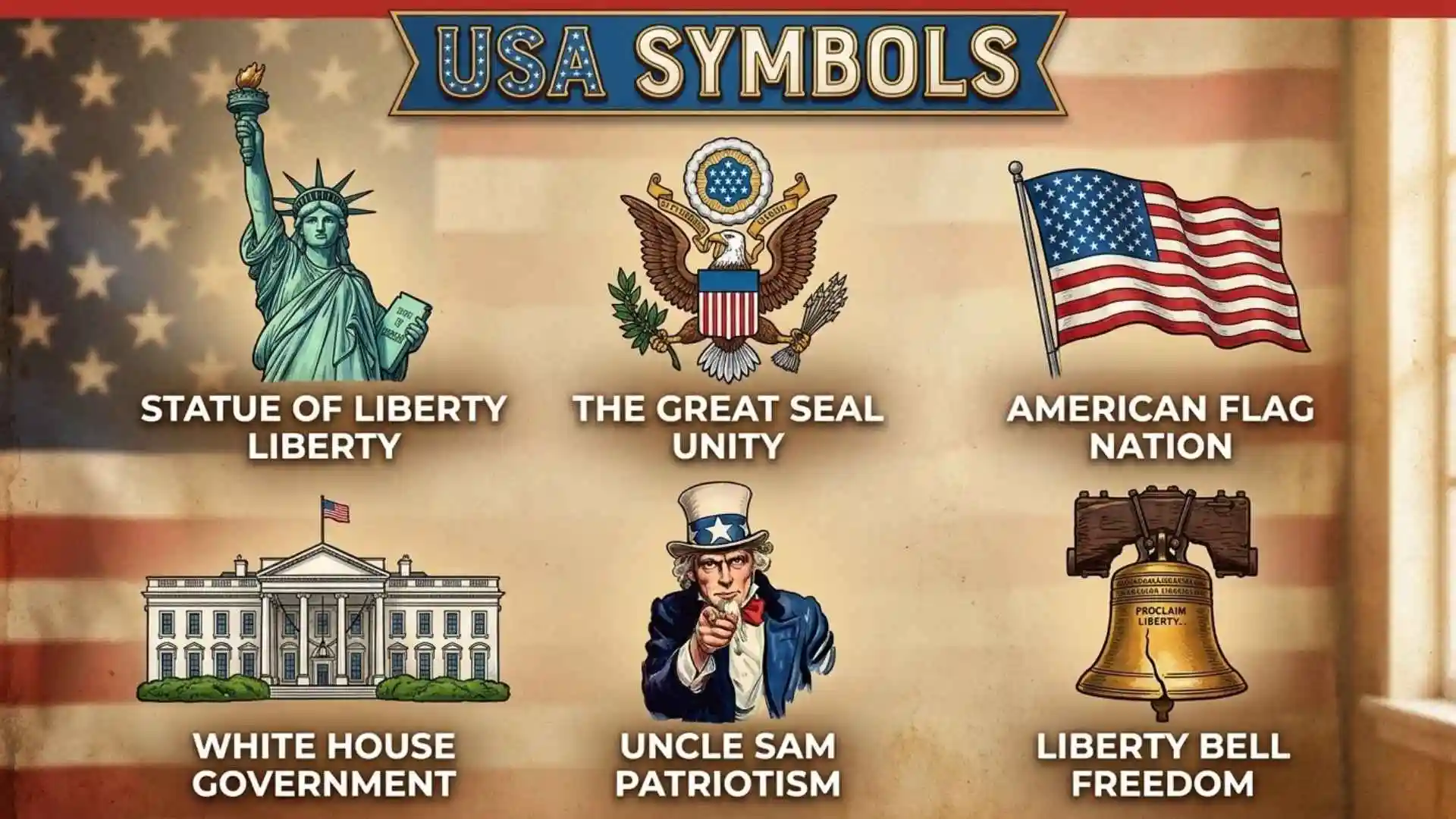
USA symbols represent the history, values, culture, and identity of the United States. From the American flag and bald eagle to the Statue of Liberty, the Great Seal, and the Liberty Bell, these powerful icons tell stories about freedom, independence, courage, unity, and national pride. Some symbols are officially recognized by the federal government, while others have become important through historical events, cultural traditions, and their lasting influence on American society.
Each American symbol has its own meaning and historical background. The 50 stars on the U.S. flag represent the states, while the 13 stripes honor the original colonies. The bald eagle symbolizes strength and independence, and the Statue of Liberty represents freedom and hope. Other symbols, including Uncle Sam, the White House, the Liberty Bell, and national monuments, reflect different parts of America’s political history, shared identity, and cultural heritage.
In this complete guide to USA symbols, you will discover the meanings, origins, and significance of America’s most recognizable national icons. From official national symbols and patriotic emblems to historical landmarks, animals, flowers, and cultural representations, each section explores what these symbols represent and why they matter. Whether you are a student, history enthusiast, or simply curious about American culture, this guide will help you understand the visual symbols that tell America’s story.
Quick Answer
USA symbols are visual objects, living species, monuments, documents, songs, and ideas that represent the United States. Major examples include the American flag, bald eagle, Great Seal, Statue of Liberty, Liberty Bell, national anthem, rose, oak tree, and American bison. Together, they express freedom, unity, strength, democracy, and national identity.
Quick Facts About USA Symbols
| Aspect | Information |
| Origin | Colonial America, the Revolutionary era, Indigenous traditions, European influences, and later federal laws |
| Historical Significance | Helped define the identity of the new United States and preserve memories of major national events |
| Main Meaning | Freedom, independence, unity, courage, democracy, and national pride |
| Spiritual Meaning | Hope, renewal, protection, moral responsibility, and the search for a higher national purpose |
| Cultural Importance | Connects citizens with shared history while allowing different communities to interpret America in personal ways |
| Modern Usage | Government seals, currency, schools, sports, military insignia, clothing, tattoos, advertising, and social media |
What Are USA Symbols?
USA symbols are recognizable images, objects, animals, plants, places, and texts associated with American identity. Some are official national emblems established through laws or government decisions. Others became important through history, public memory, art, protest, immigration, or popular culture.
The first national symbols developed during the American Revolution. The new country needed images that could separate it from British rule and communicate its political ideals. Stars, stripes, eagles, liberty caps, bells, shields, and classical figures began appearing on flags, coins, seals, and public documents.
The American flag was officially adopted by the Continental Congress on June 14, 1777. Its 13 stripes recall the original colonies, while its 50 stars represent the current states. As the country expanded, the flag changed with it, becoming a visual map of national growth.
The Great Seal of the United States was approved in 1782. Its bald eagle, olive branch, arrows, shield, and Latin motto created a symbolic portrait of the young republic. Over time, American symbols appeared in schools, courtrooms, military ceremonies, immigration stations, civil rights marches, and national memorials.
Their importance comes from repetition and emotional experience. A flag seen during a holiday parade may inspire pride. The same flag carried during a protest may represent a demand that the country fulfill its promises. Symbols remain powerful because their meanings can be shared, debated, and renewed.
Deep Symbolic Meaning of USA Symbols
Spiritual Meaning
On a spiritual level, many USA symbols express hope, moral purpose, renewal, and the desire for freedom. The Statue of Liberty raises a torch, suggesting illumination and guidance. The bald eagle rises into the sky, connecting earthly struggle with higher vision.
The stars on the American flag can be interpreted as points of light within a larger whole. Each state has a separate identity, yet every star belongs to the same field. This reflects the spiritual idea that unity does not require complete sameness.
National symbols can also function like sacred objects during ceremonies. People stand, remove hats, place hands over their hearts, or observe silence. These actions create a shared emotional space, even among people with different religious beliefs.
Psychological Meaning
Psychologically, symbols turn complex ideas into images the mind can quickly recognize. Freedom is abstract, but a broken chain makes it visible. National strength is difficult to picture, but an eagle with open wings gives it shape.
In Jungian psychology, an archetype is a recurring image or pattern found across human stories. The eagle resembles the ruler, guardian, and sky messenger archetypes. The torch represents knowledge. The shield represents protection. The journey toward a promised land appears in immigration stories and national myths.
These images create belonging, but they can also awaken disagreement. One person may associate the flag with military service, while another connects it with civil rights struggles. The emotional power comes not only from the object but from the experiences attached to it.
Cultural Meaning
Culturally, USA symbols help people tell a national story. They appear during Independence Day celebrations, presidential ceremonies, sporting events, school lessons, military funerals, and citizenship ceremonies.
However, American culture is not shaped by one historical experience. Indigenous peoples, enslaved Africans, immigrants, religious minorities, veterans, workers, and social reformers have all interpreted national symbols differently.
Therefore, the most meaningful understanding of USA symbols recognizes both national ideals and historical contradictions. Liberty can represent an achievement, a promise, or a goal that has not yet been fully reached.
Types and Variations of USA Symbols
The American Flag
Visual description: Thirteen red and white stripes with 50 white stars on a blue field.
Meaning: National unity, independence, sacrifice, and the union of the states.
Cultural connection: Known as the Stars and Stripes and sometimes Old Glory, the flag appears at schools, government buildings, military events, homes, and public demonstrations.
The Bald Eagle
Visual description: A large bird of prey with a white head, brown body, powerful wings, and hooked beak.
Meaning: Strength, freedom, alertness, independence, and authority.
Cultural connection: The bald eagle has appeared on the Great Seal since 1782. In December 2024, it was formally designated the national bird under federal law, strengthening its official place among American symbols.
The Great Seal of the United States
Visual description: A bald eagle holding an olive branch in one talon and arrows in the other, with a shield on its chest.
Meaning: Peace supported by strength, national sovereignty, defense, and unity.
The motto “E Pluribus Unum” means “Out of many, one.” It reflects the creation of one nation from separate states and diverse communities.
The Statue of Liberty
Visual description: A robed female figure holding a torch and a tablet, with broken chains near her feet.
Meaning: Liberty, enlightenment, human dignity, immigration, and freedom from oppression.
The statue was a gift from France and was dedicated in 1886. For millions of immigrants arriving through New York Harbor, it became a powerful sign of possibility.
The Liberty Bell
Visual description: A large bronze bell with a famous crack.
Meaning: Independence, resistance to oppression, abolition, and civil rights.
The bell’s crack has added to its symbolic power. It suggests that liberty may be imperfect yet still capable of calling people toward justice.
The American Bison
Visual description: A massive grazing mammal with a broad head, curved horns, and heavy shoulders.
Meaning: Endurance, wilderness, abundance, survival, and the American West.
The bison became the national mammal in 2016. Its history also reflects the destruction of wildlife and the devastating effects of westward expansion on Indigenous communities.
The Rose and Oak Tree
The rose is the national floral emblem, symbolizing love, beauty, remembrance, and emotional strength.
The oak is the national tree. Its deep roots, long life, and solid wood represent endurance, stability, and national growth.
USA Symbols Across Different Cultures
Ancient Egypt
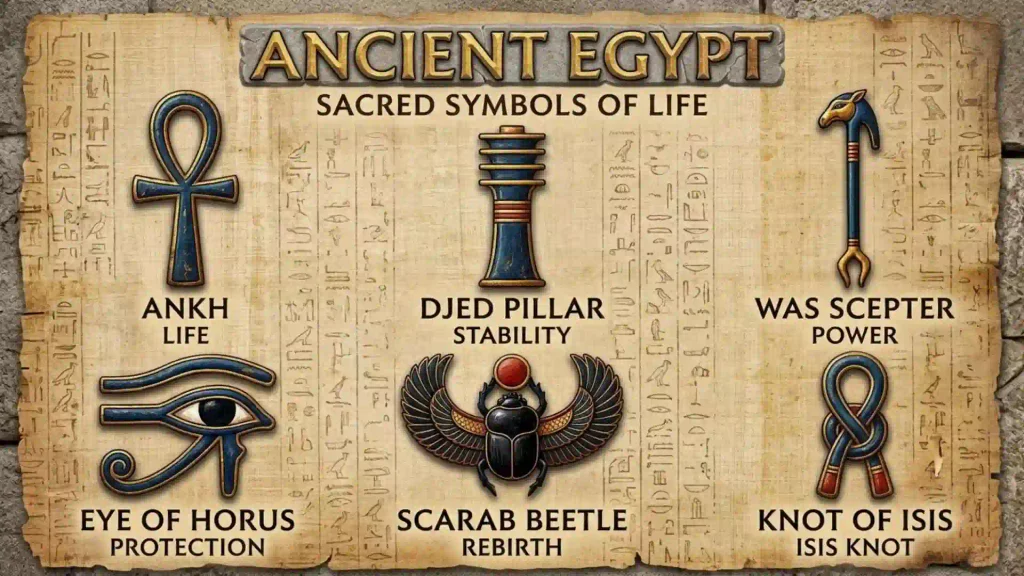
Ancient Egyptian civilization used the eagle, falcon, sun disk, and protective wings as signs of divine authority and cosmic order. Although these are not American symbols, they shaped the wider symbolic language through which later cultures understood powerful birds and celestial images.
Ancient Greece
Greek traditions connected the eagle with Zeus, the ruler of the gods. The bird represented supreme authority, victory, and communication between heaven and earth. Classical Greek ideas also influenced American architecture, democratic language, and civic design.
Roman Culture
Rome used the eagle as a military and imperial emblem. The Roman fasces, a bundle of rods associated with authority, later appeared in American government art and symbols. Unlike its later political misuse in other settings, its original republican meaning involved lawful power and collective strength.
Eastern Traditions
In many Asian traditions, stars, mountains, birds, flowers, and light carry meanings connected with harmony, wisdom, protection, and spiritual awakening. Asian American communities often combine these older cultural symbols with American flags, eagles, and patriotic colors.
Indigenous Traditions
Eagles have held sacred meaning in many Indigenous nations long before the United States existed. They may represent courage, prayer, spiritual vision, leadership, or a connection with the Creator.
It is important not to treat all Indigenous traditions as identical. Each nation has its own beliefs and artistic practices. The eagle’s sacred role in Native cultures should not be reduced to the later meaning assigned by the federal government.
Modern American Culture
Modern interpretations are increasingly personal. Immigrant families may display the flag beside symbols from their countries of origin. Protesters may carry it upside down to communicate distress. Artists may redesign it to discuss race, gender, war, environmental protection, or national unity.
Similar Symbols and Their Meanings
| USA Symbol | Related Symbol | Shared Meaning | Main Difference |
| American flag | State flags | Identity and belonging | The national flag represents the entire United States |
| Bald eagle | Phoenix | Power and renewal | The eagle is a real national animal, while the phoenix is mythical |
| Statue of Liberty | Torch | Knowledge and freedom | The statue combines the torch with immigration and civic liberty |
| Liberty Bell | Church or civic bell | Public awakening | The Liberty Bell is strongly tied to independence and abolition |
| Great Seal | Presidential Seal | Federal authority | The Great Seal represents the nation, while the presidential seal represents the presidency |
| American bison | Horse | Western history and freedom | The bison emphasizes survival, wilderness, and Indigenous history |
A common misconception is that all popular patriotic images are official national symbols. Uncle Sam, the White House, Mount Rushmore, and the red, white, and blue color combination are widely recognized, but they do not all hold the same legal status as official emblems.
USA Symbols in Mythology and Folklore
The United States is a relatively young nation, but it quickly developed its own legends.
The bald eagle inherited older mythological meanings connected with sky gods, kingship, and divine sight. In American storytelling, it became a guardian flying above the landscape.
Lady Liberty resembles older female personifications such as the Roman goddess Libertas. By turning liberty into a human figure, artists made a political principle feel protective, wise, and emotionally accessible.
American folklore also created figures such as Uncle Sam, Columbia, Paul Bunyan, Johnny Appleseed, and the cowboy. These figures represent government, national character, physical strength, expansion, independence, and life on the frontier.
Such stories helped build a shared identity, but they sometimes simplified history. Modern scholarship examines both the inspiration these myths created and the people whose experiences were excluded from them.
USA Symbols in Art, Literature, Movies, and Pop Culture
Artists use USA symbols to celebrate, criticize, or question the nation. The flag appears in paintings by Jasper Johns, patriotic posters, war photography, protest art, clothing, and album covers.
Writers and poets often use America itself as a symbol of possibility. Walt Whitman connected the nation with democracy and many voices. Langston Hughes examined the distance between America’s promises and the realities faced by Black citizens.
Movies frequently show the flag, the White House, the Statue of Liberty, or the national anthem during moments of victory, danger, sacrifice, and renewal. In science fiction, a damaged monument may signal national collapse. In inspirational stories, a raised flag may suggest resilience.
Tattoos featuring eagles, flags, stars, military emblems, or “We the People” can express service, family history, political identity, or remembrance. Fashion and branding also use patriotic imagery, especially near national holidays.
Spiritual and Dream Meaning of USA Symbols
Dreaming of an American flag may reflect identity, belonging, responsibility, conflict, or a desire for freedom. A bright flag may suggest confidence and unity. A torn or falling flag may point to disappointment, fear, or concern about social instability.
A bald eagle in a dream often symbolizes independence, ambition, higher vision, or the need to rise above a problem. An attacking eagle may warn against pride, domination, or uncontrolled power.
Dreaming of the Statue of Liberty may signal a wish to escape restrictions or begin a new chapter. A darkened torch could represent lost hope, while a shining torch may suggest guidance and personal awakening.
Dream interpretations are not fixed predictions. Their meaning depends on personal memories, cultural background, emotions, and the dream’s full setting.
Positive and Negative Meanings of USA Symbols
| Positive Meaning | Negative or Shadow Meaning |
| Freedom | Freedom denied or unequally protected |
| Unity | Pressure to ignore differences |
| Courage | Aggression or militarism |
| Patriotism | Extreme nationalism |
| Strength | Domination or misuse of power |
| Opportunity | Unrealistic promises |
| Tradition | Resistance to necessary change |
| Pride | Exclusion of people seen as outsiders |
A national symbol can hold both light and shadow. The flag may inspire unity, yet it may also become part of political conflict. The eagle represents freedom, but its power can symbolize domination when used aggressively.
Context determines whether the symbol comforts, inspires, warns, or divides.
Why Humans Are Attracted to USA Symbols
People are attracted to national symbols because the human brain remembers images more easily than abstract ideas. A single eagle can communicate power faster than a long speech.
Symbols also connect personal memory with collective history. A veteran may remember service when seeing a flag. An immigrant may remember a citizenship ceremony. A child may connect fireworks with family gatherings.
Pattern recognition strengthens this bond. Repeated colors, shapes, songs, and rituals become emotionally familiar. Over time, they form cultural memory.
Most importantly, people give symbols personal meaning. A national emblem becomes powerful when it carries a story about who someone was, what they endured, and what they hope their country can become.
Modern Uses of USA Symbols
Today, USA symbols appear in:
- Tattoos honoring military service, heritage, or personal freedom
- Jewelry featuring stars, eagles, flags, and liberty imagery
- Fashion worn during elections, holidays, and sporting events
- Branding that emphasizes American origin or craftsmanship
- Social media posts about national pride, protest, remembrance, or unity
- Home decor, including flags, historic prints, and patriotic signs
- Contemporary spiritual practices focused on freedom, justice, or community healing
- Schools, museums, government buildings, and citizenship ceremonies
Responsible use requires awareness. National symbols should not be used in ways that falsely suggest government approval, violate established display rules, or disrespect communities with different historical experiences.
Interesting Facts About USA Symbols
- The American flag has changed as new states joined the Union.
- The current 50-star design has been used since July 4, 1960, after Hawaii became a state.
- The bald eagle appeared on the Great Seal for more than two centuries before becoming the official national bird in 2024.
- Benjamin Franklin famously criticized the bald eagle’s character and expressed admiration for the wild turkey, although he did not formally propose the turkey as the national emblem.
- The Statue of Liberty’s full name is Liberty Enlightening the World.
- The broken chains near Lady Liberty’s feet symbolize liberation from oppression.
- The original Liberty Bell inscription includes words from the biblical Book of Leviticus about proclaiming liberty.
- The Great Seal contains 13 stars, 13 stripes, 13 arrows, and 13 leaves, recalling the original states.
- The American bison came close to extinction before conservation efforts helped its population recover.
- The phrase “E Pluribus Unum” appears on the Great Seal and expresses the idea of unity formed from many parts.
Frequently Asked Questions
What are the main symbols of the USA?
The main USA symbols include the American flag, bald eagle, Great Seal, Statue of Liberty, Liberty Bell, national anthem, American bison, rose, oak tree, and national monuments.
What does the American flag symbolize?
The 50 stars represent the states, while the 13 stripes represent the original colonies. More broadly, the flag symbolizes national unity, independence, sacrifice, and American ideals.
Why is the bald eagle a symbol of America?
The bald eagle was chosen for the Great Seal in 1782 because it is native to North America and visually communicates strength, independence, courage, and authority.
What symbolizes freedom in the United States?
The Statue of Liberty, Liberty Bell, American flag, bald eagle, torch, broken chains, and Declaration of Independence are widely associated with American freedom.
Are all USA symbols official?
No. Some, including the national bird, mammal, flower, and tree, have official federal recognition. Others, such as Uncle Sam and Mount Rushmore, are culturally important but have different legal or symbolic status.
What is the spiritual meaning of USA symbols?
Spiritually, USA symbols can represent hope, higher vision, moral courage, renewal, protection, unity, and the responsibility to defend human dignity and freedom.
Conclusion
USA symbols are more than patriotic decorations. They preserve the nation’s victories, struggles, ideals, and unfinished promises.
Their meanings continue to change as each generation adds new experiences and perspectives.
Whether displayed in celebration, remembrance, or protest, these symbols invite people to consider what America represents.
Their deepest power lies not only in national pride, but in the continuing effort to turn freedom, unity, and justice into lived realities.
 Sarah Thompson
 Michael Rivera