
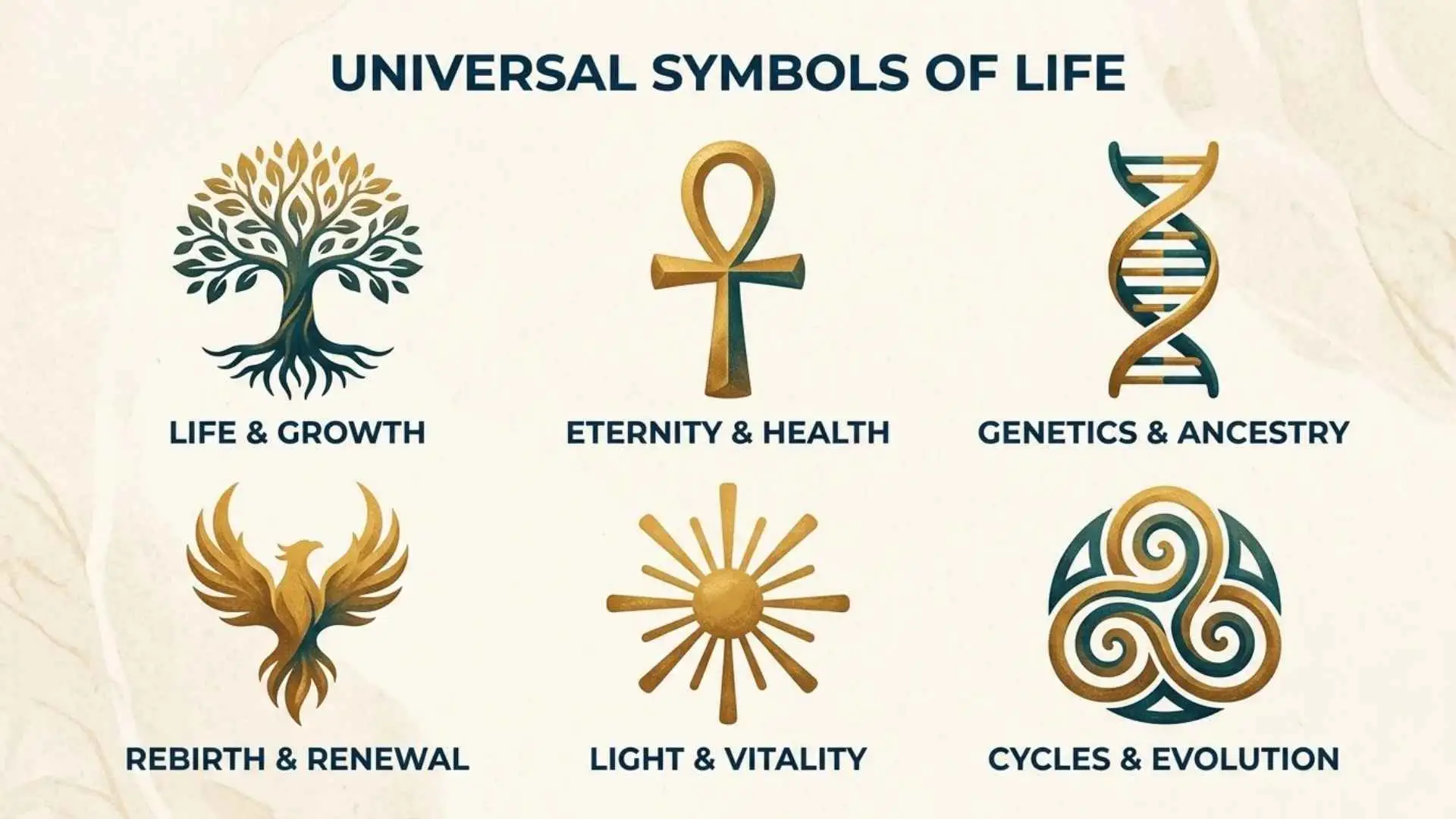
Universal symbols are powerful signs, images, and shapes that communicate ideas, emotions, and beliefs across different cultures and generations. From the heart that represents love to the sun that symbolizes life and the circle that suggests unity, these familiar images help people express complex meanings without relying on words. You can find universal symbols in ancient artwork, religious traditions, modern logos, everyday signs, literature, and spiritual practices around the world.
Although some symbols appear to have similar meanings across cultures, their interpretations can change depending on history, religion, geography, and personal experience. For example, the dove is widely associated with peace, while the tree often represents growth, strength, and the connection between life and nature. Other symbols, such as the spiral, infinity sign, cross, and lotus flower, carry different layers of meaning shaped by the traditions in which they appear. Understanding these differences helps reveal how symbols connect people while also reflecting the uniqueness of individual cultures.
In this complete guide to universal symbols and their meanings, you will explore the origins, cultural significance, and interpretations of some of the world’s most recognizable signs and images. From symbols of love, peace, protection, and wisdom to ancient geometric shapes and natural elements, each example offers insight into how humans communicate shared experiences and beliefs. Whether you are interested in history, psychology, spirituality, art, or cultural traditions, this guide will help you discover the deeper meanings behind the symbols that connect humanity.
Quick Answer
Universal symbols are images, shapes, gestures, or objects that communicate widely recognized ideas across different cultures. Examples include the heart for love, the circle for unity, light for knowledge, and the dove for peace. Their meanings often come from shared human experiences, nature, religion, mythology, and cultural tradition.
Quick Facts About Universal Symbols
| Aspect | Information |
| Origin | Prehistoric art, nature observation, ritual, mythology, and early communication |
| Historical Significance | Helped communities record beliefs, identify groups, warn of danger, and explain life events |
| Main Meaning | Communication of shared ideas through recognizable images or forms |
| Spiritual Meaning | Unity, transformation, divine order, protection, awakening, and connection |
| Cultural Importance | Preserves identity, tradition, collective memory, and social values |
| Modern Usage | Road signs, medicine, technology, branding, tattoos, emojis, religion, and art |
What Are Universal Symbols?
Universal symbols are visual signs that express ideas understood by many people, even when those people speak different languages. They may appear as geometric shapes, natural elements, animals, colors, gestures, or human-made objects.
A circle, for example, often suggests wholeness because it has no clear beginning or end. Fire can represent warmth and life, but it can also warn of danger and destruction. A tree may symbolize growth because it begins as a seed, develops roots, and reaches toward the sky.
The earliest known symbolic communication appears in prehistoric cave paintings, carved bones, burial objects, and ritual sites. Images of animals, hands, suns, and human figures were not always simple decoration. Many scholars believe they helped early communities express identity, memory, spirituality, hunting knowledge, or relationships with nature.
As civilizations developed, symbols became more organized. Ancient Egyptians used hieroglyphs. Mesopotamian societies used written signs and divine emblems. Greek and Roman cultures connected symbols with gods, virtues, planets, and political authority.
However, no symbol is perfectly universal. Meaning changes according to culture, religion, time, and context. A color associated with celebration in one society may represent mourning in another. Therefore, universal usually means widely recognizable, not identical everywhere.
Deep Symbolic Meaning of Universal Symbols
Spiritual Level
On a spiritual level, symbols give visible form to invisible ideas. Concepts such as eternity, the soul, divine protection, rebirth, or enlightenment can be difficult to explain. A symbol turns these abstract beliefs into something people can see, carry, draw, or remember.
Light often represents truth, sacred presence, and awakening. Water may symbolize cleansing, renewal, and emotional healing. Mountains can suggest spiritual effort because climbing upward requires strength, patience, and courage.
Sacred symbols also help people focus during prayer and meditation. A mandala, cross, lotus, crescent, or prayer wheel can guide attention away from daily distractions and toward deeper questions about meaning and consciousness.
Psychological Level
Psychologically, symbols affect us because the human mind naturally looks for patterns. We connect repeated images with feelings, memories, and expectations.
Swiss psychiatrist Carl Jung described certain recurring symbolic patterns as archetypes. These include figures such as the hero, shadow, wise elder, mother, child, and trickster. Jung believed these patterns appear repeatedly in myths, dreams, religion, and art because they reflect common parts of human experience.
A dark forest may feel frightening because it represents uncertainty and the unknown. A doorway can suggest opportunity or transition. A broken mirror may create unease because mirrors are connected with identity and self-perception.
Symbols often reach emotion faster than detailed explanations. A single heart icon can express affection instantly. A skull can create an immediate awareness of danger or mortality.
Cultural Level
At the cultural level, symbols create belonging. Flags, clothing patterns, national animals, religious signs, and traditional colors help communities express who they are.
They also carry collective memory. A symbol may remind people of historical victories, suffering, migration, faith, or resistance. Because of this, symbols can unite communities, but they can also become controversial when different groups interpret them differently.
Their power comes not only from appearance but also from the stories attached to them.
Types and Variations of Universal Symbols
The Circle
A circle is a closed, curved shape with no visible beginning or end. It commonly represents unity, eternity, cycles, protection, and completeness.
Circular forms appear in halos, wedding rings, mandalas, wheels, suns, and sacred architecture. In dreams, a complete circle may suggest balance, while a broken circle may represent interruption or emotional separation.
The Heart
The familiar heart shape does not closely match the anatomical human heart. Still, it has become one of the world’s clearest signs of love, affection, compassion, and emotional attachment.
It appears in romantic art, religious devotion, greeting cards, tattoos, social media reactions, and health campaigns. A broken heart communicates grief or rejection, while a glowing heart may suggest kindness or spiritual love.
The Tree
Trees represent life, growth, ancestry, stability, wisdom, and the relationship between worlds. Their roots reach into the earth, while their branches rise toward the sky.
The Tree of Life appears in Mesopotamian art, Norse mythology, Jewish mysticism, Christianity, Celtic design, and many other traditions. Family trees also use the tree as a symbol of lineage and connection.
Light and Darkness
Light often represents truth, knowledge, goodness, safety, and divine presence. Darkness may symbolize mystery, ignorance, fear, rest, or the hidden mind.
These meanings are not always morally simple. Darkness can also represent peace, protection, and inner reflection. Light can reveal truth, but harsh light may symbolize exposure or judgment.
Water
Water symbolizes life, cleansing, emotion, fertility, movement, and transformation. It appears in baptism, ritual washing, sacred rivers, healing traditions, and creation myths.
Calm water may represent emotional peace. Floods or stormy seas may symbolize overwhelming feelings, chaos, or major change.
The Eye
The eye represents awareness, perception, protection, knowledge, and watchfulness. The Eye of Horus in ancient Egypt was connected with healing and royal protection.
In modern life, an eye can represent observation, privacy, surveillance, or spiritual insight. Its meaning depends strongly on context.
The Serpent
Serpents carry both positive and negative meanings. They can symbolize healing, wisdom, rebirth, fertility, temptation, danger, or hidden power.
Because snakes shed their skin, many traditions connect them with renewal. The rod of Asclepius, featuring one serpent around a staff, remains an important medical symbol.
The Dove
The dove commonly represents peace, innocence, hope, and spiritual purity. Its peaceful meaning was strengthened by religious traditions and later by political art.
Pablo Picasso’s dove drawings helped popularize the bird as a modern international peace symbol during the twentieth century.
Universal Symbols Across Different Cultures
Ancient Egypt
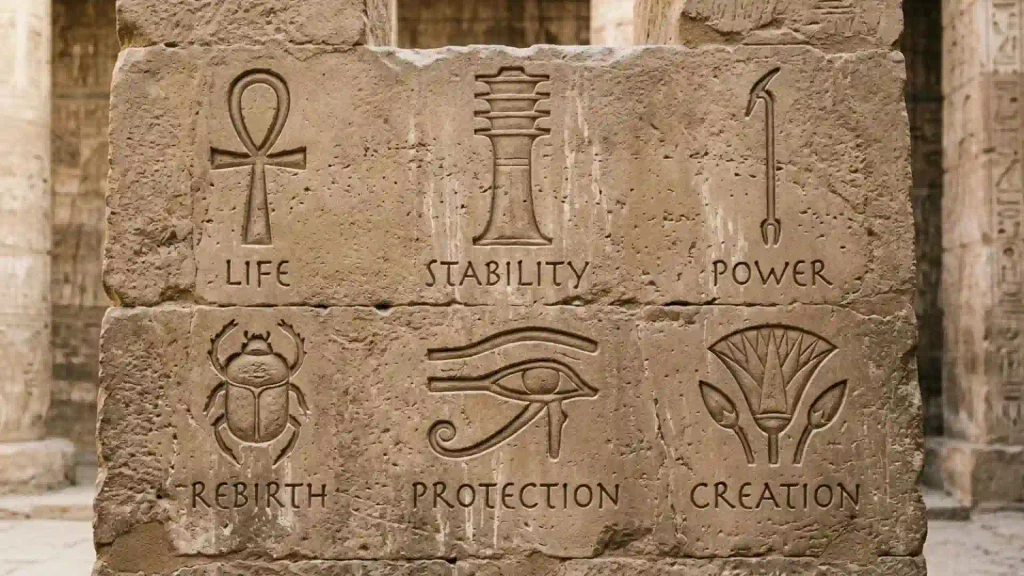
Ancient Egyptian culture used a rich symbolic system. The ankh represented life, while the scarab symbolized renewal and the rising sun. The Eye of Horus suggested healing, protection, and restored order.
Colors also carried meaning. Gold was linked with the gods and eternity, while green suggested life and regeneration.
Ancient Greece
Greek symbols were closely tied to mythology. The owl represented Athena and wisdom. Laurel wreaths symbolized victory and honor. The olive branch became associated with peace and reconciliation.
Greek myths also shaped universal symbolic figures, including the hero’s journey, the labyrinth, the phoenix, and the tragic mask.
Roman Culture
The Romans adopted many Greek symbols and connected them with imperial identity. Eagles represented power, military strength, and divine favor. Fasces symbolized legal authority and unity through combined strength.
Roman symbolism later influenced European government, law, architecture, and national emblems.
Eastern Traditions
In Hinduism and Buddhism, the lotus represents purity, spiritual growth, and awakening. It rises from muddy water yet opens as a clean flower, making it a powerful image of inner transformation.
In Chinese culture, the dragon often represents strength, prosperity, authority, and good fortune. This differs from many European stories, where dragons are usually dangerous creatures.
The yin-yang symbol expresses the relationship between opposite yet connected forces, such as light and dark, activity and rest, or expansion and contraction.
Indigenous Traditions
Indigenous traditions are highly diverse and should not be treated as one culture. Still, many use animals, plants, celestial forms, and natural cycles to express relationships between humans, ancestors, land, and spirit.
The eagle, bear, turtle, raven, and wolf can have distinct meanings among different nations. Their symbolism must be understood within the specific community that created it.
Modern Interpretations
Today, symbols travel quickly through advertising, film, digital communication, and social media. The power icon, recycling arrows, peace sign, red cross, Wi-Fi symbol, and emoji heart are recognized across many countries.
Modern symbols often aim for clarity, speed, and global usability, yet cultural differences still affect interpretation.
Similar Symbols and Their Meanings
| Symbol | Common Meaning | How It Differs |
| Circle | Unity, eternity, completion | Focuses on wholeness and cycles |
| Spiral | Growth, movement, evolution | Suggests an unfolding journey |
| Heart | Love, affection, compassion | Emphasizes emotional connection |
| Dove | Peace, innocence, hope | Often linked with spiritual or social peace |
| Olive branch | Reconciliation, peace | Suggests an offered agreement |
| Tree | Life, ancestry, stability | Connects growth with roots and heritage |
| Lotus | Purity, awakening, renewal | Emphasizes rising beyond hardship |
| Phoenix | Rebirth after destruction | Represents dramatic renewal through crisis |
| Sun | Life, energy, truth | Often suggests active power and visibility |
| Moon | Cycles, intuition, mystery | Often linked with change and inner life |
A common mistake is assuming that related symbols mean exactly the same thing. The tree and lotus both suggest growth, but the tree focuses on roots and steady development, while the lotus emphasizes purity emerging from difficult conditions.
Universal Symbols in Mythology and Folklore
Myths gave many symbols their lasting emotional power. The phoenix, found in ancient Mediterranean traditions and later European storytelling, became a symbol of rebirth because it was said to rise again after destruction.
The labyrinth entered Greek mythology through the story of Theseus and the Minotaur. Today, it can represent confusion, self-discovery, danger, or the difficult path toward truth.
Dragons appear in cultures across Europe and Asia, but their roles differ. European dragons often guard treasure or threaten communities. Chinese dragons are more commonly connected with rain, authority, strength, and prosperity.
The world tree appears in several mythological systems. Yggdrasil in Norse mythology connects different realms. Similar cosmic trees appear in Central Asian, Mesoamerican, Indian, and ancient Near Eastern traditions.
These stories shaped how later generations understood courage, death, wisdom, temptation, sacrifice, and renewal.
Universal Symbols in Art, Literature, Movies, and Pop Culture
Artists use symbols to communicate ideas without explaining them directly. A storm in a painting may suggest conflict. A fading flower may represent mortality. An open window can imply freedom, longing, or possibility.
Literature often turns objects into emotional symbols. A road may represent choice. A locked room can suggest repression or secrecy. A journey may reflect personal growth rather than physical travel alone.
Movies use color, lighting, costume, weather, and repeated objects to guide emotion. White may suggest innocence, but it can also create coldness or emptiness. Red may signal passion, danger, blood, rebellion, or power.
In tattoos and fashion, people choose universal symbols to express identity. A compass may represent direction. Wings can suggest freedom. A semicolon tattoo often communicates survival and continuation after emotional struggle.
Spiritual and Dream Meaning of Universal Symbols
Dream symbols are personal, so no image has one guaranteed meaning. Still, certain interpretations appear frequently.
Water may reflect emotions. Flying can suggest freedom or escape. A house may represent the self, with different rooms connected to memories or hidden feelings. A bridge may indicate transition, while a closed door may point to blocked opportunity.
During meditation, symbols such as light, circles, animals, or geometric patterns may arise from memory, imagination, emotion, or spiritual belief. Their value often depends on the meaning the individual gives them.
Positive dream symbols may encourage healing, confidence, or change. Cautionary symbols may reveal fear, unresolved conflict, or emotional overload. Context matters more than any fixed dream dictionary.
Positive and Negative Meanings of Universal Symbols
| Positive Meaning | Negative Meaning |
| Light as truth and hope | Light as exposure or judgment |
| Fire as warmth and transformation | Fire as destruction and anger |
| Water as cleansing and life | Water as chaos or emotional overwhelm |
| Snake as healing and renewal | Snake as danger or deception |
| Circle as unity | Circle as repetition or entrapment |
| Crown as achievement | Crown as pride or domination |
| Darkness as rest and mystery | Darkness as fear or ignorance |
| Wings as freedom | Wings as escape from responsibility |
A symbol can contain both light and shadow because human experience is rarely simple. Fire cooks food and destroys homes. Water gives life and causes floods. The meaning changes according to setting, story, and emotion.
Why Humans Are Attracted to Universal Symbols
Humans are visual thinkers. The brain can recognize a familiar image faster than it can process a long explanation. This makes symbols useful for communication, memory, and decision-making.
We are also drawn to symbols because they turn personal feelings into shared forms. Grief may feel private, but a black ribbon allows a community to express mourning together. Love may be difficult to describe, but a heart communicates it instantly.
Symbols connect individual experience with cultural memory. When people wear a family emblem, sacred sign, or national color, they feel part of something larger than themselves.
They also invite interpretation. A symbol can be simple enough for a child to recognize yet deep enough for philosophers, artists, and spiritual teachers to study for centuries.
Modern Uses of Universal Symbols
Universal symbols remain active in daily life:
- Tattoos: Express memory, identity, love, protection, grief, or transformation.
- Jewelry: Carries symbols such as hearts, crosses, eyes, trees, moons, and infinity signs.
- Fashion: Uses symbolic colors, animals, patterns, and cultural references.
- Branding: Helps companies communicate trust, speed, nature, strength, or luxury.
- Social media: Emojis and icons express emotion without long messages.
- Contemporary spirituality: Mandalas, crystals, lotus flowers, and sacred geometry support reflection.
- Home decor: Trees, suns, moons, and protective eyes create personal atmosphere.
- Public safety: Hazard signs and traffic symbols communicate warnings quickly.
- Technology: Icons for power, sound, search, settings, and connection guide users globally.
Interesting Facts About Universal Symbols
- The modern heart symbol was used in medieval art before it became strongly linked with romantic love.
- The peace sign was designed in 1958 by Gerald Holtom for the British nuclear disarmament movement.
- The medical rod of Asclepius has one snake, while the caduceus has two snakes and originally belonged to Hermes.
- The infinity symbol was introduced into mathematics by John Wallis in the seventeenth century.
- The color red can mean love, danger, luck, celebration, or political power depending on culture.
- Hand stencils found in prehistoric caves show that the human hand has served as a personal symbol for thousands of years.
- The skull can symbolize death, danger, remembrance, equality, rebellion, or the shortness of life.
- Many digital icons are based on older objects, such as the envelope for email and the floppy disk for saving files.
- Symbols can change meaning after major historical events, political movements, or commercial use.
- Even widely recognized symbols can be misunderstood when removed from their original cultural setting.
Universal Symbols: Spiritual Meanings and Interpretations
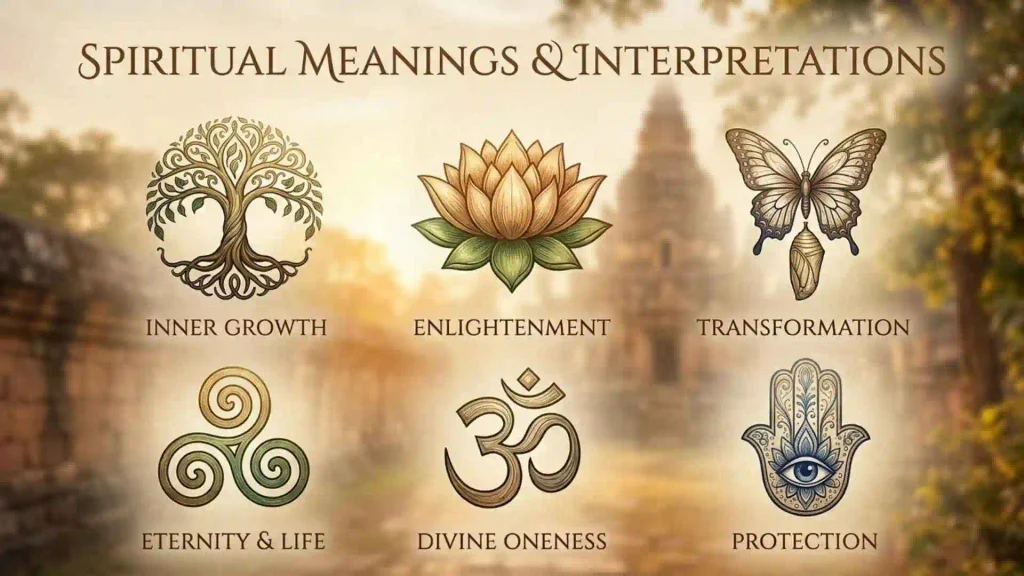
Universal symbols have played an important role in spiritual traditions throughout human history. They help people express ideas about life, death, faith, harmony, transformation, and the connection between the physical and spiritual worlds. Although spiritual beliefs differ across cultures, certain symbols appear repeatedly in religious teachings, ancient traditions, and personal practices.
For example, the lotus flower often represents spiritual growth and purity. The Om symbol is associated with sacred sound and spiritual consciousness in Hindu traditions. Similarly, the yin-yang symbol represents balance between complementary forces in Chinese philosophy. These symbols can encourage reflection and provide a meaningful way to understand complex spiritual ideas.
However, universal symbols do not always carry identical meanings everywhere. Their interpretations depend on cultural traditions, religious beliefs, and historical backgrounds. Understanding these differences helps you appreciate their deeper significance without assuming that every culture interprets them in the same way.
Universal Symbols and Meanings
Universal symbols communicate ideas through recognizable images, shapes, signs, and objects. They can represent emotions, beliefs, natural forces, human experiences, and shared values. Some symbols have developed similar meanings across different societies, while others carry meanings that depend heavily on their cultural context.
Here are some widely recognized universal symbols and their common interpretations:
| Symbol | Common Meaning |
|---|---|
| Heart ❤️ | Love, affection, and compassion |
| Dove 🕊️ | Peace, hope, and harmony |
| Circle | Unity, eternity, and wholeness |
| Tree | Growth, life, and connection |
| Lotus | Purity, renewal, and spiritual growth |
| Sun ☀️ | Life, energy, and enlightenment |
| Moon ☾ | Cycles, change, and mystery |
| Spiral | Evolution, transformation, and continuity |
| Anchor | Stability, security, and hope |
| Infinity ∞ | Eternity and endless possibilities |
| Cross | Faith, sacrifice, and Christianity |
| Yin-Yang ☯ | Balance and complementary forces |
These meanings offer a starting point for exploring symbolism. A symbol’s interpretation may change depending on where, when, and how people use it.
Universal Symbols Copy and Paste
Universal symbols are useful in digital communication, educational materials, creative projects, social media posts, and everyday writing. You can copy and paste many familiar symbols directly into your text without installing additional software.
Here is a collection of commonly used symbols with their names and meanings:
| Symbol | Name | Meaning |
|---|---|---|
| ❤️ | Heart | Love and affection |
| ☮ | Peace Symbol | Peace and nonviolence |
| ☯ | Yin-Yang | Balance and harmony |
| ∞ | Infinity | Eternity and endlessness |
| ☀ | Sun | Life and energy |
| ☾ | Crescent Moon | Cycles and renewal |
| ★ | Star | Hope and guidance |
| ✿ | Flower | Beauty and growth |
| ♻ | Recycling Symbol | Sustainability and reuse |
| ⚖ | Balance Scale | Justice and fairness |
| ♾ | Infinity Symbol | Limitlessness |
| ⛵ | Sailboat | Journey and exploration |
| ⚓ | Anchor | Stability and hope |
| △ | Triangle | Direction and structure |
| ○ | Circle | Unity and completeness |
| ✨ | Sparkles | Inspiration and magic |
How to copy: Select your preferred symbol from the table and use Ctrl + C to copy it. Then press Ctrl + V to paste it wherever you need it. Remember that some symbols may appear differently depending on your device, font, or operating system.
Universal Symbols in Literature
Universal symbols in literature are images, objects, characters, and natural elements that communicate deeper meanings beyond their literal appearances. Writers use symbolism to explore emotions, relationships, conflicts, identity, and major human experiences without explaining everything directly.
Some literary symbols have become familiar because readers repeatedly encounter them in stories, poems, plays, and novels.
- Light: Often represents knowledge, truth, hope, or understanding.
- Darkness: Can symbolize fear, uncertainty, evil, or the unknown.
- Water: Frequently represents cleansing, rebirth, change, or emotional depth.
- Roads and paths: Often symbolize life choices, personal journeys, and transformation.
- Seasons: Spring may represent new beginnings, while winter can suggest hardship or endings.
- Birds: Depending on the story, they may represent freedom, ambition, or spiritual escape.
- Gardens: Often symbolize growth, innocence, beauty, or hidden possibilities.
- Mirrors: Can represent identity, self-reflection, truth, or deception.
For example, in William Shakespeare’s Macbeth, darkness and night frequently accompany deception, violence, and moral confusion. Similarly, the green light in F. Scott Fitzgerald’s The Great Gatsby represents Gatsby’s hopes, dreams, and unreachable ambitions.
Understanding these literary symbols helps readers recognize hidden themes and explore what authors communicate beneath the surface of their stories.
10 Universal Symbols
Many symbols appear across different forms of art, communication, philosophy, and cultural traditions. The following ten examples represent some of the most recognizable symbolic ideas.
Heart
The heart is one of the most widely recognized symbols of love, affection, kindness, and emotional connection. People use it to express romantic feelings, friendship, compassion, and appreciation. Although the modern heart shape does not accurately represent human anatomy, its emotional meaning is widely understood.
Circle
A circle represents unity, completeness, eternity, and continuity. Its unbroken shape has no visible beginning or ending, making it a meaningful representation of endless cycles and interconnectedness. Circles also appear in spiritual traditions, architecture, mathematics, and cultural artwork.
Sun
The sun symbolizes life, warmth, energy, strength, and renewal. Many ancient civilizations associated it with powerful deities and the natural cycles that supported agriculture. Today, it commonly represents optimism, hope, enlightenment, and new beginnings.
Tree
Trees symbolize growth, wisdom, stability, and the connection between different stages of life. Their roots represent foundations and heritage, while their branches suggest development and expansion. The tree of life is particularly important in several religious and cultural traditions.
Dove
The dove is a widely recognized symbol of peace, gentleness, hope, and reconciliation. In Christianity, it also has spiritual significance through its association with the Holy Spirit. Its image frequently appears in peace movements, artwork, and messages of harmony.
Lotus Flower
The lotus flower represents purity, resilience, spiritual development, and renewal. Its ability to grow in muddy water has made it a powerful metaphor for rising above difficulties. It holds particular importance in Hindu and Buddhist traditions.
Star
Stars commonly represent guidance, hope, inspiration, and achievement. Throughout history, travelers have used stars for navigation, while different cultures have connected them with divine power and destiny. A star can also symbolize ambition and the desire to reach meaningful goals.
Infinity
The infinity symbol (∞) represents something without limits or an ending. It is widely used to express eternal love, endless possibilities, continuity, and boundless potential. In mathematics, it has a more specific role in describing an unbounded quantity or concept.
Yin-Yang
The yin-yang symbol represents the relationship between complementary forces in Chinese philosophy. Its contrasting black and white sections illustrate how seemingly opposite qualities can exist together and depend on one another. It is commonly associated with balance, harmony, and interconnectedness.
Spiral
The spiral symbolizes growth, evolution, movement, and transformation. It appears in natural forms such as shells, plants, and galaxies. Across different cultures, spiral designs have also represented life’s cycles, personal development, and the ongoing journey of existence.
Universal Symbols of Peace
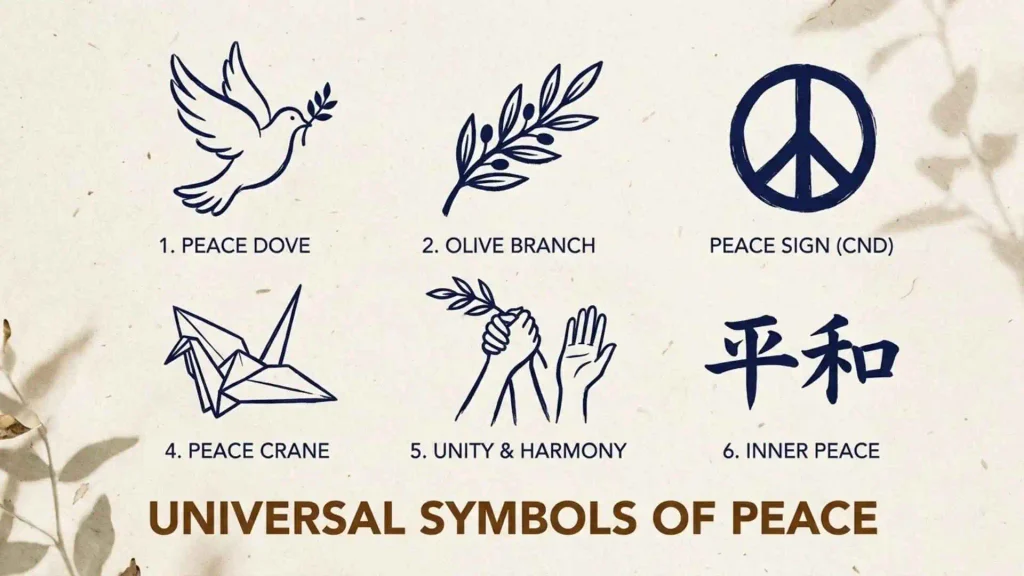
Peace symbols communicate harmony, cooperation, nonviolence, and freedom from conflict. Different cultures and historical movements have used these signs to express hopes for peaceful relationships and a more compassionate world.
Some of the best-known symbols of peace include:
| Symbol | Meaning | Background |
|---|---|---|
| ☮ Peace sign | Peace and nuclear disarmament | Designed for the British nuclear disarmament movement in 1958 |
| 🕊 Dove | Peace, hope, and reconciliation | Associated with biblical and wider cultural traditions |
| Olive branch | Harmony and reconciliation | Appears in ancient Greek and Roman traditions |
| White flag | Truce and surrender | Used in military communication |
| Broken rifle | Nonviolence and opposition to war | Associated with peace movements |
| Rainbow | Hope, unity, and diversity | Used in different cultural and social contexts |
The modern peace sign was designed by British artist Gerald Holtom in 1958 for the Campaign for Nuclear Disarmament. Its design combines semaphore signals for the letters N and D, representing nuclear disarmament.
The dove and olive branch also have a long symbolic history. In the biblical story of Noah, a dove returns with an olive leaf, signaling that the floodwaters have receded. This story helped establish the combination as a lasting symbol of hope and peace.
Although these symbols share peaceful associations, their meanings can vary depending on the historical event, organization, or community using them.
Universal Symbol Math
Mathematical symbols are a universal language that allows people to communicate numerical relationships, operations, measurements, and abstract ideas. Unlike many cultural symbols, mathematical notation follows established conventions that help mathematicians and students understand the same expressions across different languages.
Here are some commonly used mathematical symbols and their meanings:
| Symbol | Name | Meaning |
|---|---|---|
| + | Plus | Addition |
| − | Minus | Subtraction |
| × | Multiplication | Multiplication operation |
| ÷ | Division | Division operation |
| = | Equal | Two expressions have the same value |
| ≠ | Not Equal | Two values are different |
| ≈ | Approximately Equal | Nearly the same value |
| √ | Square Root | Root of a number |
| ∞ | Infinity | An unbounded concept |
| π | Pi | Ratio of a circle’s circumference to its diameter |
| ∑ | Summation | Addition of a sequence of terms |
| ∫ | Integral | Integration in calculus |
| ≥ | Greater Than or Equal To | A value is at least another value |
| ≤ | Less Than or Equal To | A value is at most another value |
| ∠ | Angle | Geometric angle |
| % | Percent | A quantity per hundred |
Mathematical symbols are essential in science, engineering, technology, economics, and education. They make complicated ideas easier to express and reduce the need for lengthy explanations.
Some mathematical symbols also have broader cultural associations. For instance, infinity is often used outside mathematics to represent eternal love, unlimited potential, and everlasting connections.
List of Symbols and Meanings
Symbols appear in almost every part of everyday life. From traffic signs and digital icons to religious emblems and mathematical notation, they help people understand information quickly and communicate complex ideas.
The following list covers several important categories of symbols and their common meanings.
| Category | Symbol | Common Meaning |
|---|---|---|
| Love | ❤️ | Affection and emotional connection |
| Peace | ☮ | Nonviolence and harmony |
| Religion | ✝ | Christianity and faith |
| Spirituality | ॐ | Sacred sound and spiritual reality |
| Nature | 🌳 | Life and growth |
| Hope | ⭐ | Inspiration and guidance |
| Justice | ⚖ | Fairness and equality |
| Infinity | ∞ | Endless possibilities |
| Protection | 🧿 | Protection against the evil eye |
| Recycling | ♻ | Reuse and environmental responsibility |
| Communication | @ | Digital addressing and identification |
| Warning | ⚠ | Caution and potential danger |
| Direction | → | Movement or direction |
| Music | ♪ | Musical notes and sound |
| Medicine | ⚕ | Healthcare and medicine |
When interpreting a symbol, consider its context rather than relying on a single definition. A symbol used in mathematics may communicate something entirely different from the same shape used in religion, literature, or artwork.
Symbols That Represent People
Symbols that represent people often communicate human qualities, relationships, social roles, identities, and shared experiences. They can express ideas about individuality, equality, family, community, and human dignity.
Some symbols represent people directly, while others communicate qualities associated with human life.
| Symbol | What It Represents |
|---|---|
| ⚥ | Combined male and female biological sex characteristics in traditional notation |
| ♀ | Female symbol |
| ♂ | Male symbol |
| ⚧ | Transgender symbol |
| 👤 | Individual person or profile |
| 👥 | People, groups, or communities |
| 🤝 | Cooperation, partnership, and agreement |
| ♡ | Love, care, and emotional connection |
| ⚖ | Equality, fairness, and justice |
| 🌍 | Humanity and global community |
| Tree of Life | Family connections, ancestry, and generations |
| Human Silhouette | Identity, individuality, and human presence |
The meanings of people-related symbols can change across different social and cultural settings. For example, the Venus and Mars symbols have historical roots in classical mythology and later became widely used in biological and gender-related notation.
Modern symbols also help represent diverse communities and identities. Their purpose is often to promote recognition, communication, inclusion, and a shared sense of belonging.
Discover Profound Symbolism
Discovering profound symbolism means looking beyond a symbol’s immediate appearance to understand the deeper ideas, emotions, and cultural associations it communicates. A simple shape, object, animal, or natural element can carry several layers of meaning.
For example, a tree may represent physical growth at first glance. However, its roots can also symbolize family history, heritage, and personal foundations. Its branches may suggest opportunities, relationships, and future possibilities. In spiritual traditions, the tree of life can represent the connection between different forms of existence.
You can explore deeper symbolism by considering these important factors:
- Historical background: Find out when and where the symbol first appeared.
- Cultural significance: Explore how different communities interpret it.
- Religious connections: Identify whether the symbol appears in sacred texts or spiritual traditions.
- Psychological meaning: Consider the emotions and ideas it may evoke.
- Artistic use: Examine how writers, painters, and designers use it to communicate messages.
- Modern interpretation: Understand how its meaning has changed through contemporary use.
One important point is that symbolism rarely has only one correct interpretation. A particular image may represent hope in one context and remembrance in another. Exploring these layers makes it easier to understand why symbols continue to influence human communication and creative expression.
Understand Symbols, Cultures, and Values
Symbols provide a valuable way to understand how cultures express their beliefs, traditions, identities, and shared values. They preserve historical stories, communicate social expectations, and help communities maintain connections with their past.
For example, the lotus flower holds significant religious and cultural importance in India and other parts of Asia. It appears in Hindu and Buddhist traditions and is associated with purity, spiritual development, and sacred imagery. Similarly, the dragon carries different meanings across cultures. In many Chinese traditions, it represents power, prosperity, protection, and good fortune, while some European stories portray dragons as dangerous creatures.
Cultural symbols can communicate several important values:
- Identity: Flags, traditional clothing, and national emblems help communities express belonging.
- Faith: Religious signs and sacred objects communicate spiritual beliefs and practices.
- Family: Trees, rings, and ancestral emblems can represent heritage and relationships.
- Freedom: Birds, open doors, and broken chains often communicate independence.
- Unity: Circles, joined hands, and interconnected patterns can express togetherness.
- Wisdom: Books, owls, and certain trees are commonly associated with knowledge and learning.
- Resilience: Mountains, phoenixes, and growing plants can represent strength through difficult experiences.
Frequently Asked Questions
What are the most common universal symbols?
Common examples include the heart, circle, sun, moon, tree, water, fire, eye, dove, cross, serpent, and infinity sign. Their exact meanings vary by context.
Are universal symbols understood in every culture?
Not always. Many are widely recognizable, but no symbol has a completely identical meaning everywhere. Culture, religion, history, and personal experience affect interpretation.
What is the universal symbol for love?
The heart is the most widely recognized modern symbol of love. Roses, rings, doves, and knots can also represent romantic or lasting affection.
What is the universal symbol for peace?
The dove, olive branch, and modern peace sign are common symbols of peace. Each comes from a different historical or cultural tradition.
Why do symbols have different meanings?
Symbols gain meaning through stories, religion, social customs, historical events, and repeated use. Different communities may connect the same image with different experiences.
Can universal symbols appear in dreams?
Yes. Dreams often use familiar symbolic images such as water, doors, roads, animals, and light. Their meaning depends on the dreamer’s emotions and life situation.
Conclusion
Universal symbols reveal how humans turn complex feelings and beliefs into simple, memorable images.
They connect ancient myths with modern technology, personal emotion with collective memory, and visible forms with invisible ideas.
Although their meanings can change across cultures, their power comes from shared experiences such as love, fear, growth, loss, and hope.
To understand a symbol is not only to study an image, but also to listen to the human story carried inside it.
 Sarah Thompson
 Michael Rivera